|
Past Reviews Off Broadway Reviews |
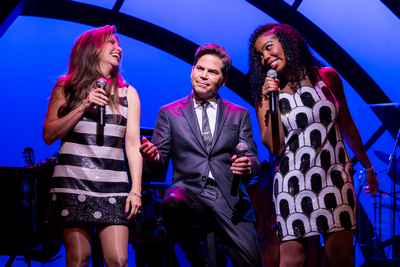
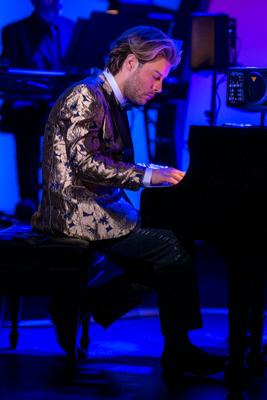
To the youngsters: Bacharach (1928-2023) wrote from the 1950s to 2020, but his heyday was the 1960s and '70s, when his instantly recognizable style dominated what were still called the airwaves, earning him millions, Grammys, Oscars, and Angie Dickinson. He borrowed from classical, jazz, R&B, gospel, and several other genres, creating some 100 pop hits out of around 1,000 songs. A Bacharach song is characterized by jagged rhythms, a structure that doesn't always conform to AABA, unpredictable time signatures–a 5/4 measure will suddenly drop into a 4/4 refrain just for the hell of it–and chords that satisfyingly don't go where you expect them to, but find better places to go. That's all evident from the overture–yay, an overture!–which begins with the opening bars of Bacharach's Promises, Promises, his very successful sole Broadway effort, and is conducted to a fare thee well by arranger-orchestrator Adrian Galante, who plays the piano (and, on several occasions, the clarinet; he likes very high notes on the latter) and leads a peppy five-piece band. He doesn't tickle the ivories, he pummels them, often bouncing up and down on the bench to accentuate a phrase. He also indulges in florid arpeggios and elaborate tone clusters, things you won't find on many Bacharach singles. But overall, let's say the sound is authentically Burt. That extends to the singers, mostly. John Pagano toured with Bacharach as his lead vocalist for decades, which ought to guarantee his excellence as an interpreter of the master, but doesn't. Professional, Vegas-slick, Pagano has a light tenor that isn't ideal for the likes of "A House Is Not a Home" or "Whoever You Are," and I can't say I felt a torrent of feeling welling out of him. He does have one wonderful moment, recalling how as a kid he was obsessed with Tom Jones's 45 of "What's New Pussycat?" despite its pops, skips, and needle sticks, then proceeds to replicate it, complete with pops, skips, and needle sticks.
It's an uncomplicated stand-up-and-sing production, created by Amas Musical Theatre and Galante, Tedd Firth, pop song scholar Will Friedwald, and Jack Lewin, whose Our Sinatra revue had a long run Off-Broadway. The scenic design, by Christopher and Justin Swader, consists of several attractive arches that don't symbolize much, and Matt Berman's lighting design favors electric oranges and reds, which somehow evoke the period. He also designed the sound, which, guess what, is turned up too high, and also goes all echoey at odd moments, though the lyrics are audible. Frank Cazares's costumes dress the ladies in spangly minidresses for the first act and gowns for the second that would do Dawn (as in Tony Orlando and) or Toni Tennille proud, while the gents don sleek suits and gaudy tuxes. The director is David Zippel, a better lyricist than Hal David ever was; he mainly keeps the cast lightly stepping and mostly smiling, sometimes even through the sad ballads. There are head-scratchers, like why does "I Say a Little Prayer" pop up in the middle of a Promises, Promises medley, and why do we get only eight bars of the Bacharach-David score to Lost Horizon (maybe because it isn't very good?). But in these Taylor Swift days, when it comes to the brilliance of Bacharach, there isn't always something there to remind me, and Going Bacharach–is the title a feeble pun on "going back"?–serves as a valuable valentine to a pop composer who, simply put, brightened the world at a moment in history nearly as difficult as the one we're in now. How well you like Going Bacharach will depend largely on how well you like Burt Bacharach, and who doesn't like Burt Bacharach? The audience around me, heavy on the boomers but dotted with younger faces, seemed very happy indeed. Going Bacharach: The Songs of an Icon Through February 15, 2026 Marjorie S. Deane Little Theater 10 W. 64th St., New York NY Tickets online and current performance schedule: GoingBacharach.com
|