|
Regional Reviews: Seattle A Chorus Line
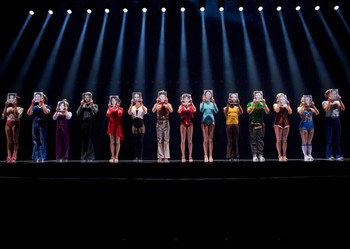
A Chorus Line explores the lives of 17 characters auditioning for a part in the chorus of a new Broadway production. Having been narrowed down following a rigorous dance audition ("I Hope I Get It"), the dancers are informed by choreographer Zach (played by Brandon O'Neill) that four boys and four girls will be selected to join the company. To make his final selections, Zach asks the group to tell stories about their lives, specifically regarding their interest in dance. With various degrees of discomfort and resistance, each character relates their motivation and personal histories. Some stories are humorous and see dance as a form of self-expression (both Judy and Bobby talk about their idiosyncrasies), while some explore childhood emotional trauma (Sheila, Bebe, and Maggie find escape in "At the Ballet"). All relate that, for them, dance is central to their being, both because of and at times despite their individual circumstances. It is indeed dance that propels the narrative. The central number, "Hello Twelve, Hello Thirteen, Hello Love" is a 15-minute ensemble piece in which all the characters, in rapid and disjointed fashion, explore themes of puberty, sexuality, body image, and how no one emerges unscathed from life. Diana (Samantha Gershman) follows up this sentiment by expressing the importance of finding inner strength and of making one's own way in order to carry on ("Nothing"). When the group takes a break, Zach tells Cassie to stay behind, and the audience learns that the two had previously shared a romantic relationship. Cassie was once a promising starlet and left to find success in California. Not finding the success or work she was anticipated, she returned to New York to find work doing what she loves most: dance ("The Music and the Mirror"). Zach expresses that she is "too special" to dance in the chorus. Cassie counters that everyone in the chorus line is special and it is a privilege to be among individuals with so much talent. As Cassie leaves the stage, Paul enters and tells Zach his personal history. His poignant monologue about family and personal acceptance, coupled with Cassie's story about reinvention, mirrors and contrasts Diana's earlier song about self-reliance and determination. It becomes clear to the audience that this is no longer just an "audition." The show becomes an exploration of the human condition and how everyone, no matter their situation or history, is always auditioning in a metaphoric chorus line. The desire to live one's authentic and unique self, to shine and stand out, is tempered by society's expectation that one should simply fit in. As the group rehearses a routine in which they must dance in perfect unison, Paul falls, exacerbating a former knee injury. After he is taken to the hospital, the question is posed: "What do you do when you can't dance anymore?" Don (Nehemiah Hooks) expresses his love of performing but acknowledges that his priority is his family. Sheila (Tori Gresham) realizes that, at 30 years old, she is approaching the end of her career and is considering leaving theatre to start a dance school. As she considers this, she muses, "Am I selling out, or growing up?" It is Diana, the self-aware pragmatist, who expresses that nothing lasts forever, expectations need to be realistic, and that regrets have no place when considering following one's passions in life ("What I Did For Love"). The grand finale, with the entire cast resplendent in 1930s-style musical revue top hats and tails, follows Zach's intentionally anticlimactic final selection of dancers. The audience is left appreciating the artistry of the entire cast as a cohesive unit and valuing each dancer as a unique and valuable individual. A Chorus Line is one of the Broadway canon's most recognizable and well-known musicals. It is well loved, and like many well-loved things, can appear a little worn, dated, and taken for granted. That is not the case here. Director Denis Jones has infused this new production with intention and vision and has assembled a cast that is cohesive, committed, and clearly enjoys working with each other. Each performer is a standout in their own way and commands the stage when it is their time to shine. Their transitions from separate characters to an ensemble working as a single unit are seamless yet still show their individual growth and progression through the course of the show. There are several moments in the program when the audience response could stop the show. Tori Gresham, Emily Ann Brooks, and Kayla Pecchioni (Sheila, Bebe, and Maggie respectfully) deliver an unvarnished view of childhood family trauma, without any sense of melodrama or self-pity. Ms. Pecchiono's solo displays vocal strength and control that belies her character's timid nature. Similarly, Samantha Gershman (Diana) is so at ease on the stage that one forgets that she is acting and not just having a conversation with the audience. Her rendition of "Nothing" involves the audience on her journey of self-awareness as opposed to just singing a story about a difficult high school experience. Kayden Oliver's Paul delivers a monologue of raw pain fueled by shame, guilt, and fear of letting his passions and desires show, forcing the audience to confront their own traumas in return. Despite the audience's enthusiastic appreciation, the show progresses without interruption, prohibiting any one character from garnering more attention than any other, and preserving the narrative's momentum. While their individual stories and songs differentiate the characters, so do their outfits. In general, the costumes acknowledge the '70s of the show's debut. However, not every character's costume reflects what one would expect at a dance audition. It seems incongruous to see someone wearing an ascot to a high intensity dance audition, or to imagine someone wearing a jacket tied around their waist for the entire ordeal. However, these costumes indicate who the characters are before they are introduced to the audience. Bobby (Connor Russell) is hilariously foppish in a way only an outré ascot could suggest. Paul's jacket exposes his reticence to reveal himself to the world, and Val's (Susanna Cathryn Ballensky) attire reveals her... assets. The costumes make the characters more relatable to the audience outside of the dance context, thereby involving them further into the action on the stage. So much of the joy of A Chorus Line is getting to know the individual dancers involved in the audition process. Histories, motivations, and personalities are all explored. The triumph those selected at the end of the show exhibit and the various reactions of those experiencing yet another, and potentially last, rejection begs the question: what happens next? The show ends with more questions than there are answers. There is no information regarding the musical the dancers are auditioning for. What is Zach looking for? Why did he choose the dancers he did? Certainly, different characters resonate differently with each audience member. Without context, there is no way to justify Zach's decisions. The non-answer answer comes in the enigmatic character Larry, Zach's assistant choreographer (Arthur Joseph Cuadros, who is a truly brilliant dancer om stage). As Zach's assistant, Larry spends his time on stage asking Zach what he wants: where he wants the dancers, what routine he wants them to rehearse next. What Zach wants, he essentially tells those in line is: Larry. Larry has the routine exactly as Zach wants it. Larry is the ideal. Ironically, Larry is also the only character we know nothing about. In this regard, he can be seen as all the outside influences that cannot be known, anticipated, or controlled. He is inscrutable, and his perfection is unattainable. How this dynamic can be analyzed regarding original choreographer and director Michael Bennett is the topic for another discussion. This production of A Chorus Line is lively, heartfelt, and thought provoking, involving an amazing cast that is an absolute must see. A Chorus Line runs through September 27, 2026, at 5th Avenue Theatre, 1308 5th Ave. Seattle WA. For tickets and information, please visit please visit 5thavenue.org or call 206-625-1900. |