|
Regional Reviews: Other Regions Les Misérables Also see Gil's reviews of Grease, Mary Shelley's Frankenstein, Troilus and Cressida, See How They Run, She Loves Me, Something Rotten!, Hamlet and Harmony
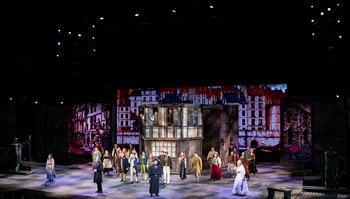
Set in 19th century France and based on the classic novel by Victor Hugo, Les Misérables tells the epic tale of Jean Valjean, a man imprisoned for stealing a loaf of bread to feed his starving sister's child. After repeated escape attempts turn his original five-year sentence into nearly two decades of hard labor, he emerges from prison resentful and desperate. Although released on parole, Valjean soon steals from a compassionate bishop, whose unexpected act of mercy inspires him to transform his life. Determined to leave his criminal past behind, he dedicates himself to helping others and seeking redemption, but his journey is continually threatened by the relentless pursuit of the unwavering police inspector Javert. Valjean's struggle to outrun his past while proving that people are capable of profound change forms the emotional heart of this sweeping and unforgettable story. The entire cast at Tuacahn is phenomenal, with each actor bringing nuance and layers to these beloved characters with singing voices that are incredibly clear and consistently shine bright. David Toole and Randal Keith are delivering two of the best portrayals of Jean Valjean and Javert, respectively, that I've ever seen. They inhabit the roles and instill every lyric they sing with so much clarity and emotion that it's impossible not to be swept up into the epic tale. They both have impeccable singing voices, with Toole delivering knock-out versions of his three dramatic solos, "Valjean's Soliloquy," "Who Am I?," and "Bring Him Home," and Keith's version of "Stars" shimmers with intensity and emotion. These are profound performances you won't soon forget. Mindy Smoot Robbins layers the portrayal of Fantine, the woman who falls on hard times and whose child, Cosette, is raised by Valjean, with an assortment of emotions, including anger, anguish, and love, while delivering a beautiful version of "I Dreamed a Dream." Kelsey Lee Smith delivers a searing performance of "On My Own" as Eponine, the poor girl in love with the richer Marius. J.T. Wood and Rachel Schoenecker, as the student Marius and the grown-up Cosette, bring assured delivery and an immediacy to their portrayals with Schoenecker's lilting soprano and Wood's rich tenor voice delivering beautiful versions of their songs, including their duo, "A Heart Full of Love," and Wood's superb "Empty Chairs at Empty Tables." Davey Burton Midkiff brings passion and power to role of Enjolras, the leader of the student revolutionaries, and Zach Berger and Janna Cardia provide several pops of humor as the Thénardiers. Emmitt Klc is wonderful as Gavroche (Jayven Cook alternates in the role), and Kassie Nielson and Betty Jorgensen charm as the young Cosette and Eponine, respectively (Lena White alternates in both roles). The large ensemble create three-dimensional portrayals of a wide range of characters, with clearly defined performances and crisp vocals. The Tuacahn production is vast and expansive, and director Sarah Hartmann uses every inch of the large stage, even using the area behind, framed by the beautiful mountains behind the Tuacahn stage, for the opening sequence in which Jean Valjean and his fellow men on the chain gang are using pick axes on large boulders when Javert enters on a horse. That gives you an idea of how large the scale is for this production. Hartmann also makes numerous original directorial choices that are simple but highly effective. These help clarify the connection between Cosette and Eponine, even having the young Eponine look hopeful that Valjean will also take her away when he comes to bring Cosette home with him after living with the Thénardiers, something I've never seen done in a production before but that makes perfect sense. The transition from the younger Cosette and Eponine to their older counterparts is also simply done but works beautifully. Hartmann brings a chilling moment to "Empty Chairs at Empty Tables" that is simple, makes great use of the small pit area downstage, and packs a punch, and there are an abundance of other excellent directorial decisions that add weight and emotion to the piece. Clayton Dombach's scenic design uses several large, two story units and a bridge that move and change throughout to depict the various locations in the show, with Gabriel Aronson's video designs depicting beautiful landscape backgrounds, similar to paintings; they are comparable to the ones used in the recent national tour of the show that resembled paintings by Victor Hugo. The costumes by Rickey Lurie ground the show in 19th century France, and Annie Hardt's hair and makeup designs are excellent. Rob Siler's lighting is superb; the effect he uses for "Stars," with stars projected on the entire mountain area behind the stage, is very impressive. Josh Liebert's sound design ensures every single lyric and line of dialogue is crystal clear, impressive for such a large outdoor venue. The choreography by Ashley Marinelli adds a nice sense of style and movement in many of the large ensemble numbers, and Christopher Babbage's musical direction is perfect, with a fifteen-piece orchestra that sounds magnificent throughout. Les Misérables is one of those musical adaptations that gets just about everything right in the transfer from book to stage. Even though it has a large scale and a cast of almost 40 individuals, Tuacahn's production feels intimate, bringing out clarity and emotion in this epic tale of struggle and redemption. If you've never seen a production of the show before, you're in for a treat, and even if you've seen it a dozen times, you'll find many nuances, original directorial touches, and superb performances throughout in Tuacahn's stunning production of this beloved musical. Les Misérables runs through October 23, 2026, at Tuacahn Center for the Arts, 1100 Tuacahn Drive, Ivins Utah 84738. For tickets and information, please visit www.tuacahn.org or call 800-746-9882. Director: Sarah Hartmann Cast: |