|
Regional Reviews: Minneapolis/St. Paul As You Like It Also see Arty's reviews of Doctor Faustus, The Taming, Annie, You're a Good Man, Charlie Brown
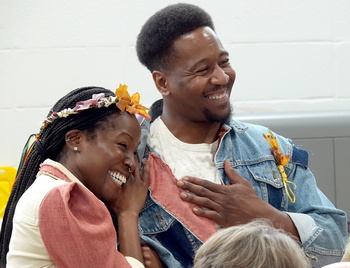
What Orlando does not know–but the audience does–is that his tutor is also his beloved, Rosalind, disguised as a young man called Ganymede to test the outer limits of Orlando's passion. Rosalind's deceit (in the guise of Ganymede) is a source of delicious, witty, and bawdy humor. While she chides Orlando for being so thoroughly besotted with her, in his absence, she swoons for him. The device prompts gleeful laughter without compromising Shakespeare's genius for language. Ten Thousand Things Theater Company is presenting As You Like It as the first show in its 2026-2027 season. Ten Thousand Things is known for its unique mission of bringing its work to settings where audiences have little, if any, opportunity to see live theatre. These settings range from halfway houses to free-meal programs to assisted living to prisons. With this mission in mind, it is not surprising that the majority of their seasons have included a play by Shakespeare, be it comedy, history or tragedy. After all, if bringing theatre to audiences whose members may have no prior experience with the form, why not begin with the best? Ten Thousand Things not only makes great theatre accessible with stripped-down productions–no lights or sound equipment, minimal set pieces and only as sound and music making devices as can fit in a van–but also with its direct performance style. The company does not water down the playwright's language, but presents it in a direct manner that ensures the narrative and the characters' motives are clear and relevant. The place, the costumes, and the language may harken to 500 years ago, but the human beings on stage behave just as any walking down the street today might. There is no pretense, no artifice–just the enactment of human beings behaving recognizably human. This production marks the 30th Ten Thousand Things show I have seen, and it is among the funniest and frothiest of them all. In part, that is the result of the play as written, with four pairs of mis-aligned lovers in the Arden Woods turning everything that seems amiss right, and contrasting the light and generosity of the pastoral setting with stern vindictiveness at the seat of power. It is also, though, the product of Caitlin Lowans' supple direction, calling each actor (most of whom play multiple roles) to create distinctly comical characterizations without sacrificing the integrity of the work as a whole. The story begins after Duke Frederick has usurped the throne from his older brother, Duke Senior, the latter seeking refuge with his loyalists in Arden Woods. Frederick allows Senior's daughter, Rosalind, to remain at the court, as she is close as a sister to Frederick's only child, Celia. Meanwhile Orlando, the youngest of three sons, has been denied his share of their father's inheritance by his older brother, Oliver. To earn a sack of gold, Orlando accepts a challenge to wrestle against the man Frederick is backing. At court, Orlando and Rosalind meet and instant sparks fly between them. With Rosalind continuing to express contempt for the coup against her father, she is banished by Frederick. Unable to part with Rosalind, Celia conspires to leave with her, fleeing to Arden Woods in search of Rosalind's father. As two damsels in the woods in need of protection, Rosalind devises that she will disguise herself as a boy, Ganymede, and claim to be brother to Celia, who will be called Aliena. After Orlando defeats Duke Frederick's wrestler, and is given warning that Frederick will take murderous vengeance on him, he too flees into Arden Woods. There he meets up with and is welcomed by exiled Duke Senior and his crew. Furious, Frederick summons Oliver to find Orlando and drag him before the court. Add to these Touchstone, the court fool who left in the company of Rosalind and Celia; a pair of lovesick shepherds named Silvius and Phoebe; a guileless country girl named Audrey; an assortment of other country folk, lords in service to Senior or Frederick, and vicars, and you have the galaxy of characters, who, with assurance (because it is a comedy), will pair off with their perfect matches and repent or forgive as warranted. Seven actors portray all of these characters, and all are stupendous. Foremost is Nubia Monks as Rosalind, not only because her character feels most central to the play, but also because Monk's performance bursts with the expression of everything Rosalind feels–her scorn for Frederick, her devotion to Celia, and most of all, her lusty thrall for Orlando. Moreover, Monks conveys the wit that marks Rosalind as a worthy heroine. Monks and Darius Dotch, winning as the besotted Orlando, are totally in balance together. Dotch depicts Orlando's strength as well as the tender side of his nature. Monks and Isa Condo-Olvera, as Celia, are also in perfect balance as cousins whose devotion is boundless. Condo-Olvera conveys Celia's appealing blend of sweetness and feistiness. The actor is also affecting, hidden behind a bushy beard, as Orlando's devoted, aged servant, Adam. Bill McCallum displays marvelous range, being ferocious as the usurping Duke Frederick, almost pathetically lovelorn as the shepherd Silvius, and whimsically insightful as Touchstone, the court fool who is a constant source of wisdom. Greg Watanabe is hilarious as the brutish wrestler, creating a character who speaks only in grunts, and is compassionate and clear-headed as Duke Senior, expressing appreciation for all he has gained in the woods, rather than bitterness over what he has lost. Dustin Bronson is aptly despicable, early on, as Orlando's brother, Oliver, and persuasive in his moment of repentance. As Amiens, a lord serving Sir Senior, Bronson has opportunities to enrich the show with Shakespeare's songs, partnered with the show's fabulous music director, Joni Griffith, who in a bit of whimsy, appears on stage, while playing violin, as a mesmerizing deer–a truly magical scene. Katie Bradley is hilarious as the love-crazy shepherd, Phoebe, and stoically contemplative as Jacques, a lady (though more often, the character is a male) serving Duke Senior, who is burdened with a melancholy outlook on life. In this role, Bradley superbly delivers what is undoubtedly the play's–and one of Shakespeare's–best known soliloquies, "All the world's a stage/And all the men and women merely players/They have their exits and their entrances/ And one man in his time plays many parts." Bradley, as Jacques, goes on to describe the seven acts, or ages, of man, from infancy to the end of life, that brings "second childishness and mere oblivion/Sans teeth, sans eyes, sans taste, sans everything". While scenic elements are always minimal in Ten Thousand Things productions, they are most effective, with a pair of coat-trees wrapped in yard, festooned with leaves, representing Arden Woods. Sarah Bahr designed those, as well as the costumes, which are wonderfully inventive composites of pedestrian contemporary attire (a jeans jacket, a man's sport jacket) with fabric inserts and flounces that might have adorned a Disney princess (or prince), and elaborately uses nubby white (for nobles) and brown (for country folk) yarn in braids, macramé, and woven swatches, giving an overarching sense of the pastoral Arden Woods to the production. The result is totally enchanting. Also a shout-out goes to Annie Enneking, credited as wresting choreography. Enneking is one of our theatre scene's premier fight choreographers and intimacy coaches whose work is always notable, but it stands out here especially for the wonderful wrestling sequence that manages to be both grueling and comical and (one presumes) safely enacted. All of the community-hosted performance of As You Like It are sold out, but Ten Thousand Things also presents each production at more typical venues, and there are still tickets available (as of today) for most of those. Those public performances are staged in the same, marvelous style as the community-hosted performances, with all seats in a small square configuration, only two or three rows deep so that everyone is in close proximity, and with all the lights on so that audience members see one another, and actors see you as well. It is a unique, and consistently satisfying, theatre experience. As You Like It, a Ten Thousand Things Theater Company production, runs through October 18, 2026, at Open Book, 1011 Washington Ave. S., Minneapolis MN; October 22 - October 25 at Hennepin Avenue United Methodist Church, 511 Groveland Ave., Minneapolis; October 29 - November 1 at Playwrights' Center, 710 Raymond Ave., St. Paul; and November 5 - November 8 at 825 Arts, 825 University Ave, St. Paul. For tickets and information, please visit www.tenthousandthings.org or call 612-203-9502. All remaining community-hosted public performances are sold out. Playwright: William Shakespeare; Director: Caitlin Lowans; Music Director: Joni Griffith; Costume, Scenic, and Props Design: Sarah Bahr; Wrestling Choreographer: Annie Enneking; Text Coaching: William Sturdivant; Stage Manager: Matthew Meeks. Cast: Katie Bradley (Jacques/LeBeau/Phoebe), Dustin Bronson (Oliver/Amiens), Isa Condo-Olvera (Celia/Adam/Audrey), Darius Dotch (Orlando), Rayyan Khan (understudy), Bill McCallum (Touchstone/ Duke Frederick/Silvius), Nubia Monks (Rosalind), Laila Sahir (understudy), Greg Watanabe (Duke Senior/ Charles the Wrestler/ Corin) |