|
Past Reviews Off Broadway Reviews |
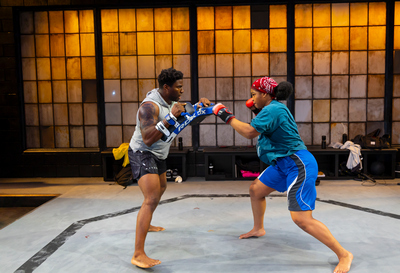
Set in Philadelphia, the play opens with Big (Okieriete Onaodowan), a reigning titleholder, battling an unseen opponent. The barbarity is evident, but with choreography by Rickey Tripp and fight direction by Gerry Rodriguez, the effect is balletic, almost lyrical, and Onaodowan's execution is thrilling. (Sijara Eubanks is listed as an MMA consultant and gives the production a stronger claim to authenticity.) The one-sided skirmish and the subsequent solitary victory highlight the sense of loneliness that Big wears like an over-sized hoodie after the bout. Big's isolation is punctured by the arrival of Lil (Aigner Mizzelle), his half-sister whom he hasn't seen in sixteen years. When they are first reunited, they stand outside of the octagon that is boldly stenciled onto the canvas flooring of Andrew Boyce's gritty, industrialized gymnasium scenic design. The iconic shape calls to mind the eight-sided cage trademarked by the UFC (Ultimate Fighting Championship), and the fraught family drama is framed as blood sport. (Cha See's lighting, Mika Eubanks's costumes, and Mikaal Sulaiman's original music and sound design capture the stark contrast between the seedy urban environments and the flashy professional arenas.) The siblings face off, and in a series of tussles, they grapple with their difficult pasts marked by an abusive father, absent mothers, and the impact of alcoholism. In a dramaturgical mirroring effect, Anyanwu's writing includes its own jabs and reversals as the characters trade old recriminations and weaves in childhood flashbacks. As adults (she's nearing 30, and he is approaching 40), Big and Lil find a common bond through fighting. Their relationship evolves into one of coach and trainee. As directed by Anyanwu, the performances are outstanding, and Onaodowan and Mizzelle are ideally matched, like impeccable sparring partners. As the brother and sister come to terms with their own inner monsters, they gradually peel back the layers, disclosing their characters' internal vulnerabilities. It's obvious that their outward indomitability masks a deep-seated fear of abandonment. And in a desperate attempt to pierce Big's protective armor, Lil castigates him, pointing to his attempts to deflect personal responsibility:
Yet, as compelling as the performances and fight sequences are, the central relationship still feels under-explored, and there seem to be narrative gaps in the script. For instance, the sixteen-year silence between the siblings is never satisfactorily explained. Given that Big has been sober for some time and that he was a father figure to his little sister, it isn't clear why he had continued to cut off his only surviving kin. The timing of Lil's sudden reappearance also feels more like a dramatic convenience than a motivated choice, and a late-play introduction of a childhood memento steers the nuanced acting into heavy-handed sentimentality. Although it is not a perfect play, the theatricality and performances on view in The Monsters offer a vital reminder that theatre can offer the same visceral experience as a high-stakes slugfest. The Monsters Through March 15, 2026 Manhattan Theatre Club New York City Center, Stage II, 131 W. 55th St. Tickets online and current performance schedule: ManhattanTheatreClub.com
|