|
Past Reviews Off Broadway Reviews |
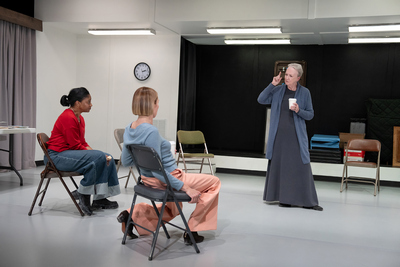
You won't be able to tell much from dots's set, a sterile white meeting room in what could be a church, a strip mall, almost anywhere. Let's go with church, since that's where so many Alcoholics Anonymous groups meet. There, Jane (April Matthis), the leader of one such group, is setting up for its next gathering, when interrupted by shy, halting Rayna (Kelly McQuail), whose first meeting this will be, until she ducks out. In the first of several instances I don't understand at all, it later appears that Rayna has become a regular, but we see little of and find out little else about her; later still, Rayna will repeat some of the Jane-Rayna dialogue with a new prospective member, to purposes unknown. And she'll practice a song she's rehearsing for an AA anniversary celebration, beautifully rendered by McQuail, but again, linked to nothing. Perkins is playing with our minds, and in the process diminishing the clarity and pointedness that might have come with a more straightforward narrative. The Jane-Rayna exchanges generate ample audience laughter, and credit there is due to director Les Waters, who staggers the rhythms and has us identifying with the awkwardness of some initial encounters. He also keeps us visually interested when, like, 80% of the blocking consists of women sitting in folding chairs, barely moving. They're inert, but their sparse body language and bolder facial reactions convey a lot. The rest of the group straggles in. Joan (Elizabeth Marvel) is confrontational and self-possessed, though ultimately supportive of those around her. Jolly (Kathleen Chalfant) is indeed jolly, and able to infuse a line like "No thank you, Joan, I'll sit when I'm dead" with a Kathleen Chalfant zing, while coping uncertainly with the ravages of age. Joane (Maria Elena Ramirez)–also pronounced Joan, and why did Perkins give every character except Rayna a J name, because he's a Jacob?–loves gossip and relates a traumatic encounter with her teenage son, one that Perkins's program note also sheds some light on. And Janet (Mallory Portnoy), who offers the first "topic," a recitation to the group that invites commentary, uncoils a rather remarkable dream involving a car and a corpse. Portnoy spins it with fine delicacy, but what it all means–relationships with men, maybe? her relationship with God?–is another example of Perkins's frustrating ambiguity. The acting is lovely. When isn't Chalfant wonderful, and Matthis, whom we know from Toni Stone and Primary Trust as capable of much more, ably conveys Jane's empathetic, take-charge qualities; we only wish Perkins had given Jane more colors. Oana Botez's costumes are right for these ladies, and while Yuki Link's lighting design doesn't have to work very hard–harsh industrial overheads, mainly–it contributes to the atmosphere. The action seems to be one AA meeting, for the most part, but with excerpts from others, flashbacks and -forwards, cryptic allusions across time, and a fadeout that has Chalfant playing a new character Jolly inadvertently mentioned some minutes back, or is this just Jolly with a different name, or is it happening in her head, or someone else's, and when is it happening? So much vagueness, plus much of that frequent theatrical annoyance, characters interrupting and shouting over one another unintelligibly, plus one baffling moment where four of the women let out a long collective scream. I may be way off, but I'll put this out there: Maybe this whole thing is the fever dream of one character, splitting herself off into several women to process the difficulty of overcoming an addiction. Or maybe it's happening outside of time, in some undefined eternity–is that stopped wall clock a hint? But in Perkins's universe, it's hard to know how literally to take anything. As with Liberation last season, The Dinosaurs may speak eloquently to women who have been through anything like what the characters onstage are going through, but the rest of us may feel like we're viewing it through a glass plate. The emotions are there, we can perhaps identify with them, but we're stopped a little short of being moved. And why The Dinosaurs, anyhow? Perkins may be referring to the burden of antiquated sexual roles these women have had to shoulder, or possibly the growing obsolescence of in-person groups like these, where people meet to provide one another guidance and solace, instead of vanishing into their phones. But as with much else, he isn't saying. The Dinosaurs Through March 1, 2026 Playwrights Horizons Peter Jay Sharp Theater, 416 West 42nd Street Tickets online and current performance schedule: PlaywrightsHorizons.org
|