|
Past Reviews Off Broadway Reviews |
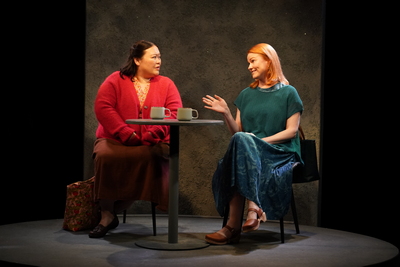
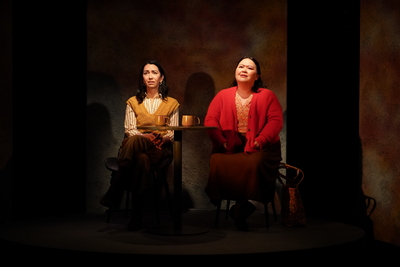
Daniel Prosky's modest set is a symphony of gray: gray table and two gray chairs on a gray oval platform, framed by gray walls. To symbolize the characters' gray existences? Perhaps, for Anna (Danielle Ryan), Denise (Kate MacCluggage), and especially Cora (Carmen L. Herlihy) seem like ordinary Dubliners leading very ordinary lives. They meet, infrequently, at this little gray café to celebrate the old times they enjoyed in Ranelagh and bring one another up to date, always in pairs; the three don't share the stage till curtain call. Cora is the conduit, the one who's always friendly and supportive, even as she doesn't have much going on in her life and has to navigate a narrow strait between Denise and Anna, who used to be close but now despise one another. Anna thinks Denise stole Oliver, "the love of my fucking life," from her–before he broke up with her, or so she says, while Denise remembers it differently. Denise and Oliver married and had a son, then Oliver died, we don't know of what. Anna wouldn't even attend the funeral, and Denise has deeply resented her ever since. At least ten pages of O'Rowe's script is Denise and Anna hurling vile invective about each other to Cora. We don't find out until near the end of that long first scene that Denise and Anna are sisters; why did O'Rowe conceal it? It deepens the wounds. Whenever Cora tries to broker a reconciliation between the sibs, she's stopped short. So the first question is, when a later scene has Anna and Denise reunited and adoring one another, regretting all the previous bad blood... what happened? O'Rowe likes to put gaps in the narrative, sometimes contradictory ones. They're like pockmarks on an otherwise unblemished surface.
It's a miniature: small in cast, production, and running time (an hour ten). So why do so many peculiarities crop up? First, what era are we in? The chatter sounds current, but current events are never raised, no one carries a phone, and when someone's arranging a future meeting, it's always, "I'll call." (Stephanie Bahniuk's costumes, attractive in themselves, are no help in pinpointing a time period.) Why does nearly every scene begin with someone entering while someone else is waiting, and an exchange of, "Sorry about that," "That's OK"? When the reunited Denise and Anna mention Cora and somberly stop in midthought as though something dreadful happened to her, why is that the last of that? And why is the final scene a replaying of the first, too much of it, with a new beginning–Cora having unaccountably become a famous author–and a new coda? The new dialogue rehashes events in their lives that wouldn't have happened yet, and the looping around suggests that maybe this whole play is happening in Cora's mind, or maybe isn't happening at all, it's just O'Rowe going on about women's friendships, the gossamer ramblings blanketing the strong emotions underneath. It's a jolt of a finish, a trait it shares with Ulster American, its Irish Rep upstairs neighbor. Finally, why The Approach? Nobody approaches anyone, and it's not about an approach, i.e., a strategy for doing something. I'll assume that the Approach is the name of the little gray café and let it go at that. And Anna, Denise, and Cora are fine company. Just ambiguous. The Approach Through May 10, 2026 Irish Repertory Theatre W. Scott McLucas Studio Stage, 132 W. 22nd St. Tickets online and current performance schedule: IrishRep.org
|