|
Past Reviews Off Broadway Reviews |
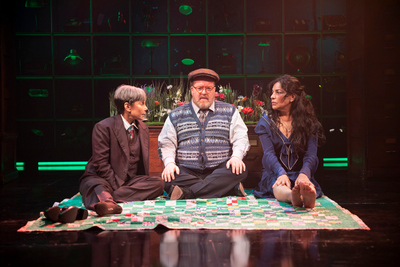
The Adding Machine is a biting satire about the devastating effects of capitalism and industrialization on a character appropriately called "Mr. Zero," played here per The New Group's commitment to nontraditional casting by Daphne Rubin-Vega (the original Mimi in Rent). When we first encounter our protagonist, he has already been beaten down through 25 years in a life of repetitive drudgery. He is sour at work, disgruntled in his marriage, and given to indulging in racist and xenophobic diatribes. More, he is so dehumanized that he can shrug off a sudden act of violence; it simply fits in with his worldview. It's fascinating to watch the unraveling of this automaton of an everyman whose personality has been all but erased. But it can be a bit much at times. So let's be grateful that a 21st century playwright, Thomas Bradshaw, has been pegged to tinker with the original script. Bradshaw, a master at very dark humor, is just the guy to bring some of that spirit into the production. Possibly the best bit of tinkering here has been the addition of a narrator, played with wonderfully dry wit by Michael Cyril Creighton, whom fans of the Hulu television series "Only Murders in the Building" will recognize as the annoying yet endearing Howard Morris. Creighton, who also plays, as the program puts it, "everybody else" who isn't one of the three main characters, starts things off on a cheery note: "You are about to witness a heart-warming tale about modern life crushing the human spirit." He then adds, "you may even recognize a few things from your own life. If so, I apologize in advance." On that note, we dive into the play's sardonic heart of darkness. It opens on a couple lying in bed. On one side, silent and nearly motionless, is Mr. Zero. Next to him is his long-suffering, neglected wife Mrs. Zero (Jennifer Tilly). For a very long time, we are treated to a rambling one-sided "conversation," during which Mrs. Zero talks and talks and talks about everything and nothing, including the unhappy life she is leading being married to such a lump of a man. Next thing we know, it is morning, time for Mr. Zero to drag himself off to his job as a bookkeeper. There he will sit day after day at a table he shares with his co-worker Daisy (Sarita Choudhury). She goes through a pile of receipts and reads aloud the amounts, one by one, to Mr. Zero, who then writes them in the ledger. And so it circles around and around: drudgery at home and drudgery in a job that has been going on for 25 years. To mark the occasion, the boss calls him into his office. Expecting a commendation or even a raise, our hero learns instead that he is being summarily fired. He is obsolete in the eyes of the company, about to be replaced by a calculating machine. In a rare awakening from sleepwalking his way through life, Mr. Zero murders the boss. Act I wraps up with a quick arrest, trial, conviction, and execution. You'd think that this was the end of the play. But, no, "this is just the beginning," the narrator tells us as he shoos us off for an intermission. Act II starts on a much different note, in which Mr. Zero, much to his surprise, finds himself in what seems to be some version of heaven. Turns out that Daisy is there as well, though how she got there is equally confusing since we learn she committed suicide not long after Mr. Zero's execution. It also seems that both have been silently smitten with the other through all their years together at work. So, quite a turn of events. Does the play suddenly morph into a romantic comedy? Hmm. But enough plot reveal. Instead, let's talk about how this production succeeds on multiple levels, with surprisingly little fudging for contemporary audiences. The performances under Scott Elliot's direction are all beautifully delineated. Daphne Rubin-Vega and Jennifer Tilly give us a Mr. and Mrs. Zero whose deep-seated belief in the American Dream has been so thoroughly drummed into them that they cling to it despite the evidence of their empty lives. Sarita Choudhury's Daisy, notably the only character with an actual name, offers at least the possibility of redemptive human connection. And Michael Cyril Creighton's "everybody else" provides a welcome dash of humor and modernism to bridge the century since the play was first produced. But beyond the strong performances lie some of the most innovative design elements in town, from Derek McLane's clever set (a staged dinner party is a real hoot) to Jeff Croiter's brilliant lighting effects and Stan Mathabane's immersive, theater-filling sound design. This production works beautifully on all levels. The Adding Machine is a triumph for The New Group at its new Off-Broadway home. The Adding Machine Tickets on sale through May 17, 2026 The New Group Theatre at St. Clement's, 423 W 46th St. Tickets online and current performance schedule: TheNewGroup.com
|