|
Past Reviews Off Broadway Reviews |
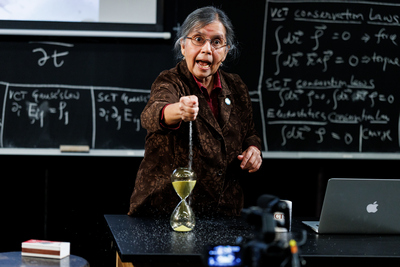
Krit Robinson's set, as we enter the Peter Jay Sharp Theater, accentuates the strangeness. At a long blackboard separated by a pull-down movie screen displaying a long-ago slide of her and her son on a sand dune (there's a lot of sand in this play, including a rapidly depleting hourglass), Chakraborty is writing out formulae the uninitiated will never be able to decipher. The other side of the blackboard declares, "Rheology of Fragile Motion." Another, smaller screen stage right has a camera trained on sand in a jar. Downstage from that is a sandbox; soon she'll be taking her shoes off and walking around in it. The lights don't go down, and Chakraborty, a warm maternal presence with a professorial bent, is quizzing the audience on basic matters of physics. Really, if you're not into the fourth wall breaking down, don't go to this. The first questions are basic, how do liquids differ from solids and such, what happens when a solid like sand displays liquid qualities, and did you know that no two grains are alike. But soon her theoretical-physicist queries are drifting above many of our heads. She's been obsessed for decades, she says, with the question, "How do substances like sand hold together even as they come apart from themselves?" There's an extensive discourse on that until, in what seemed to me a rather shabby theatrical trick of Chowdhury's, his mother feigns a coughing fit, then another, then a third. We've uncomfortably arrived at an is-there-a-doctor-in-the-house stage, but it turns out it's a ruse–an excuse for Chowdhury, in the audience but clearly not a regular theatregoer because he's wearing a face mic, to interrupt and start down his own road.
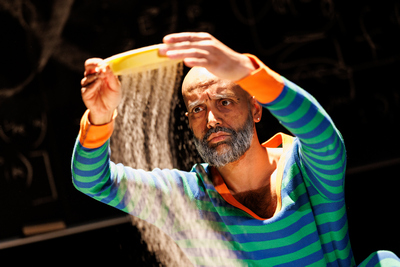
But Chowdhury dwells on mortality plenty–Gen-Xer that he is, every other word is "like"–and at one point extracts a skeleton with what looks like Chakraborty's hair from that sandbox and embraces and lies next to it. This is creepy. Her death, he thinks, would literally kill him–he expresses that as a hypothesis–and Chakraborty, in a touching and eloquently delivered hypothesis finale of her own, postulates on why that wouldn't happen. "You are elastic. You will hold your shape." In between are role-playing scenes of mother and son at earlier life stages; a long monologue about Chakraborty's own mother, featuring a color slide of her shortly after dying; protracted dialogue in Bangla, fortunately with supertitles; and a side excursion into Chowdhury's sexuality (he's lusting after music director George Crotty, who accompanies the pair's vocals on cello). The lighting, by Mextly Couzin and Masha Tsimring, is classroom-harsh for the lecture portion, but achieves one dazzling effect when the lights dim and Chowdhury appears to be writing on the blackboard in green neon; the sound, by Tei Blow, is exemplary, except for that artificial miking when Chowdhury emerges from the audience. Rheology was commissioned by HERE Arts Center and developed with the assistance of a couple of other companies, and it seems to spring whole-hog from Chowdhury's mother-fixated mind. Chowdhury, who excellently directed Prince Faggot at Playwrights earlier this season, seems on sandier footing with this one. Did we really want to peer this closely into his and Chakraborty's obsessions, and are any large insights being elicited from them? Those with a predisposition toward physics may find fascinating things in Rheology; for the rest of us, it feels rather like being back in college, in a course we didn't especially want to take. Rheology Through May 16, 2026 Playwrights Horizons Peter Jay Sharp Theater, 416 W. 42nd St. Tickets online and current performance schedule: PlaywrightsHorizons.com
|