|
Past Reviews Off Broadway Reviews |
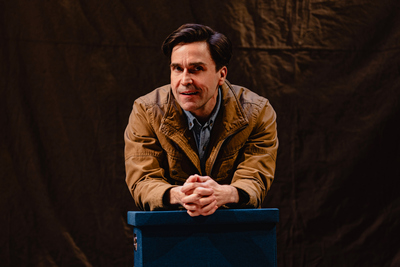
Directed by Rob Melrose, the production, which is officially titled Thornton Wilder's The Emporium, serves as both a dramaturgical speculation of the playwright's vision and a compelling literary excavation. The performance begins in what appears to be a research library's reading room. (Walt Spangler's scenic design and Cate Tate Starmer's lighting, which feature an imposing, rusting, and brightly lit "Emporium" marquee, are notable for their fluidity.) A narrator (Joe Tapper) explains the provenance of the 360-page handwritten manuscript that Wilder began in 1948. The play was announced for Broadway twice, and Montgomery Clift was set to star in it. It remained unfinished and unproduced when Wilder died in 1975. The play itself traces the life story and nine tough goodbyes of John Foster (Tapper, ingratiating and spirited), an orphan, who was found in a basket at the entrance of the Emporium, a world-class department store. After transferring from an orphanage, John grows up under the care of the Grahams, a farm couple. Mr. Graham (Derek Smith, who is terrific in several different roles) is a cruel father figure, and Mrs. Graham (Candy Buckley, also wonderful in assorted parts) rouses his desire to pursue a career in the Emporium. Unlike other department stores, like, say, the commonplace Craigie's, she impresses on him the Emporium as a life's calling, "something you can belong to." Years pass, and no matter how diligently he tries, John cannot seem to secure a position in the store. His sweetheart, Laurencia (Cassia Thompson, who is endearing as the lovely and cunning salesclerk), works in the store and offers an insider's view of life behind the counter. He takes a job at Craigie's but doggedly strives for his longed-for career. The narrative unfolds with a number of metatheatrical flourishes, as well as a few echoes from Wilder's earlier work, that aficionados will instantly recognize. For instance, The Emporium consistently breaks through the fourth wall, and the characters Mrs. Frisbee, Miss Coley, and Mr. Benjamin (delightfully played by Mahira Kakkar, Eva Kaminsky, and Patrick Kerr) are delegates from the audience, commenting on and taking part in the proceedings. There are references to an imminent "storm of the century" that evoke the apocalyptic disasters from The Skin of Our Teeth and a hint from Emily's "Farewell, Earth" monologue from Our Town. Having lost her job, Laurencia bids an emotional adieu: "So long, Emporium. Goodbye counter where I stood all day. Thank you, mural of all four seasons." Additionally, the actors often interact with the (real) audience members throughout, emphasizing the sense of shared community that is a hallmark of Wilder's full-length plays. Furthermore, the design elements, including Alejo Vietti's costumes, Charles G. LaPointe's wigs, Darron L West's sound, and with a special nod to Anya Kutner's props, are a tribute to the author's capacious theatrical imagination. Yet, the play is far from perfect. Near the end of the first act, the narrator explains that the playwright had outlined (but never wrote) a prologue that would be delivered incongruously and, with Wilderian cheek, at the beginning of the second act. (Since it was never written, the audience gets a chance to vote on the chance to hear Lynn's version. My audience chose to have it performed.) The prologue reveals the play's central conceit and the metaphorical significance of the unobtainable Emporium. Unfortunately, the metaphor overtakes the play, and it is hard to be moved by the cosmic lessons the characters learn at the end. We appreciate the wit and audacity behind these figures, but we don't get to know them as we do the Antrobuses or the denizens of Grover's Corners. They are as elusive as the exclusive department store. As we were leaving the theater, my companion and I discussed whether or not the play in its current form would have been a success if it had been produced during the playwright's lifetime. We both agreed that it more than likely would not have fared well, and it would have been considered an artistic disappointment. That did not diminish, however, our gratitude for the opportunity to see a new play by Thornton Wilder and check off one more "goodbye" on our mystical score sheet. Thornton Wilder's The Emporium Through June 7, 2026 Classic Stage Company Lynn F. Angelson Theater, 136 E 13th Street Tickets online and current performance schedule: ClassicStage.org
|