|
Past Reviews Off Broadway Reviews |
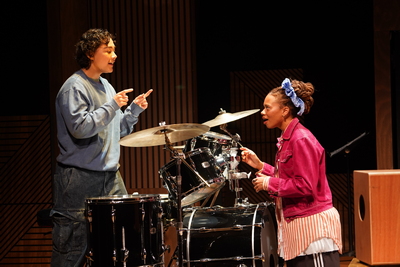
The four high schoolers meet by chance at a distinguished music program in Berkeley, California and have been assigned to perform together. Fax (Hillary Fisher) is a gregarious young woman who initially sees herself as a disciplined opera singer who rejects musical improvisation. Therefore, ornamentation and embellishments should only be gleaned from the score. As she explains, when it comes to singing, "I like having more of a roadmap." Inclined toward extemporization, the group's pianist, Rile (Yeena Sung), is both impulsive and emotionally reckless, and they are still finding their musical path. "My mom started me taking lessons 'cause you're supposed to learn an instrument," they say, "but I don't know why I'm still doing it." Drummer Margot (Naomi Latta) has a troubled home life, and she channels her despondency into music that incorporates avant-garde, freestyle forms that artists like Cage championed. Sounds drawn from nature, street noises, and rhythms of conversations provide her percussive inspiration. The final member of the quartet is Clementine (Gianna DiGregorio Rivera), who is adept at several different instruments yet is all but invisible to the other three except when they find themselves alone with her. The character is noticeably underwritten, but that may be the point. Under Pam McKinnon's direction, the performers are in perfect harmony, and for an extended musical sequence, Fisher, Sung, and Latta make impressive music together. (Davis composed the original music.) Furthermore, they convey teen angst without condescension or mockery. When one of the characters states matter-of-factly, "it'll be great when we're done being teenagers and never have emotions again," we are pulled back to a time when it seemed that adulthood would resolve all the presumed misfortunes of our tortured youth. The design team beautifully captures this specific time and place. Mel Ng's costumes express the casualness of adolescence while gesturing to the meticulous deliberateness each character had surely dedicated to the selection of every single article of clothing. Nina Ball's set, invoking an austere and majestic concert hall's rehearsal room, imparts a sense of history, tradition, and grandness that the girls are simultaneously embracing and challenging. Fan Zhang's sound serves the music effectively, and Russell H. Champa's lighting efficiently and dramatically transforms the scenes that take place in the rehearsal room as well as those taking place throughout Berkeley. Davis's script exudes its own musicality with its interweaving motifs, contrapuntal dialogue, and aria-like monologues. But watching it, I was reminded of the Emperor's response to Mozart's opera in Amadeus: "There are simply too many notes." Davis presents a surfeit of ideas and hot-button topics, but they don't all cohere. The repeat signs in the title suggest the cyclical patterns of teenage girlhood and the behaviors that are rehearsed and re-rehearsed, over and over. However, in attempting to take on so many different concerns facing teens, we don't get to know the characters deeply. Instead, there are riffs on bulimia, gender identity, same-sex desire, substance abuse, parental neglect, and class difference, but these elements feel fragmented and underdeveloped. Creating a form of dramaturgical dissonance, the play also toys with the concept of "chance." This includes, for instance, a freak accident caused by an earthquake, and even more implausibly, a coincidence involving a sperm donor. ||: Girls :||: Chance :||: Music :|| is an ambitious and noteworthy endeavor in highlighting the social circumstances adolescent girls confront daily. There are moments of irrefutable radiance, but these high notes get lost in the competing cacophony. ||: Girls :||: Chance :||: Music :|| Through June 21, 2026 Vineyard Theatre 108 E. 15th Street Tickets online and current performance schedule: VineyardTheatre.org
|