|
Past Reviews Off Broadway Reviews |
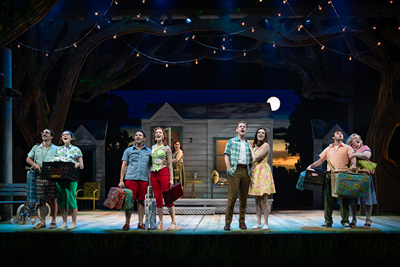
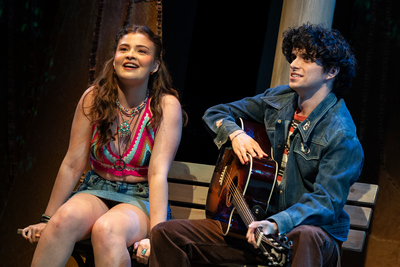
AnnMarie Milazzo (music and lyrics) and Pamela Gray (book and additional lyrics) oblige with A Walk on the Moon, now onstage in an unusually elaborate production for the Laura Pels (it's not a Roundabout show). They've gotten it, let's say, half right. The story and setting still appeal, and the emotions, when they don't boil over into needless production numbers or sung rants, can still be affecting. But the directness and simplicity of the original are compromised. Gray has been quite faithful to the screenplay, which was also hers. About all that's missing is a crucial episode where 9-year-old Danny (Leo Caravano at some performances; I saw Reid Gardner Clarke, and he was adorable) gets stung by wasps, leading to a contentious face-off among the three principals. The rest of the movie is on stage. It's summer 1969, a momentous moment in American history, what with the Apollo 11 moon landing and Woodstock about to happen, and Vietnam protests deepening a much-discussed generation gap. Dr. Fogler's Bungalow Colony, a Catskills retreat for middle-class Jews, would seem a welcome respite for the Kantrowitzes. But Marty (Max Chernin) must keep toggling between there and Brooklyn, where he's an overworked TV repairman who long ago abandoned bigger dreams. Pearl (Talia Suskauer) feels shoehorned into her role as wife and mother, fretful over having missed the opportunity to be anything else; in a key line of dialogue, she asks her mah jongg buddies (Caroline Frederick, Megan Kane, and Becca Suskauer), "You ever feel like the whole decade's gone by and you haven't even been in it?" Marty and Pearl are lucky to have Lillian (Andréa Burns), his mother, along, to be a doting bubbe to Danny and Alison (Sophie Pollono), a rebellious 15-year-old in the early throes of teenage horniness. Alison is more political than she was in the movie–she even gets a whole song about protest, where she urges budding boyfriend Ross (Oscar Williams) to get more involved. But the romantic focus is mostly on Pearl, who's fascinated by the itinerant salesman Walker (Sam Gravitte), a 1969-style free spirit with long hair, rolled joints, tie-dyed shirts, and an f-the-authorities attitude.
Oh yes, the songs. Milazzo traffics heavily in the 1969 sound, the four-piece orchestra dominated by two guitars, riffing in the modes of the many Woodstock artists cited in the script. Going for a Joni Mitchell or Richie Havens vibe may be stylistically appropriate, but it grows more than a little monotonous. A few songs work very well: the plaint of Pearl and her clique over the irrelevance of Betty Friedan's "The Feminine Mystique" to their lives; Lillian's recounting to Pearl of Marty's larger ambitions and how they got squashed; Marty's reassurance to Alison that, no, her being born didn't ruin her parents' lives, it made them. In such simple moments as these, you wish Gray and Milazzo had relaxed a little more elsewhere. And that the production had relaxed a little more. Tal Yarden's set is efficient enough, the Kantrowitzes' bungalow mid-stage and an inviting copse of trees, their leaves beckoningly rustling, behind; his video design, period TV clips and protest footage, and flags unfurling, is overbusy. So is Robert Wierzel's lighting, which at one point turns those green leaves purple, to uncertain purpose. More welcome are Ricky Lurie's costumes, a late-'60s riot of miniskirts, plaid shorts, and flowery dresses. Justin Stasiw's sound is, no surprise, overloud. Sheryl Kaller's direction is somewhat more boisterous than the material merits, while Josh Prince's choreography has a suitably ragged feel for a group of non-Terpsichorean working stiffs. The cast ranges from capable to better than that. Pollono is a terrific Alison, strong-voiced and exuding teenage vulnerability, and she and Williams have a nice puppy-love thing going; Burns, while feeling young to play a grandmother of a teen, has never been less than an expert musical artist. (Lillian was played in the movie by Tovah Feldshuh, who here amusingly voices the offstage camp announcer, broadcasting such pronouncements over the loudspeakers as "If you need a little nosh, Shimmy the Pickle Man is on the premises!") Chernin and Gravitte are both just fine, without measuring quite up to their respective cinematic counterparts, Liev Schreiber and Viggo Mortensen; Suskauer sings powerfully and catches Pearl's inner turmoil, but to fully understand this woman, we need more than, as she keeps saying, "I want more." It's 1969, she's a Flatbush wife and mom, and what choices does she have? She wants more what? Which is its own small tragedy, the women of that era and previous eras who were so rushed into their appointed roles that any alternate existences were cordoned off; I just felt the pain of it more in the film. And yet, when the Kantrowitzes, the mah jongg ladies, and their spouses (Andrew Faria, Michael Tacconi, and David R. Gordon) watched as footage played of the moon landing, and Neil Armstrong uttered his one-small-step-for-a-man line, I remembered my 10-year-old self seeing it on my grandmother's 21-inch black-and-white Hotpoint console, and I got all misty. A Walk on the Moon isn't an ideal adaptation, but if you're old enough to wax nostalgic about those times, or if you can identify with the parental struggles Pearl and Marty are suffering, you may want to pay them a visit. Better yet, rent the movie. A Walk on the Moon Through August 22, 2026 The Laura Pels Theatre at the Harold and Miriam Steinberg Center for Theatre, 111 W. 46th Street Tickets online and current performance schedule: AWalkontheMoonMusical.com
|