|
Past Reviews Off Broadway Reviews |
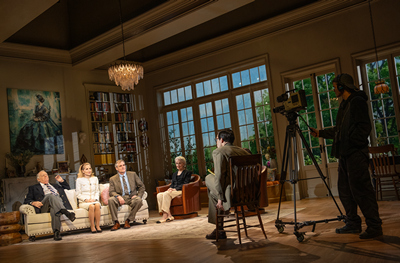
Even disappointing Wasserstein has its intermittent charms, boosted by a production that is, by Signature Center standards, mighty elaborate. Mikiko Suzuki MacAdams's set, a well-appointed Georgetown living room circa the millennium, is quite lovely, with its wall-high bookshelves and windows, and a woodsy backyard that resembles nothing I've ever seen in Georgetown. It's the residence of super-achieving Lyssa Hughes (Jean Lichty), a noted doctor just nominated to be surgeon general, and her husband Walter Abrahmson (Robert Sean Leonard), a sociology professor who's glib and supportive, and, at least as inhabited by Leonard, just doesn't have as much personality as we'd like. The two have twin sons we never meet, raising the question of why Wasserstein bothered to write them in except to pile more responsibility on Lyssa's overburdened shoulders, and a variety of friends and relatives who populate the Abrahmson-Hughes living room with well-timed entrances and exits. Wasserstein's employment of this sizable supporting cast feels, for her, clumsy–most of these characters fulfill one vital plot function and then just hang around. Judith (Montego Glover), Lyssa's best friend, is another overachiever, an oncologist who's racing against her biological clock and doling out extended monologues, with punchlines that don't pay off, about being Black and Jewish. Quincy (Carmen Zilles) is a star former pupil of Walter's, a feminist author who can't deny a sexual charge whenever her old prof is around–another plot point that surfaces and vanishes. Morrow (Ryan Spahn, overdoing the fey in the first act and quieting down in the second) is an old friend of Walter's, a gay-hedonist screenwriter who nonetheless is conservative and stridently pro-life, and I'm still doing the mental calculus on that. Timber (Chris Ghaffari), a telegenic TV reporter, is there to do a puff piece on Lyssa that quickly dispenses with the puffery when Morrow blurts out a minor long-ago infraction of hers. (She failed to answer a jury duty notification, and now that threatens her nomination; were we ever that innocent?) Lyssa's dad (Dakin Matthews) is a far-right senator from Indiana who loves his daughter but not her politics, his new wife (Mary Beth Peil) a cultured Hamptonian matriarch who's amusing whenever she appears, because Mary Beth Peil is playing her. It should flow, but it feels episodic, with Wasserstein taking too many side trips down this large assemblage's mental byways, and ladling on the social issues without ever getting deeply analytical. She can't resist a quip (Quincy to Judith: "I'd love to talk to you about being Black and Jewish, you're a walking Crown Heights!"). What's mainly on her mind, it seems, is the still-infuriating double gender standard in American politics. Lyssa's jury oversight, she maintains, wouldn't matter if Lyssa were a man (really?), and Lyssa's mention to Timber of "icebox cakes and cheese pimento canapés" is seen as a swipe at Indiana housewives. It's a loud echo of Hillary Clinton's 1992 comment, "I suppose I could have stayed home and baked cookies" rather than become a lawyer, and Lyssa emerges as very Hillary-like. Lichty, whose La Femme Theatre Productions produced this, portrays her with the proper Hillary crispness and efficiency; it's just not a performance that resonates, that affords us an eye into Lyssa's soul. That may be structural–Lyssa, ever guarded and responsible, would always maintain a steel surface. But, as many experienced with Hillary, it puts her at something of an emotional remove. Until Lyssa's last-minute remark, "Maybe one day every woman who comes into national focus won't be forced to stand for the women of America." Yep, that resonates. Some of the supporting cast make stronger impressions. Peil, of course, and Matthews fetchingly personifies the savvy, media-ready politician of an earlier era. And Will DeVary, as a detestable, bow-tied young media consultant out to make Lyssa more relatable, pulls laughs out of lines that shouldn't have them. Glover struggles to make Judith something more than a symbol, and Spahn needs to dial down on the gay. Alan C. Edwards's lighting prettily illuminates the Georgetown sky turning purple, pink, and aqua, if not always at logical times, and Sarna Lapine's direction feels more like traffic management, what with all those entrances, exits, and crossings. An American Daughter does satisfy as an exercise in political nostalgia: Imagine an era where liberalism and conservatism fought as brave equals, real issues mattered more than sound bites, and social media existed but hadn't taken over our lives. Its still-timeliness as a savaging of the roles women remain forced to play has some bite. But it's bloated: too many subplots that don't amount to anything, and no way it has to drone on for over two and a half hours. I don't know how substantially different the new second act is from the old one. But maybe neither was especially good. An American Daughter Through September 20, 2026 La Femme Theatre Productions The Irene Diamond Stage at The Pershing Square Signature Center, 480 W. 42nd Street Tickets online and current performance schedule: LaFemmeTheatreProductions.org
|