|
Past Reviews Off Broadway Reviews |
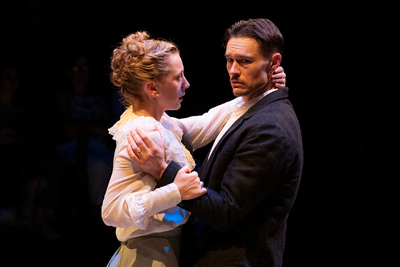
Ivanov has always been a difficult play to stage. The central characters are generally unlikable, and the plot relies on hoary melodramatic conventions. Yet, as the fledgling New American Ensemble company demonstrated last spring with its gutsy, fiery production, Ivanov can be both provocative and compelling. Rather than reining in the chaotic elements, the play benefits from interpreters who lean into them as that previous production did. The Real Ivanov, on the other hand, seems intent on glossing over these problematic rudiments. In a press release, Strausfeld states that her adaptation "hews close to the original, but removes repetition characteristic of plays from Chekhov's era when theater acoustics were less optimal, actors demanded more material, and audiences loved to see and be seen at intermission." These claims are historically dubious, but even more egregiously, the judicious pruning robs the play of its depth of character and the sense of inertia that pervades the provincial setting. Indeed, rather than merely catering to actors' egos, the original's leisurely, verbose scenes heighten the tension between comedy and tragedy. Moreover, the structural repetition and circular dialogue are inherent to Chekhov's design. Stripping them away is like justifying the deletion of the three sisters' repeated desire to go to Moscow because body mics helped make their intent clear on the first utterance. The key plot points, nevertheless, remain. The story revolves around Ivanov (Sam Underwood), a self-described "whining Hamlet" who is professionally disillusioned and severely depressed. He has fallen out of love with his formerly Jewish wife, Anna (Ivory Aquino), who is dying of tuberculosis. Anna's moralistic doctor (Elijah Guo) urges Ivanov to take her to Crimea, where the climate might prolong her life. However, Ivanov is unwilling or unable to help his ailing wife. He is saddled with debt, including money owed to the neighboring landowners, the Lebedevs (Spencer Aste and Sarah Long), whose daughter Sasha (Amelia Mason) is deeply infatuated with him. Surrounding Ivanov is a circle of hangers-on and disingenuous associates, such as his manipulative estate manager Borkin (Sam Adegoke); his jocular uncle, Count Shabyelsky (Jordan Lage); and the tempestuous widow Babakina (Kimberlee Walker). Kosyk (William DeMeritt), an excise officer, and Avdotya (Soph Metcalf), a social interloper, round out the cast. An unfortunate byproduct of giving the actors less material to work with is that the performances tend to be one-note. Underwood makes the most of his sustained lugubrious note, but we don't get to see the complexity or basis for his profound despondency. Lage provides much of the comic relief, but his blustering buffoonery grows tiresome. The standouts are Aste as "the old drunkard" Lebedev and Mason as his compassionate and impassioned daughter, Sasha. Aste convincingly and movingly shows the character's benevolence for his old friend Ivanov while trying to maintain equilibrium in his own home. Mason offers a similarly layered portrayal, providing an empathetic anomaly among the gossiping, bickering neighbors, potentially giving the show a more apt moniker, The Real Housewives of Post-Feudal Russia. Strausfeld's direction aligns with her minimalist approach to the text and works well within its context. Performed on an empty stage save for a bench, a table, and a long, red carpet-runner in the final act, the production calls attention to its theatricality and artifice. Only Ella Matza's period costumes and Tim Rempel's patently fake but recognizable 19th-century guns convey the historical milieu. The simple staging is generally befitting, but there are a few self-conscious moments in which the directorial effects do the heavy lifting that the original text could carry on its own. The first is a repeated freeze image in which Ivanov steps away from the crowd as the lights shift, signifying his acute isolation and incapacitating desperation. (Jiyoun Chang designed the sets and lighting.) The other is the fourth-act wedding scene. Although set in a pantry in the Lebedevs' house, the action here takes place entirely on a carpet strip demarcated by Chang's claustrophobic lighting. As the characters jockey for position in the small space and threats of duels are bandied about, the strain increases until Ivanov's fate is sealed. Visually, it's an interesting choice, and the imagery persuasively captures the play's shocking (but unsurprising) violent climax. Yet, in the end, I couldn't help but think that this is Ivanov delivered in rhetorical snippets and carefully curated snapshots. If this is the real thing, I would far prefer to savor Chekhov's counterfeit version. The Real Ivanov Through September 19, 2026 Lynn F. Angelson Theater, 136 E 13th Street Tickets online and current performance schedule: RealIvanov.com
|