|
Past Reviews Off Broadway Reviews |
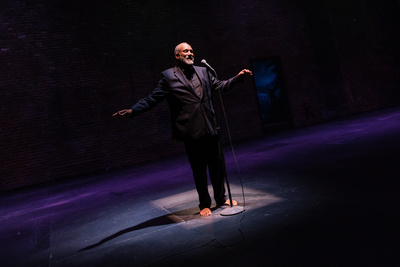
Basquiat (1960-1988) is a fascinating figure, an original who rose up from nowhere to dominate the downtown art scene, mostly after his tragic early death. One work, the 1982 Untitled, went for $110 million in 2017–a moment amusingly re-created by Smith, peddling a snooty British accent (he can also do Haitian, Jamaican, and Brooklynese). The works are, at first glance, cartoonish, but there's a lot going on, and they depict a Black culture that the 1980s art world otherwise simply ignored. He befriended everyone from Larry Gagosian to Andy Warhol to Debbie Harry, dated Madonna among many others, and painted and drew vociferously, all the while indulging in cannabis, methadone, and heroin, which eventually killed him. But you won't find out a lot about any of that at New York Theatre Workshop, where Smith, for some reason barefoot, presides at a mic, assisted by his busy sound designer, Marc Anthony Thompson, twiddling knobs stage left. The mic enables Smith to go anywhere from whisper to shout, and his is an expressive voice. His topic wanderings, though, are curious. He keeps going down blind alleyways. A 1960 plane crash in Park Slope, which occurred close to Basquiat's birthdate but otherwise is at best tangential, rates repeated mention. The large number of artists, visual and otherwise, who died at the age of 36. Smith's earlier job running an elevator at the U.S. Capitol, which he says as if it were a splendid joke, "has its ups and downs." His 1980s identity as "Hollywatts," a West Coast rapper who commented on the rich/poor-Black/white divide in L.A. His alliance with Spike Lee, for whom he played Smiley in Do the Right Thing, evidently after pestering Lee to write the character in. Great Black musical artists, such as Charlie Parker and Bud Powell, who landed in lunatic asylums. It's a wide net, wider than you'd imagine from the title. There's a lot of Black rage on that stage. A justifiable emotion, one that theatre should and does explore. It just overtakes the Basquiat. A great deal of time is devoted to Michael Stewart, a Black artist inexplicably murdered by transit police in 1983. He's the subject of a key Basquiat work, and the genesis of Smiley. No argument with mentioning him; he belongs up there. Maybe not for such a stretch. Smith also directed himself, savoring long vocal pauses and dramatic, but very dark, lighting, by Arlo Sanders. He moves well, and his versatile voice is the product of some well-honed stage training at Yale and in London. We like the guy. But you'd expect something called In Honor of Jean-Michel Basquiat to contain at least a smattering of the title subject's work, wouldn't you? Raphael Mishler's spare scenic design includes a backdrop behind a small upstage doorway that does reveal a Basquiat-like background, but that's it. It's indicative of Smith's focus that the show's poster, of which many in the audience took selfies pre-curtain, writes out the title in Basquiat-esque lettering, but is mostly a shot of Smith. If you want to know more about the latter, his impressive career, and what inspires him, you'll probably enjoy this exactly 60-minute journey. If you came for a fix of Jean-Michel, you may walk out a Basquiat case. In Honor of Jean-Michel Basquiat Through October 4, 2026 New York Theatre Workshop, 79 E. 4th Street, New York, NY Tickets online and current performance schedule: NYTW.org
|