|
Past Reviews Off Broadway Reviews |
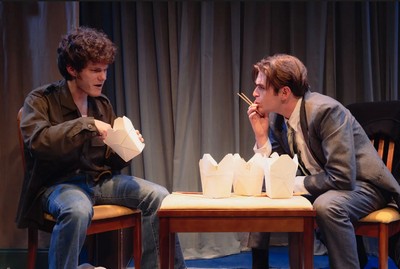
Sadly, the very fine acting career of Jodie Foster may forever be footnoted by the claim from would-be assassin John Hinkley Jr. that he shot President Ronald Reagan, just a couple of months into his first term of office, in order to get her attention. As someone who was alive during that 1981 event, I'll vouch that his motivation sounded to the general public like an unbelievable sick joke back then. Today, audience members at Eric Micha Holmes dark drama Falls for Jodie, more familiar with the high-profile actions of (usually) angry young American white males, may be intrigued by the play's look at issues such as stalking women and the media's sexualization of children long before the internet both made us more aware of the abundance of such instances and, in some ways, contributed to it. An FBI report cites that in November of 1980, Hinkley checked into the Colony Inn in New Haven, Connecticut, near Yale University where Foster was attending her first year, and Holmes' two-character exploration is fiction inspired by fact. Hinkley's diaries tell us that not only did he develop an obsession with child actor Jodie Foster after seeing her in the 1976 film Taxi Driver, but he was also deeply depressed by the December 1980 gunshot murder of John Lennon by Mark David Chapman. When Holmes has him arriving at the Colony Inn at the play's outset, costume designer Rodri Hernandez Martinez has him dressed recognizably in Lennon's "New York City" t-shirt with a guitar in tow. Later in the play he'll sing a bit of John Lennon's "Working Class Hero." As effectively played by Boone Sommers, Hinkley is seen as a sullen, defensive soul who has convinced himself that he is essentially a romantic dedicated to protecting Foster from those who would take advantage of her. To the credit of Sommers, the playwright, and director Terrence I. Mosley, there is no romanization of his feelings, especially when it becomes apparent in one scene that he perpetually sees her as the child from the film and can't deal with the reality of her as an adult. By contrast, Harry Thornton plays the hotel's night concierge, Eddie, as a slick, sharply dressed huckster who makes every sentence sound like a sales pitch. "Wanna party? Just leave a message in my box. Need a place to meet girls?," Eddie offers, his inflects suggesting he's a procurer of both legal and illegal customer perks. Eddie sees Ronald Reagan as America's savior who will expand opportunities for, "men who work for a living. Real men like us, like you, can win a movie star." In the modern vernacular, audiences would immediately recognize Eddie as an entrepreneur who, having been made aware of Hinkley's family's corporate wealth, convinces him to invest in his idea for a mail order business that sounds like a pre-internet version of Amazon. With Hinkley convinced that his new title as the president of a company will surely impress Foster enough for her to have a date with him, Falls for Jodie delivers a commentary on how corporate American can feed on the promise of fulfilling unrealistic dreams of its consumers and investors. It's not an easy partnership, and fight choreographer Tom Zay does some impressive work staging a full-out brawl in a tiny space. At its best, Falls for Jodie has a bit of a Sam Shepard quality to it when focused on its conflict of disturbed masculinity. At its current state, the play falls victim to a lack of action, as major points are talked about rather than seen. But I wouldn't be surprised if, after publishing, Falls for Jodie becomes a popular choice for college drama students looking for something interesting for scene study classes. Falls for Jodie Through October 18, 2026 The Tank 312 W 36th Street Tickets online and current performance schedule: thetanknyc.org
|