|
Past Reviews Off Broadway Reviews |
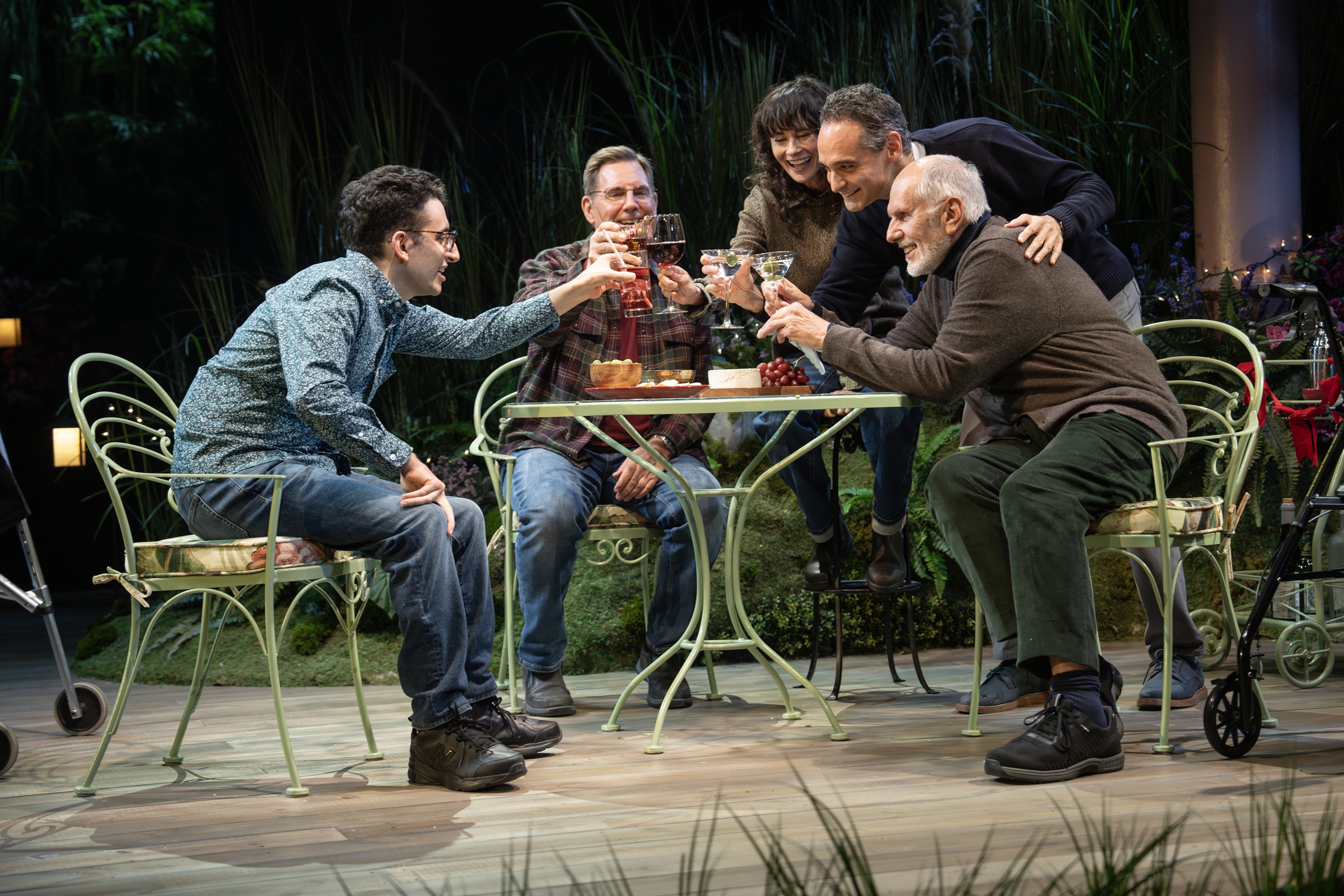
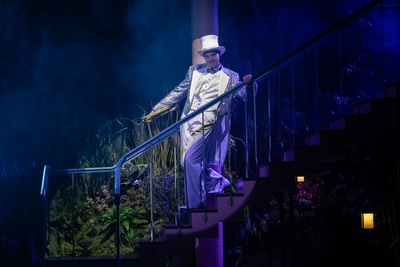
Good Time Charlie turns the backyard where Haddad staged shows as a child into the setting for another family production, only now everyone knows they are characters in Ryan's play and reserves the right to dispute his version of events. Jonathan Raviv as Charlie, Tim Bagley as his partner Lou, Michael Cristofer as his mentor Sheldon, and Beth Malone as Ryan's aunt Janice are among the "relatives" who interrupt scenes and alter the running order, while Haddad plays himself and Artemis Pebdani and Nael Nacer double across generations of the Haddad family. The show's press materials even provide family photographs taken in Charlie and Lou's actual garden in Shaker Heights, Ohio, along with production photos of Afsoon Pajoufar's meticulous recreation of it on the Martinson Hall stage. The boundary between family history and theatrical imagination is particularly porous. Showtunes pass through a queer chain of mentorship as Charlie's older friend Sheldon becomes his guide to movies, theatre, travel, and conversation. Charlie hands that world down to Ryan, and Sheldon eventually tutors Ryan as well, insisting that he read Albee and steering him toward Pippin and Kurt Weill. Lou supports Charlie's bond with Sheldon, grateful that his lover and friend have each other so he can spend more time reading and gardening. Charlie observes that "sometimes your soulmate and the love of your life are two different people" as queer intimacy is dramatized through a network of relationships that help sustain one another. Since the network spans generations, Ryan comes of age in a family that has already reckoned with having a gay son. Charlie was first to encounter family resistance when his parents–Ryan's great aunt and uncle (Pebdani and Nacer, who also play Ryan's parents)–demand Charlie choose dentistry over theatre, deny his homosexuality, and force him to see a psychiatrist. Years later, Ryan has an easier path, though his father initially polices his clothes and "gender neutral" purse. He tries to "draw a line from there to here," unable to reconcile the loving aunt and uncle he knows with the parents Charlie remembers. The "good time" in the title travels from cruelty toward friendship, chosen family, love, and good living through adversity. The phrase first appears as a homophobic taunt written on a condom given to Charlie by so-called friends, precipitating confrontation during which he feels forced to come out to his parents. Decades later, when Sheldon's declining health prevents him from making a New York trip, he urges Charlie to go without him and "have a good time." Good Time Charlie features a recurring grand staircase that literalizes grand ambitions. Charlie descends it for a sequined entrance worthy of Mame. Interrupting an attempted recreation of the Act I finale of Grey Gardens, Ryan navigates the stairs without his walker as a "surprise" for the audience. Through a gratifying spectacle celebrating Broadway fantasy, disability, and inheritance, Uncle Charlie literally gives Ryan the grand entrance he wanted for himself.
The metatheatrical abundance behind Good Time Charlie's punchlines also presents dramaturgical problems. Haddad, known for more concentrated autobiographical work like Dark Disabled Stories and Hold Me in the Water, is attempting to stage a sprawling family drama, but the characters around Ryan are not developed much beyond his view of them. He does appear aware of some of the play's limits, however. Janice protests that American theatre hardly lacks gay male stories and asks where the women are; Ryan concedes the point while insisting that gay male stories remain the ones he knows how to tell. At two hours and fifteen minutes, the play's accumulation of theatrical anecdotes, citations, and overexplained scenes feels indulgent. Danny Sharron's direction lacks momentum, the episodic structure sags, and the family pageant becomes tedious. Haddad is charismatic as ever, but gives his skilled ensemble more exposition than character to work with. Michael Cristofer still stands out as Sheldon, giving his acquired disability detailed physical specificity without sacrificing the character's imperious wit. Pajoufar's lush garden and Barbara Samuels's expressive lighting often accomplish what the script struggles to do, moving us deftly among backyard, memory, fantasy, and performance. In an obligatory scene, Ryan asks Charlie if he envies the career and family support he has enjoyed. "Oh, I'm completely envious!," Charlie admits. But Charlie also acknowledges that if he had pursued show business in New York, he might never have met Lou or Sheldon, and that losing those relationships would be more devastating than never becoming a star. Ultimately, Good Time Charlie's core insight is that nobody makes a life alone. Ryan inherited more than Charlie's taste in theatre; he inherited possibilities that Charlie, Sheldon, Lou, Janice, and the rest of this extended family helped cultivate through support and sacrifice. The play could trust that inheritance more, and explain it less. Good Time Charlie Through October 25, 2026 Public Theater Martinson Theater, 425 Lafayette Street Tickets online and current performance schedule: PublicTheater.org
|