|
Past Reviews Off Broadway Reviews |
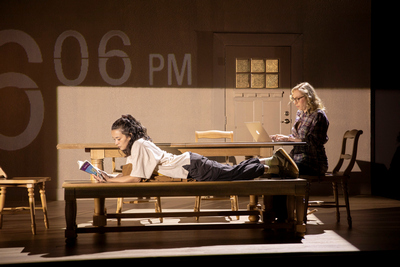
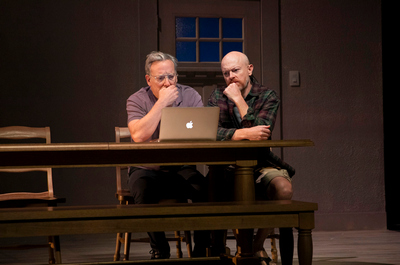
When Adam (Jeff Biehl) hangs a Pride flag outside the new home he shares with Will (Jeremy Shamos), neighbor Jeanie (Crystal Finn) interprets it as a threat to children. Immersed in QAnon conspiracies, she broadcasts her suspicions online, while Adam and Will discover her TikTok feed and consume their "crazyneighborlady" as entertainment. Jeanie's 15-year-old daughter Delia (Izabel Mar) struggles with her mother's internet addiction and her violation of a promise not to post about her. Modes of surveillance multiply as characters watch one another through Ring door cameras, phones, windows, blinds, social media, and anonymous accounts. Washburn's cleverest device is a high school English assignment requiring Delia to write a soliloquy for a Shakespearean character who doesn't already have one. She chooses Goneril from King Lear, introducing storm imagery (with QAnon overtones) that hovers over the entire play. Delia wonders why anyone needs to speak private thoughts aloud, a practice paralleling today's popular performance of the solo social-media selfie video. Mar is riveting as Delia, bringing ferocious teenage energy to the writing and rehearsal of Goneril's imagined soliloquy. Her discovery that thoughts can be "forged into weapons" later becomes literal when Jeanie's online hate leads nearby Will to buy a gun as potential protection. Washburn and Finn resist reducing Jeanie to a gullible consumer of misinformation. She is articulate and capable, and Finn's funny, sincere performance keeps her from becoming a caricature of extremism. Her husband Michael (Andrew Garman) urges her to stop posting obsessively and get a "real job," but Jeanie, desperate for followers, treats social media like a religious calling. Her daughter disproves a Holocaust-denial claim in a minute, but facts seem irrelevant to Jeanie's quest for purpose and the possibility that she might transform the world through online posts.
The constant collision between physical and virtual realities is thrilling and unnerving. Jared Mezzocchi's immersive, colossal projections expand beyond the kitchen-table playing area, fulfilling the script's instruction that the screen world be "larger than life" and "threaten reality." Dates, texts, videos, and overlapping images gradually engulf surrounding surfaces until digital experience swallows the physical room. Tei Blow's sound design mixes typing, message alerts, dog barks, ordinary household noise, and operatic arias. When Delia calls from the next room for homework help, her unanswered "Mom!" acquires the eeriest echo as Jeanie, cooking while listening through earbuds to a conspiracy podcast, cannot hear her. During the play's climactic storm, Jeanie's online paranoia crosses the street as she broadcasts a video from her car before charging into the tempest to snatch the neighbors' Pride flag. The stormy scene invokes King Lear, QAnon, religious apocalypse, and inspirational internet rhetoric. Cha See's lighting design culminates with an ominous red wash over the shared domestic world as characters converge in a mad tableau. Delia's imagined storm becomes real. The TikToker becomes a theatrical performer as Jeanie turns Lear's storm speech into a prophecy of the Great Awakening. ANON shows how users try to manipulate algorithms to attract viewers, but says little about how platforms steadily feed users more extreme material. More attention to that reverse process, including how the influencer herself became influenced by conspiratorial content, would offer a more complex exploration of agency and responsibility. The play's title recalls the Shakespearean word "anon," meaning immediately or at once, while also suggesting the anonymity of online identities. Both meanings seem fitting for a world in which people speak to unseen strangers while insisting everything can change "in a moment." Delia first breaks the fourth wall to announce intermission but Jeanie claims the audience by the end. We have become spectators to "crazyneighborlady" just as Adam and Will did. In addition to its warnings about conspiracies, guns, and digital radicalization, the play's most disturbing observation may be that if you speak into an audience long enough, performance begins to feel like reality. ANON Through November 1, 2026 MCC Theater The Newman Mills Theater at the Robert W. Wilson MCC Theater Space, 511 W. 52nd St. Tickets online and current performance schedule: MCCTheater.org
|