|
Past Reviews Off Broadway Reviews |
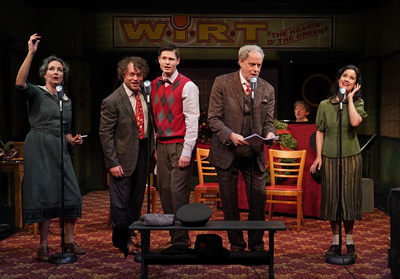
So you'll understand if I get a bit guarded about any attempt to mine riches from the original, which, incidentally, is #21 on the IMDB's top-250 movie list. There have been several: A terrible 1970s TV-movie starred Marlo Thomas as a distaff George Bailey; Sheldon Harnick and Joe Raposo wrote a stage musical adaptation in the 1980s that got some things right but still didn't match the source; another, by Keith Ferguson and Bruce Greer, gets produced with some frequency. And in recent years something called It's a Wonderful Life! A Live Radio Play, by Anthony E. Palermo, has been dotting the hinterlands, now landing at Irish Repertory Theatre, though what exactly is Irish about this property isn't clear. You can see what's appealing about reducing Bedford Falls, New York to five actors in front of big 1940s microphones: It's easy to produce, it doesn't need much of a set (though Irish Rep's, by James Morgan after a Charlie Corcoran original, is quite cozy and agreeable), and it taps into the memories of practically the whole audience, who know the story from endless seasonal TV showings when the movie went into public domain decades ago. But what can a purported December 1946 radio broadcast offer that It's a Wonderful Life can't? Well, variations on the original, ways of boiling it down to its essentials, and a heavy dollop of nostalgia. The movie runs about two hours ten; this version is an hour shorter. And by adding traditional seasonal songs (David Hancock Turner is the able music director), the Frances Hackett-Albert Goodrich screenplay is further diluted. This Bedford Falls, then, is considerably less populous. No Violet! No Annie, the Baileys' sarcastic maid! No Eustace, the furrowed-brow bank clerk! Only glimpses of the four Bailey children. So the actors, frequently switching roles, though Reed Lancaster is consistently George Bailey and Ali Ewoldt is Mary (she also juggles several amusing sound effects), have to establish their characterizations mighty quickly. Under Charlotte Moore's direction, they do pretty well. Ashley Robinson, covering everyone from Clarence the angel-second-class to Sam Wainwright to Uncle Billy, finds distinctive personalities in each. Rufus Collins's versatile voice varies to impersonate Mr. Potter, Gower the druggist, the radio announcer, and seven or eight others; his Potter hasn't the delicious out-and-out villainy of Lionel Barrymore, but he's satisfyingly hateful. And Leenya Rideout has a real workout, essaying Mrs. Bailey, Tillie, and many other characters, several of them male. Plus, this quintet has to run through a couple of 1946 radio commercials, promoting war bonds (was anyone selling war bonds in December 1946?) and the health benefits of smoking Lucky Strikes. Plus they all sing. Let's say they're a busy bunch. Lancaster's George goes in for a wide Midwestern drawl, catching many Jimmy Stewart vocal mannerisms, but you know he's not going to equal the pathos Stewart brought to George's breakdown and joyous recovery; how could he, bereft of Capra's close-ups, Dimitri Tiomkin's scoring, and so many missing lines? Ewoldt has Mary's devotion to family and attractive ordinariness down pat, and she can really sing. But her Mary doesn't grow as a character the way Donna Reed did; again, it's probably the shorthand adaptation's fault more than it is hers. The songs, pleasant listening in themselves, don't do a lot to enrich the mood–mostly, they're signposts. "Brother, Can You Spare a Dime?," complete with verse, tells us we're in the Depression and a run on the Bailey Building & Loan is imminent; the end of World War II is marked with "Keep the Home Fires Burning," which in fact was a World War I anthem. And Mary, telling George she's pregnant, would probably be very happy, but I doubt she'd launch into "Blue Skies." David Toser's costumes include some hilariously awful 1940s neckties, and I salute whoever got the bell on that large downstage Christmas tree to ring when, spoiler, Clarence gets his wings–how did they do that? And all right, when Clarence told George "each man's life touches so many other lives" and Harry Bailey toasted "my brother George, the richest man in town," I got misty–because the basic material's so good, and because the solid, democratic, multiethnic 1940s American values that saturate Bedford Falls are so different from where we are today. It's a Wonderful Life! A Live Radio Play (the original, by the way, lacks an exclamation point) is a sweet little evening, then, a nostalgic animated Christmas card. And if you haven't seen the movie lately, it's a quick reminder of what a thorough, life-affirming universe Capra created. When the camera pans across that crowded Bailey living room in the final scene and we see most of the population of Bedford Falls, we know at least a little something about practically everyone in the frame. (What other movie accomplishes that?) But get this: On December 14, the magnificent United Palace in Washington Heights is showing It's a Wonderful Life, complete with pre-movie caroling, theater organ accompaniment, and TCM's Alicia Malone interviewing Donna Reed's daughter. Now, that's worth a trip uptown. It's a Wonderful Life! A Live Radio Play Through December 31, 2025 Irish Repertory Theatre Francis J. Greenburger Mainstage,132 West 22nd Street Tickets online and current performance schedule: IrishRep.org
|