|
Regional Reviews: Albuquerque/Santa Fe A Midsummer Night's Dream
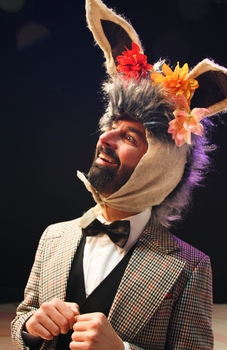
Leslee Richards, the director, has put a new spin on one of the several plots within the play. She gives most of Oberon's lines to Titania and most of Titania's lines to Oberon. So who winds up enamored of Nick Bottom, whose head has been transformed into that of an ass? It's not Titania. This could be looked at as just being different for novelty's sake, but I think there's some justification for it. When we first meet Oberon and Titania, the king and queen of the fairies, they are quarreling because Titania is raising a "changeling" boy from India whose late mother was one of Titania's devotees. Oberon wants the boy, badly. "Give me that boy," he demands, but Titania refuses. So Oberon sends Puck to find the flower whose juice causes people to fall in love with the first thing they see when they wake up. His plan is to use it on Titania so he can take the boy while she is distracted by being madly in love. His plan works, he gets the boy, and one of Titania's fairies transports the boy to Oberon's bower in Fairyland. (What happens after that, we don't know.) That's the way it was written by Shakespeare. But why is Oberon obsessed with getting the boy? It makes me wonder about his proclivities. Purely platonic? Remember, the play takes place in ancient Athens. Maybe it's not so farfetched that Oberon and Bottom connect (admittedly, while Oberon is under the influence of the flower's magic) instead of the expected pairing of Titania and Bottom.
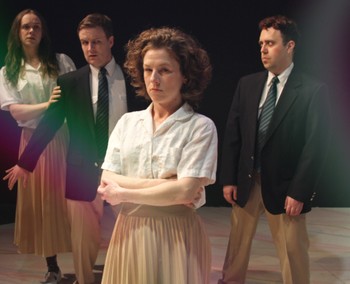
Leslee Richards, assisted by stage manager Ludwig Puchmayer, has put together a wonderful cast and has put them through their paces, so the action keeps flowing seamlessly. The four Athenian young people are Hayley Manion Smith (Hermia), Ian R. Q. Slater (Helena), Nate Clifford (Demetrius), and Kellen Paine (Lysander). They all look age appropriate and all are good actors. As is usually done, the roles of Theseus and Oberon are played by one actor (the regal-looking Alex Glover), and the roles of Hippolyta and Titania are played wryly by Bridget S. Dunne. She's quite funny. In this production, Puck, played by Colyn Morris, also takes on the smaller role of Philostrate, the master of revels. She's convincing in both parts. These three actors manage some quick costume changes and all three do fine work. It's always a pleasure to see Neil Faulconbridge (Egeus) on stage and hear his rich British accent. (By the way, be sure to read Neil's and Alex's bios in the program.) The fairies attending Titania and Oberon don't have a lot of lines, but they add a lot to the mise en scène. They are played gracefully by Emi Davis, Anita Kemp, Lily Menice, and Annie Shao. The mechanicals who each play a part in the Pyramus and Thisbe play-within-a-play, including such roles as a wall, the moon, and a lion, are played well by Eddie Dethlefs, Alex Gonzalez Armbruster, Emma Tyrell, Sivan Gordon-Buxbaum, and Emiliano Aguilar, who is really funny as Francis Flute/Thisbe. The star of the mechanicals, and actually the star of the whole show, is Ed Chavez at Nick Bottom. He is the best comic actor in town, in my opinion, and his performance here should not be missed. The set by Mary Rossman is just a few platforms plus a curtained bed. It serves the purpose well, and the hanging fabrics with twinkle lights on the corners of the set are just right. The costumes for the Athenians are contemporary, no togas or sandals, but the costumes in the fairy kingdom are magical. Good work by Tara Gotham, Louisa O'Neill, and Kip Caswell. Sound design by Casey Mraz, using some of Mendelssohn's incidental music (I think), is apt, and lighting design by Nick Tapia is atmospheric. Props and set decoration by Nina Dorrance are, as always, just right. It seems incongruous to see a midsummer play in mid-winter, but Leslee Richards knew what she was doing when she programmed it for January. It's the perfect jolt of fun and magic while we are waiting through these short days for spring to arrive. A Midsummer Night's Dreamruns through February 1, 2026, at The Vortex Theatre, 2900 Carlisle Blvd NE, Albuquerque NM. Performances are Fridays and Saturdays at 7:30, Sundays at 2:00. Tickets $20 to $26. For tickets and information, please visit vortexabq.org. |