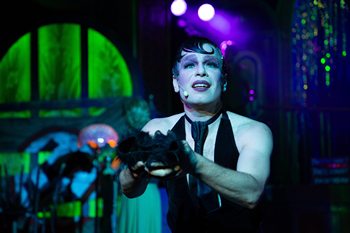
|
Regional Reviews: Albuquerque/Santa Fe Cabaret
The Cabaret we see nowadays on stage is not exactly the same as when it opened on Broadway. Three songs were added for the 1972 movie (which was quite different from the original) and then incorporated into the stage version. Some songs were dropped, but one of my favorites, "I Don't Care Much," was added later. The directors of revivals have made the show grittier, more open about homosexuality, and more despairing. I think the show has become better with each iteration. The book, adapted by Joe Masteroff from Christopher Isherwood's novel "Goodbye to Berlin," takes place in the waning days of the anything-goes Weimar Republic. The characters are living in a hedonistic, amoral, and anomic world. It's the time of the Great Depression. Not much to look forward to, so what does anything matter? Hitler has not yet come to power, but Nazism is rising quickly. We, the audience, know that intolerance and super-regimentation will soon spread across Germany. We know what is going to happen to the Jews and homosexuals, but they do not know, or they don't want to know, which makes it all the more poignant. Our doorway into this world is through the Kit Kat Klub, where the sleazy Emcee welcomes strangers who speak German, French, and English. The star of the floor show is a young English singer of questionable talent named Sally Bowles. Even though she sleeps around, she is always out of money. Eventually, she wheedles herself into the room in a boarding house that a young American writer, Cliff Bradshaw, is renting. Sally ultimately gives Cliff plenty to write about. The boarding house is run by Fraulein Schneider, not young anymore and never married. She has an ongoing relationship with Herr Schultz, who owns a fruit and vegetable shop. (It helps to know that a pineapple was a very precious commodity in those days.) He considers himself German because he was born and lived all his life there. Unfortunately for him, the "real" Germans do not consider him one of them, because he's a Jew. This subplot is ultimately heartbreaking. Why it was left out of the movie, I don't know. The Santa Fe Playhouse production is directed by Anna M. Hogan. She emphasizes the decadence of the era and the brutality of the Nazis who are soon to come to power. Poor Cliff is not only severely bludgeoned; he has acid thrown in his face. The Kit Kat Klub becomes a sad shell of itself. It's the end of the line for many of these people. Hogan's is, overall, a fine interpretation of the show. One of my criticisms is that it doesn't maintain its level of energy all the time. Sometimes it drags a bit, and the first act seemed longer than I recall it being. I saw an early performance, so maybe they have picked up the pace by now. My only other criticism is that the Emcee's brief song, "I Don't Care Much," should be a still moment amid turmoil, but Hogan has Sally and her boss Max pantomiming an argument/fight in the background. I would have appreciated a bit of calm to be able to concentrate on the song. The cast does very good work. Jeffrey Barba is not the creepiest Emcee I've seen, but he's certainly energetic. Rachel Biggs does well as Sally. I'm not sure that her British accent is totally consistent, but her acting and singing are good (except that some of her songs ended "power ballad" style). The role of Cliff is a thankless one. He gets to sing for about two minutes, and he's the male lead in a musical! Bradley Lewis is brave to take on the role. He sort of underplays it, especially early on, but honestly, there's not much there with which to make an impression. Karen Gruber Ryan is great as Fraulein Schneider, both in acting and singing (although she also sometimes belts it out "power ballad" style at the end of a couple songs). Paul Kerrigan plays Herr Schultz just right. His singing voice, though, is almost too operatic for the part. Isabel Madley and Jensen Klodnicki are both very impressive in secondary roles, and the rest of the ten people in the ensemble deserve a lot of credit for a job well done. Santa Fe Playhouse is using the theater in the Scottish Rite Temple of Santa Fe for this production. The building is over a hundred years old, and the decor could be considered part of the set. The set built specifically for this show was designed by Daniel P. Hogan and it works fine for the limited space. Lighting design by Ben Rawson is understated but good. Sound design by Saibi Khalsa is for the most part good, but I had trouble understanding some of the lyrics at times. This might be a function of the space rather than of the sound equipment or the singers' enunciation. The costumes by Dylan Hawkinson perfectly reflect the era (although I'm not sure what's going on with Cliff Bradshaw's vest). Hair and makeup are well done by Mary Hogan (a trio of Hogans worked on this show). It could not have been easy to choreograph this since the ensemble members all do different moves, but Laura Orozco Garrett has pulled it off. Music director Gretchen Amstutz does a good job conducting the six-member live band and, I assume, coaching the singers. A shout-out to the production stage manager Lara Terrell, first assistant Sara Cameron, and second assistant Jenna Fernandez for running a show with a lot going on. Cabaret has always been one of my favorite shows. Some musicals are so much of their time that, when that time has passed, they become relics. Cabaret is of a time, but that time is fascinating and not so very far removed from our own time that the show remains vital. We might think that we would not act like the characters in Cabaret if we were in similar circumstances, but as one of the songs asks, "What Would You Do?" That question troubles me to this day. Cabaret, presented by Santa Fe Playhouse, runs through July 19 2026, at the Scottish Rite Temple, 463 Paseo De Peralta, Santa Fe NM. Performances Fridays, Saturdays, and Sundays. For tickets and information, please visit www.santafeplayhouse.org. |