|
Regional Reviews: Chicago The Taming of the Shrew Also see Mary Beth's review of Miracle on South Division Street and Christine's review of Amadeus
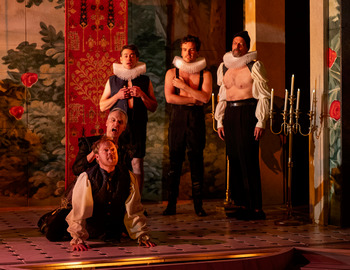
Inspired by the routinely cut induction in which a drunken peasant, Christopher Sly, become the victim of an epic play-within-a-ply prank by a nobleman, Lyons sets up a business run by "The Hostess," who facilitates complex role play scenarios for the ultra-wealthy and influential. In this case, her clients are the tech mogul Lord K, who seems to be the driving force behind the "experience," and his wife Lady K, who has abandoned her own career to support her husband's endeavors. They are joined by Lord B, an aspiring politician who embraces a family values platform, as well as his wife Lady B, an influencer, and her assistant, Chris Sly, who has been roped in at the last minute. All of the information regarding these real-world identities is communicated through a program insert. Although there is a brief opening scene in which these characters appear to read and sign contracts, as well as exchange unseen tokens for costume elements that denote the roles they will play, the scene conveys none of these specifics except in the broadest strokes. It is evident, for example, that Lady B is an influencer and Chris is her assistant, but one would be hard-pressed to recognize her husband as a politician, let alone one with conservative values, and there is no obvious way of knowing that Lady K once had a career she has since abandoned. Thus, the framing device gets off to a shaky start. Complicating this are the choices about what roles the clients will take on and which ones will be played by actors from The Hostess's stables. Lord K, presumably at his own insistence, plays Baptista, the father of both Katherina, played by his own wife, and Bianca, played by Lady B. Lord B and Chris respectively take on the roles of Bianca's suitor (and eventual husband), Lucentio, and Lucentio's servant Tranio, who takes on the role of Lucentio so that his actual master can woo Bianco in the guise of a tutor, Cambio. The other servants, Bianca's other suitors, and most notably, Petruchio are played by unnamed, in-house actors. Because we know nothing about these characters beyond a single paragraph of text provided for each on the insert, these "casting" decisions (and even the motivations for participation for anyone other than Lord K) seem arbitrary, and the execution of the play within the play doesn't shed much light. Occasionally, the clients, in their "real-life" identities, seem to be observing scenes. For example, after Petruchio has dragged Katherina back to his house to "tame" her, Lord K, Lord B, and Chris Sly are outfitted in various flavors of fetish wear, complemented by ruffs. Petruchio abuses them as roundly as he eventually abuses Katherina, and all the while, Lady B (in her Bianca costume) looks on, laughing most of the time, with The Hostess looming behind her. But if this is meant to convey that the publicly prudish politician is consensually kinky in his home life, this is not at all clear from what plays out on the stage. Moreover, Lord K's demeanor suggests he was unprepared for the scene, and Chris Sly, of course, seems to have little choice but to participate. Those particular waters are muddied by the fact that Lord B initiates a kiss with him at the end of the show's first half. Sly certainly seems to welcome the kiss, but there's little way to tell what the character does and does not have the power to consent to. The framing device also compromises the show's pacing at several points, such as the protracted scene where the starved, sleep-deprived Kate succumbing to Petruchio's bullying translates into what seems intended to be Lady K submitting to the actor playing Petruchio. This begins with her licking food from his fingers and ends with the two smearing the food not on her body, but on her dress, leaving the actors to muddle through the tailor scene with filthy hands. And at the play's end, as Kate delivers the famous speech about wives submitting to their husbands (or at least part of it), she holds a microphone and moves so that the cord begins to wrap around her body. This leads into Petruchio approaching and further binding her. Both scenes are awkward and drawn out, detracting from the story, rather than enriching it. But despite the fact that the framing device does not work overall, there are fun elements to it. Both Lady K and Lady B muff their performances early on–Lady K out of seeming annoyance at her husband, and Lady B because she cannot shake off her ever-camera-ready influencer persona. On a related note, the sisters' costumes (design by Kotryna Hilko, who does tremendous work overall) in the early part of the play seem deliberately not quite right, as Kate's deep-red ensemble might have been repurposed from an opera, and Bianca's from any given production of the Wizard of Oz. Moreover, the sights and sounds of the production work well. Jackie Fox's set creates a muraled wall with huge, arched wooden doors breaking up the pale green pattern. This is elevated a few steps above a white tiled floor with black accents, and a red curtain at the top of the stairs, leading down, allows for separation of the action as needed. The lighting by Maximo Grano De Pro and associate lighting designer Sierra Walker also helps to redirect attention as needed, and Ethan Korvne's compositions help the framing device to work in its successful moments. The cast are solid across the board, and it's notable that to a person, their performances are committed and well-executed, even if their characters' motivations are either not apparent or shift too rapidly to be fully comprehensible. Mark L. Montgomery grounds the production in firmly Shakespearean territory with his performance as Baptista. Aided by the most elaborate period costume, Montgomery plays it straight in terms of making it clear that Lord K is serious about the role, and yet, without fail, he finds all the sparkling comedic moments that keep companies and audiences returning to a problematic play. Nate Santana (Lucentio) and Ryder Dean McDaniel (Tranio) make for an an enjoyable pair. Santana conveys the immediate ease that both Lord B and Lucentio feel at the prospect of playing a role. This is effectively juxtaposed to both Chris Sly being eager to make the boss's husband happy and Tranio's over-the-top rendition of a nobleman. Samuel Taylor and Dexter Zollicoffer, as Bianca's suitors Hortensio and Gremio, also show complete command of what's funny in these somewhat confused and confusing roles, and each takes care to establish a distinct character, even as they play with the overlap between the two. Netta Walker is pitch perfect as an influencer with a high adorability quotient, and although the adaptation does not really earn Bianca stealing much of Kate's final speech and delivering it in a rage, there is no fault to find with Walker's delivery of this, nor with her shattered exit as she and Lord B warily lean on one another and she snaps at Chris Sly to follow. On a similar note, Melisa Soledad Pereyra's performance is well done enough that the piecemeal character concept and direction are frustrating. Even when Lady K is resisting playing the part, Pereyra is fiery and funny, and later when she succumbs to Petruchio's abuse, she plays the transformation with an interesting mix of vulnerability, ambivalence, and practicality. Jay Whittaker is a compelling Petruchio. In an interview in the program he notes his frustration with performances of the role that lay the charm on thick and back off the brutality. Certainly he is not guilty of the latter, and as for the former, what he achieves is not charm per se, but a kind of magnetism that does much to make the premise of the adaptation work when it does. As Petruchio's servant, Grumio (as well as the false Vincentio), Alex Weisman's performance speaks to Whittaker's in some interesting ways. Weisman is unrelentingly big and bawdy, and there's a streak of meanness that mirrors Petruchio's darkest elements. The Taming of the Shrew runs through December 14, 2025, at Court Theatre, 5535 S. Ellis Ave., Chicago IL. For tickets and information, please visit CourtTheatre.org or call 773-753-4472.
|