|
Regional Reviews: Chicago Dorian
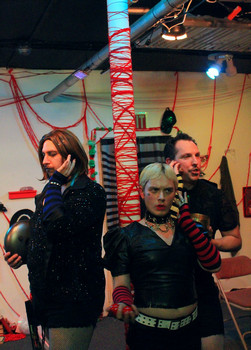
David Zak's tiny Open Space Arts is home to Dorian, a genre-defying, manic, and incredibly creative three-person show that brings new biographical clarity to playwright Oscar Wilde's only novel, "The Picture of Dorian Gray" by blending it with well-known characteristics and events of Wilde's life. Dorian, written by Phoebe Eclair-Powell and Owen Horsley, is a complete triumph in every way. As storefront theaters go, Open Space Arts is one of the smallest: maybe 25 seats with a pillar that separates the audience from the stage. Yes, it does obscure views at times from some seats, but, sitting in the second row with a giant directly in front of me in addition to the pillar, I was not that bothered. The reason for that is the free-wheeling, brilliantly directed and performed ensemble show that never for a second is anything other than compelling. Director Aaron Holland was more than up to the challenges that this play presents, starting with casting. His ensemble of Luke Gerdes, Anthony Kayer, and Brian Kulaga, each of whom plays multiple characters, clearly are having what should be an illegal amount of fun here, as did Holland's set designer, Phoebe Huggett, who chose to create a mostly wide open space (this being my first show from Open Space Arts, I don't know if that is their standard, but it certainly fits) and then decorate its walls with what appears at first to be utterly random objects from props director Marz Allswede that prove useful as the dramatic/humorous play rolls on. Most of these objects are draped with red yarn, which is also wrapped around the pillar and drops like a waterfall from the ceiling before piling up in one corner. The actors are all perfect. Gerdes plays (among other characters) Dorian, a small, attractive, self-absorbed young man who allows his inherited wealth to turn him into a hedonistic "player." Basil (Kulaga), a painter and friend who would love to be more than that with Dorian, shows him a painting he has done of the young playboy that accentuates his youth and beauty. When reminded by Basil's friend Henry (Kayer) that this will fade away with time while the portrait remains beautiful, the vain Dorian makes an offhand wish that his new portrait would age instead of him. (Be careful what you wish for: the painting, hidden away in an attic, becomes, over time, horrifying, its visage affected by Dorian's various sins.) Gerdes also plays Lord Alfred Douglas, who goes by Bosie, the effeminate young man who introduced Wilde to the secret underground of homosexual life in London. It is Bosie's homophobic father, the Marquess of Queensberry, whose written accusation that Wilde was a "posing sodomite" ultimately led to the playwright being convicted and sent to jail. Kulaga is an actor who sinks into his roles, and here he plays two very different key parts. As Basil, the artist, he is fairly stereotypical of what Victorian society thought of gay people, and his unrequited love for Dorian pretty much dominates his life. But he also plays the pugilistic brother of an actress who killed herself as a result of a snub by Wilde, about as different from the genial and inoffensive Basil as it is possible to be, and he is impressive in both parts. Wilde himself (as well as the actress Sybil Vane and Henry, who makes that comment about Dorian and the painting that so shaped the young man's life) is played by Anthony Kayer, and it is easy to believe that he is the quick-witted, defiantly long-haired, everything-but-openly gay bon vivant. His Wilde doesn't blend into backgrounds and doesn't apologize for who he is (even though these characteristics end up with him doing two years at hard labor). Almost all the time–even in court–he presents himself as the droll, brilliant playwright, always going for the quip instead of the serious answer even when it would be much more prudent in the Victorian era to hide his nature. These three actors not only play their parts, but they sing and dance, as well. This is not a musical by any means, but (as though showing off his multi-talented cast) Holland, taking cues from the clever script, keeps the play exciting by doing the unexpected at every turn. There are wonderful anachronistic mic drops (Holland also designed the sound) and a repeated motif where one of the actors (out of the blue) says "Pose!" and all three suddenly look as if they are in Vogue. The play is a visual treat as much as an inspired creation that conflates real history with a masterful horror novel. Behind the scenes, this production is mostly Holland's. Lex Newman's lighting design is limited by the space, but it always strengthens what we see. Holland, though, in addition to directing the play and acting as sound designer, also handled the costumes and the side-wall projections that are fun, but unfortunately from my second-row seat were all but invisible. His costumes, though, are gloriously memorable. Along with pieces stashed all over the stage to signify who the actor is playing at the moment (including a Muppet-like judge that Allswede whipped up from that red yarn pile in an upstage corner for Kulaga to don), the base elements (visible almost all the time) include well-torn fishnet stockings, brightly striped full length gloves, and various black tops. The playful, almost surreal, costuming decisions add to the play's eclectic visual identity. Dorian runs through December 21, 2025, at Open Space Arts, 1411 W Wilson Ave, Chicago IL. For tickets and information, please visit openspacearts.org or call 773-773-7837.
|