|
Regional Reviews: Chicago Eureka Day
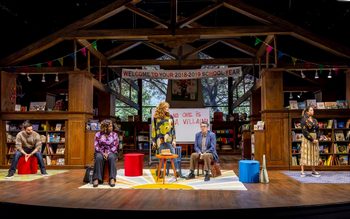
In a lesser hand, or with a lesser director than Lili-Anne Brown, a scene like this might never have worked, with either the comedy or the seriousness of the issue–more than one student is already seriously ill with a highly contagious disease–rendering the other moot. Here, though, it is a major highlight of the play, as some parents online indicate that they don't believe in vaccinations and the rest of the community, in shock, discovers that there are many such anti-vaxxers in their midst. If this had been an in-person meeting, a riot might have broken out. But as it cascades out of control, almost impossibly splitting the audience's focus between the arguments among the board and the outrageous and uproarious chat visible on the screen, Brown shows her great strength in organizing discordant entropy, and Spector finds a way out that preserves at least the possibility of everyone putting all of this behind them for the good of the school. I should make it clear: Eureka Day is not at all a polemic. Nor is it a reflection of post-pandemic hysteria or a comment about RFK, Jr. In fact, the play was first produced in 2017, well before COVID showed everything in it to be prescient indeed. No, this is a play about the way that differences, big or small, can wreak havoc in a populace, and what is a reasonable solution in a situation where people's opinions are adamantly opposed from each other. Does the board bow to the many anti-vaxxers among the parents and keep the school open? Or does it close the school until the problem has passed, possibly even changing its protocols to make school attendance dependent upon vaccination? And what happens if two of the five board members themselves are anti-vaxxers? This is a school community at which, we are informed at the start, every decision of the board has to be reached by consensus. Even one holdout renders it impotent to find an answer. Spector's script and Brown's direction show us the impracticality of this notion, no matter how wonderful it might be as an ideal. Who wouldn't want there to be a consensus about decisions, leaving no feelings hurt? It's lovely as a concept, but this play illustrates its problems and limitations. Conflict avoidance is also lovely, but sometimes things can't be resolved nicely. Spector is careful not to make the anti-vaxxers the villains; in fact, the man in charge of the meetings, Don (PJ Powers), makes a point of writing "No one is a villain" in large letters on the white board. His attempt to use logic to diffuse a highly emotional argument, though, predictably falls flat. But that sign is not the only evidence of Spector's careful balance in this play: the main anti-vaxxer board member, Suzanne (Rebekah Ward), gets the show's single most passionate, sympathetic speech in defense of her position. The other board members are similarly well-developed. Wealthy Eli (Jürgen Hooper) is a man who often is so overwhelmed by ideas that pop into his head that he can't stop himself from interrupting the others to let them know. (He also profusely apologizes every time.) Meiko (Aurora Adachi-Winter), constantly knitting, is anti-vax herself and highly emotional. (She and Eli, both married, are having a clandestine affair.) The final, and newest, member is Carina (Gabrielle Lott-Rogers), a Black woman who has just begun sending her son to the school and ultimately is, in Kipling's terms, the one "who can keep (her) head when all about (her) are losing theirs"; she becomes the soul of the board through all of the ugliness. Each of the actors is excellent in these roles, though Ward and Lott-Rogers, yin and yang among the characters, are the most powerful–in very different ways. This is all played out on one of the best unit sets you are likely ever to see. Collette Pollard's rendering of the school's library, where the board meets, is simply perfect, as are the properties and set dressing by Amy Peters. As soon as you walk into the theater, this large, beautiful, meticulously designed structure shines as a fully realized, warm, and welcoming space. As a retired teacher, I can easily say I'd love to work there (if they could figure out how to deal better with conflicts). You are unlikely to find a more totally fabulous, funny, and challenging way to start a new theatre year. TimeLine Theatre Company's Eureka Day runs through February 26, 2026, at the Broadway Playhouse in the Water Tower Place building, 175 E Chestnut St, Chicago IL. For ticket and information, please visit timelinetheatre.com.
|