|
Regional Reviews: Chicago The Dance of Death Also see Karen's review of The Irish... and How They Got That Way and Richard's review of Birds of North America
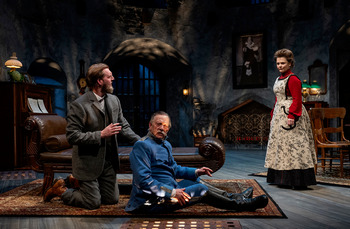
McPherson's take on the text is notable not just for how it adeptly "translates" language that is a century and a quarter old, but also for its laser focus on Edgar and Alice. The two are, of course, unquestionably what Strindberg is most interested in, but McPherson strips out the brief appearances by other characters, and to a certain degree strips the character of Alice's cousin (and lover) Kurt down to his essentials. Without diminishing the importance of the role, McPherson homes in on Kurt as a catalyst for the latest iteration of Alice and Edgar's dance. The approach seems rooted in the somewhat mysterious early dialogue between Edgar and Alice that indicates that the two have lured unwitting third parties into the middle of their game of mutual destruction on more than one occasion before. McPherson expands the conversation a bit and places an explicitly sexual spin on it, and yet the direction and actors' choices convey that whatever sex there might or might not have been was hardly the biggest turn on for either Edgar or Alice. It's a remarkably interesting approach that goes a long way toward reconciling the disparate tones of the play's two halves. Strindberg's claustrophobic rumination on cruelty and wickedness, as well as McPherson's particular view of the text, is well-supported by Collette Pollard's scenic design. The curved walls of the fortress ascend to the very top of the space, towering over the audience and creating the feeling that they are hemmed in by the space, just as the characters are. The lighting design by Lee Fiskness coaxes haunting faces out of the crumbling stone, and dramatic shafts of light shooting up through the grates in the floor evoke the souls of the condemned, reminding the audience that this home is quite literally a prison. Rick Sims' sound design amplifies the isolation of the island, the fortress, and the relationship between Edgar and Alice. Sims never seeks to make the sound design seamless. For example, when the music from the party at the nearby doctor's house becomes audible, we have the sense that Edgar and Alice have simply turned up the dial on long-standing grievances to feed the immediate conflict between them. In effective contrast, Sims transforms what Strindberg renders as a brief, possibly hallucinatory conversation between Edgar and a poor old woman into echoing, mostly unintelligible whispers calling out to Edgar from beyond the grave that suggest the "freedom" the main characters see in death is ambiguous at best. Sims' choices in the original music are also interesting and enrich the visual aspects of the staging. As one might expect, harrowing strings chime in as the violence, both physical and psychological, escalates between the characters, yet the music between scenes, and especially at the very end of the play, is comparatively sedate, emphasizing the tortured, cyclical nature of the dance. Jeff Perry's performance as Edgar anchors the production. The text calls on the actor playing this role to swing wildly from bombastic speech and frenetic movement to catatonic weariness and childlike fear. Not only does Perry fully and effectively realize these extremes, he creates naturalistic throughlines between the two, and in doing so highlights the fact that McPherson's language truly honors the emotional and psychological core of Strindberg's original. Kathryn Erbe complements Perry with a performance that is, for the most part, maddeningly unflappable. Erbe makes sure the audience can see Alice flip emotional and psychological switches as she evaluates what kind of performance will best meet the moment and accomplish her goals (such as they are, given the patterns the characters are locked into). Erbe takes this beyond a superficial focus on Alice's past as an actress, digging deep into her active decisions to trap and manipulate the play's men. Although one can see how this approach, in less skilled hands and under less thoughtful direction, could slip into simplistic misogyny, Erbe's layered performance effectively challenges this. Given how tightly intertwined the performances by Erbe and Perry are, as well as McPherson's streamlining, Cliff Chamberlain has his work cut out for him finding points of entry into the dynamic. In the early going, the performance is subdued to the point that it might be lost in the fiery back-and-forth between Edgar and Alice, but Chamberlain builds and builds, and the approach repays patience on the part of the audience, becoming something quite remarkable when taken as a whole. The Dance of Death runs through March 22, 2026, at Steppenwolf Theatre Company, 1650 N. Halsted St, Chicago IL. For tickets and information, please visit steppenwolf.org or call 312-335-1650. |