|
Regional Reviews: Chicago The Merry Wives of Windsor Also see Christine's reviews of Ma Rainey's Black Bottom and The Sugar Wife
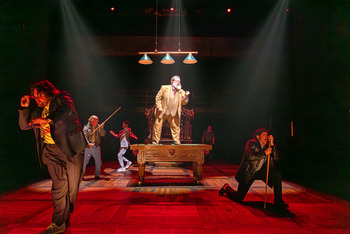
In his program note, Breen indicates that this endeavor began with doing away with versions of the play that cut and reworked various elements and instead returning to the First Folio to take Shakespeare's efforts and intentions seriously. This isn't to say that some of the fat has not been trimmed from the text in this version, but certainly Breen includes rarely seen interactions and dialogue, and still offers a well-paced story that feels less disjointed than other productions, yet is by no means bloated, nor does its run time feel over long. The thrust stage in CST's Courtyard Theater is well suited to a rapidly shifting story with a great deal of running around, and the scenic design by Max Jones builds on this strength. The Pages' proper suburban home is signified by a simple front door, draped with flowering vines, that can be flown in and out. The wonderfully tasteless, but opulent, interior of the Fords' home is simply represented with a white bearskin rug, a white couch with a gold metal frame, and an eyesore of a sculpture perched on a tacky glass-and-gold end table. As this is the setting for the play's most intimate, yet farcical moments, Jones' design also makes use of a balcony that runs the width of the stage that actors access via stairs on either side. The Garter is a pointedly British sports pub that simply rolls in from up center and adds a billiard table, and a brightly lit white faux marble counter suggests that Dr. Caius is the cosmetic surgeon to everyone in Windsor. Jones pays equal time to each of these locations, no matter how fleetingly they are employed, and Marcus Doshi's lighting works flawlessly to underscore the message that Windsor is a real, though heightened, community. The original music and sound by Lindsay Jones is jazzy and heavy on the baritone sax. In practical terms, this facilitates shifts from location to location, but the music also supports the show's playful, larger-than-life vibe. Jones also serves as the costume designer. Unsurprisingly, this aspect of the production is pitch perfect as well. The childless Mistress Ford is all animal prints, tight-fitting pants, and off-the-shoulder sweaters, whereas Mistress Page reads as the affluent suburban soccer mom. Master Ford lives out his midlife crisis in disguise as Master Brook, who sports a leather jacket, toupee, and wire-framed dark glasses. Jones also goes big with the many different costumes for Caius and Sir Hugh Evans. Caius is always over the top and high end, whereas Sir Hugh is hopelessly, nerdily Welsh. The choices for these two characters are important in that they do not at all shy away from broad comedy, but neither do they compete with Falstaff's timeless fat-cat look which features three-piece suits, complete with gold watch chain, and silk smoking jackets. The performances are fantastic across the board. Although the show is theoretically Falstaff's, Breen anchors this production in the wary friendship between Mistresses Page and Ford, as well as the machinations of Mistress Quickly. As Mistress Page, Ora Jones is a harried mother and under-appreciated wife, but every inch a person in her own right. Her controlled body language and stony glares play beautifully against Issy van Randwyck's mincing, energetic persona. Like Jones, van Randwyck effortlessly plays up the cougar stereotype while still creating a quick-witted, lived-in character who reads as both believably weary of her husband's ridiculous jealousy, yet comfortable and invested in her marriage. Breen's direction is impressive in weaving together the performances of Chiké Johnson (Master Page), Timothy Edward Kane (Master Ford), Nate Burger (Dr. Caius), and Nick Sandys (Sir Hugh Evans). Each of these actors contributes to the sense that these men approach every conflict and situation with deadly seriousness. This approach lets Shakespeare's comedy speak for itself, yet each of the actors adds a unique facet to these absurd situations. In his high-end track suit, Johnson conveys Master Page's aging cool and bewilderment as to how he finds himself entangled with such a decidedly uncool collective. Kane, in contrast, plays Ford as barely clinging to sanity from the beginning, yet he still believably heightens, then hilariously deflates in an instant as the Merry Wives disclose their plot against Falstaff. Burger and Sandys deserve particular credit for the broad comedy that forms the foundation of their performances, as well as the fact that the two successfully keep to their own comedic and melodramatic lane. Too often, stagings of the play lapse into competition and one-upmanship rather than collaboration, and the rapport these two actors build is the most impressive example of how this approach to the text distinguishes itself. Jason Simon's performance as Falstaff both rests on and amplifies the other strengths of the production. Simon's early swagger sets up the satisfying unraveling of the character, and as he delivers his final lines from an open grave, Simon captures how irresistible the character is, despite his utter corruption. One of the interesting aspects of Breen's fresh approach to the play is the reality that the text has Mistress Quickly acting in isolation to a large degree. Nancy Voigts is terrific in the role. She approaches as a highly capable woman who is no-nonsense on the surface, but has not lost her love for mischief, even though she has managed to extricate herself from Falstaff's brand of chaos. Without wishing to imply a knock against Breen's fidelity to the text, Voigts' work makes one crave a bit more interaction with the other characters. The contributions of the supporting players cannot be overstated here. Paul Oakley Stovall is effectively overbearing as Shallow, which plays perfectly in opposition to the fastidious, unbearably awkwardly portrayal of his kinsman Simple (Diego Sanchez-Galvan, who is hilarious). As Bardolph, Teddy Gales reads as his own hot mess of a man, but also a kind of Falstaff waiting in the wings. Colin Huerta's Pistol and, at this performance, Tyler Ravelson's Nym effectively offer nods to the old gang without grabbing too much focus in a story that has, in many ways, moved on from the other Falstaff plays. As the Host of the Garter, Bret Tuomi blends level-headed exasperation with his tenant with complete inability to resist the gravity of Falstaff's nonsense. Breen unapologetically backgrounds the story of the young lovers, Anne Paige (Olivia Pryor) and Fenton (Sam Bell-Gurwitz). In doing so, he makes the convincing case that Shakespeare himself fully intended this. Nonetheless, the two actors make a lasting impression in their brief moments in the spotlight. Pryor, in particular, has clearly studied the performances of Johnson and Jones and blends the cool of the former with the haughty intelligence of the latter to create a young woman coming into her own. Bell-Gurwitz has less to work with, and yet he makes it clear to the audience that this is the one man in Windsor who appreciates Anne for her character, rather than her fortune, and thus is the one man in Windsor worthy of her. The Merry Wives of Windsor runs through May 3, 2026, at Chicago Shakespeare Theater, Jentes Family Courtyard Theater, 800 E. Grand Avenue, Chicago IL. For tickets and information, please visit chicagoshakes.com. |