|
Regional Reviews: Chicago Windfall
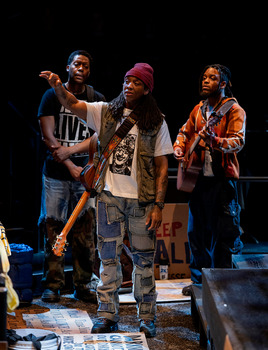
The play dips in and out of reality as Henri "Mr. Mano" Tamaño alternately confronts and denies the apparent truth that his estranged child, Eli, has been "harmed" by the city-state in the course of occupying a vacant lot outside a Black site they have reason to believe is the last-known location of a neighborhood childhood who has been disappeared. Throughout, Mano argues the with the ghost of his adopted son, Marcus, who hounds Mano to take the money on offer from the city-state to preemptively make the problem of Eli's apparent death disappear. Three "apparitions" from shadowy institutions representing the city-state join Marcus in, at first, trying to reason with Mano, then proceeding to threats that escalate from the economic to the existential. As Mano remains largely fixed within his interior world, Marcus appeals to the audience for help in convincing him to take the money and escape from both the city-state and a landscape shaped by self-recrimination. Similarly, Eli and their fellow activists, Cori and Brother #1, not only tell the story of the structural violence that has led their generation to use the lessons of their elders in new ways to break out of the cycles of harm and hopelessness, they encourage the audience to stomp, clap, and shine their cell phone flashlights as part of an ongoing, community-empowering ritual. The production design is key to realizing the power of McCraney's play. The scenic design by Andrew Boyce is deceptively simple. Boyce represents Mano's South Side home, the putative primary setting, with a few pieces of mismatched furniture and half a dozen or so houseplants. But true to McCraney's determination to write for the space, in reality, the setting is the erratically transforming world brought into being by the actions of Eli and their fellow activists. Boyce conveys this by tucking practical items from Eli's encampment, as well as handmade protest signs, haphazardly under the low stage and all along its perimeter. Boyce peppers the uppermost reaches of the theater with posters advertising community services (hair-braiding, beginner guitar lessons, face-painting, and so on), as well as familiar messages of protest and empowerment. As Eli's legend grows, the gap between the encampment and Mano's home is closed, as Block and Neighborhood signs appear throughout the upper part of the theater, plastered over with pro-Eli stickers and signs. Qween Jean's costume design mirrors this fluid movement between the real and the hyper-real. Marcus and Mano are outfitted in what amounts to the uniform for men of their respective generations. First Lady, Miss Second, and The Last One, all played by the same actor, blur the lines between character, stereotype, and archetype, whereas as Cori and Brother #1 take on almost supernatural visual signifiers as Eli's lieutenants. Jason Lynch's lighting and the sound design by Willow James, on the whole, contribute to the immersive success of the show, although it seems likely that these elements will undergo further refinement throughout the show's run. At the performance I attended, there were a handful of moments when the interplay between stage and house lights seemed slightly mistimed, and the sounds of the wider world are not quite as fully realized as they seem intended to be. In terms of performances, Michael Potts is both charismatic and heartbreaking as Mano. His performance commands the audience's attention and never relinquishes it. From the first moment he enters, carefully and desperately dictating a text to Eli, begging them to come home so the two of them can work things out, to the blend of aching remorse and building fury in his final monologue, Potts breathes painful, hopeful life into the character. Glenn Davis's performance as Marcus is a true give and take with Potts. Neither man is entirely legible without the other, yet Davis conveys Marcus's learning and growth, even as he projects rigidity and pure pragmatism. Alana Arenas has the particular challenge of speaking for the Kafkaesque architecture of the city-state. This begins with the stern but light touch of First Lady, a schoolteacher turned bureaucrat for the unnamed (and unnameable) department, proceeds through the exaggerated Latina stereotype, Miss Second, and culminates in the dark, virtually inhuman Last One. Through all three incarnations, Arenas communicates that each character is drawn to the very human squabbles born of Mano's non-linear engagement, yet ultimately bound to reinforce the cruelty of the structures they are complicit within. Jon Michael Hill and Namir Smallwood tread similar lines in their dual roles as Cori/Nurse and Brother 1/Officer, respectively. As Eli's closest compatriots, Hill and Smallwood ground both the activist movement (and, by extension, Eli), as well as the institutions of the city-state, in reality and the actions of individual people. The two exhibit fear and falter, yet step up both when Eli calls them to and when circumstances demand it of them in the wake of Eli's disappearance. As Eli, Esco Jouléy is as captivating as Potts. They fill the space with their larger-than-life personality, yet their performance never sacrifices the very human elements of Eli that are critical to keeping the story from wandering into purely mythic territory. The work between Jouléy and Potts near the play's end is heartrending and enlivening in equal measure, underscoring the fact that everything the audience has witnessed and participated in is true, regardless of what elements are or are not factual. Windfall runs through May 31, 2026, at Steppenwolf Theatre Company, Ensemble Theater, 1650 N. Halsted St., Chicago IL. For tickets and information, please visit steppenwolf.org or call 312-335-1650. |