|
Regional Reviews: Chicago Loki: The End of the World Tour Also see Christine's review of The Movement You Need: An Evening with Brendan Hunt
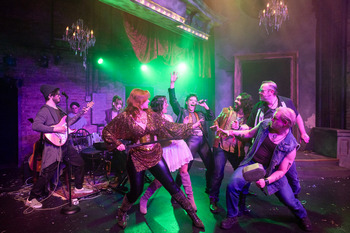
The story's throughline centers around Loki's decision to leave Jotunheim for Asgard, as he's grown tired of the cold. The pantheon is more or less evenly split when it comes to this disruption, with Thor and Freya expressing wariness and low-key hostility, Sigyn feeling instant attraction toward the newcomer, and Baldur providing de facto support for Loki's presence via his neutrality. Although Odin is preoccupied by the idea of Ragnarök, he finds Loki appealing and ultimately swears him to blood brotherhood. The bromance turns sour, though, when Loki unpacks his baggage in the form of three of his children: Hel (queen of the realm of the "dishonorable" dead), Fenris (the wolf), and Middy (the Midgard Serpent). To varying degrees, all the other gods, save Baldur, are disgusted and unnerved by "the kids" and Loki's deep attachment to them. Although Odin's superficial attachment to the letter of the law regarding honor, truthfulness, and blood brotherhood keeps them safe (albeit far from accepted) for a time, when Loki and Sigyn marry, Odin takes the opportunity to banish the three, subjecting each to the torments detailed in the Edda. Loki, outraged by this intolerance for difference on the part of the "good" guys, sets about pitting the various parties against one another and, in his despair, bringing about Ragnarök. Although the show is arguably a bit too long, it's hard to know what might be trimmed, as the choices the adaptation makes are routinely interesting. For example, Calvit takes the view that Freya and the gold-obsessed Gullveig, a mysterious figure mentioned only once in the Edda, are one and the same. This introduces a secret that Freya harbors and Loki overhears and uses as leverage against her. And when it turns out that her secret was no secret to Odin, Freya finds that she has every reason to act against him. Similarly, the decision to include the conception and birth of Sleipnir offers an opportunity to lean into Loki's shapeshifting and gender fluidity, as well as to underscore Odin's hypocrisy when he is charmed by the "gift" of the "pony," rather than horrified by the half-giant monster. Likewise, although the inclusion of Thrum and the theft of Thor's hammer might seem to be a distraction on the surface, in reality, the events that unfold within this story shed light on Loki's character and complicate the relationship between Thor and Loki in productive ways. True to the show's advertising, the songs lean toward the rock end of the spectrum, with ballads and more "traditional" musical theatre numbers mixed in quite skillfully. Howe's influences and inspirations are clear, but nothing sounds like a knockoff: The songs are catchy, the lyrics are clever, and the show is original cast recording ready. Moreover, the conceit of the Norns serving as the three-person band on guitars, bass, keys, and drums works very well both conceptually and within Lifeline's relatively small space. Lindsay Mummert's scenic design also makes good use of that space. The overall vibe is of a classic theater that is falling into ruin; above the band, upstage right, is an askew chunk of ornate proscenium and a swag of red velvet curtain. This is underscored by a tall, wide threshold upstage left that's slightly elevated above the stage floor, and a decaying chandelier above this part of the stage. Using a simple sheet of heavy plastic in the doorway, a set of chains attached to the railings that flank the entrance in the middle of the audience, and a set of rolling construction stairs, Mummert not only solves the practical issues of representing the prisons for Loki's children, but cultivates the show's conceit that the audience is also in on the drama. On a related note, because he band is upstage right, there's a certain amount of peril inherent in the equation of amp cords and cast members using the entrance in this area, but the fact that the characters are aware of and interact with the Norns helps to ease this. The lighting design by G. "Max" Maxin IV both smoothly directs the audience's attention around the various physical spaces and brings on the necessary supernatural elements. Emily Hayman's sound design and the music direction by Howe show careful attention to the size of the space and do good work choosing the moments to let the sound be overwhelming. Of particular note is the fact that even with an unshielded drum kit, the instruments never overwhelm the voices, yet the choice allows for the drummer to pull out all the stops during the final battle. Aly Amidei's costumes are also testament to the care and skill that Lifeline puts into productions at the scale of its company. Those who are costumed more or less "out of closet" each have distinct elements that speak to their characters, yet still gel with the overall look of the ensemble. This gives Amidei the latitude to focus on flashier looks for Loki and Freya, for example, to anchor the visuals in the mythic. The performances are great, both vocally and dramatically, starting with Jack Chylinski. Their Loki has charisma for days, and yet the character is so comically aggravating in his mischief that the reactions of others to the newcomer seem rational and earned. Chylinski's voice and physicality are excellent, and they don't sacrifice Loki's genuine emotion to the comedy and mischievous fun. Their performance goes a long way in further elevating the strong foundation of the show itself. Janelle Sanabria is also outstanding, both vocally and dramatically as Freya. Sanabria has the powerful voice the role calls for and she eagerly and adeptly explores the rich role for Freya that Calvit's book provides. Frey's determination to be remembered as a warrior, and her ultimate embrace of her true identity as Gullveig are compelling and moving in Sanabria's hands. As Baldur, Peter Gertas is an interesting complement to Chylinski's Loki. His demeanor is calm enough to be maddening in its own right, particularly when he tries to maintain his peace-love-and-understanding mindset in the face of truly horrible events. Like Chylinski, Gertas deserves credit for underscoring how this story, which is superficially about a simplistic battle between "good" and "evil," resonates in today's world. Scott Danielson's performance as Odin is similarly important. Danielson's voice and presence are perfect for impressing the audience with that Allfather energy from minute one, yet Danielson also lets the cracks show in this rigid, out-of-date approach to the end of the world. Early on, Odin's attraction to Loki and his black-and-white decrees seem defensible, at least to some degree, but Danielson skillfully hollows out the character as the story moves toward its fated conclusion. Thor (Keenan Odenkirk) and Sigyn (India Renteria) are definitely supporting characters, but both are well-played. Odenkirk is an appealing lunkhead as the god of thunder, but not just a lunkhead. He finds the opportunity adds depth by playing up Thor's petty jealousy of Loki as well as the confusion that stems from his unexpected and unwanted attraction to the god of mischief. India Renteria has a bit less to work with, as Sigyn is rather underwritten, but her voice is strong and she does well fleshing out the ethereal, somewhat stereotypically feminine character. Grace Reidenauer (Hel), Anthony Kayer (Fenris/Thrym), and Avery Thompson (Middy) form an effective trio as Loki's children, although the songs for these characters are somewhat rougher than the rest of the show. All three are strong singers and good actors (Kayer, in particular, has a ball in the campy number as Thrym), but both musically and dramatically, this is an aspect of the show that likely needs some refinement. Finally, Kelan Smith (Norn 1 and the co-music director, who also plays bass and guitars), Kara Olander (Norn 2, keys and bass), and Alek Boggio (Norn 3, percussion and bass) are simply terrific as both musicians and actors. The Norns provide commentary on the action and occasionally interact with the characters, playing an important role in stitching the various stories together. Loki: The End of the World Tour runs through June 14, 2026, at Lifeline Theatre, 6912 N. Glenwood Ave., Chicago IL. For tickets and information, please visit www.lifelinetheatre.com or call 773-761-4477. |