|
Regional Reviews: Chicago Deserted Also see Seth's review of Leopoldstadt, Christine's reviews of Catch as Catch Can and Untitled Vampire Play, and Kelly's review of Damn Yankees
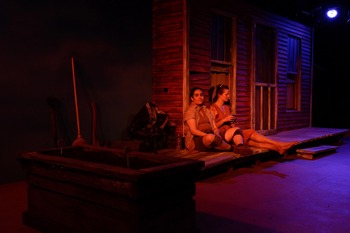
In the uncomfortably near future, Jodie and Emma have won a grant that offers them soil and seeds, with the intention that awardees will grow food in a world where most either survive on canned goods or starve, and in so doing, help to fight desertification brought on by climate change. Although Cam, a representative of the grant organization, indicates that their proposal won courtesy of its hopeful tone, it soon becomes clear that for the couple, the move to the farmhouse that was once in Jodie's family is born of desperation. Over the course of the play, we learn that Jodie had worked as a psychiatrist, but some work-related incident led to a breakdown. This, in turn, motivated Emma to buy into Jodie's fantasies of a simpler life, closer to the land, where they can feed their community. The pair receive an almost immediate reality check, however, in the form of a nameless "neighbor" who becomes obsessed with the idea that Jodie has promised to "share." Moreover, Cam's initial visit to check on Jodie and Emma's early progress reveals that the granting organization has little idea of the circumstances the couple is facing and how improbable it is that they will in any way "succeed." As phone calls continually come in from faceless individuals who want to buy the soil and seeds, Emma becomes increasingly paranoid that someone will try to steal from them. More legitimately, she is concerned about Jodie's safety and well-being after the neighbor arrives in the middle of the night, obsessed with Jodie's off-handed promise that she and Emma will eventually share with the "community," and holds a knife to Jodie's throat. Emma rashly insists that they sell some of their winnings to buy a shotgun to protect themselves. Jodie continues to unravel, and the neighbor continues to menace them until a final, bloody confrontation leaves the neighbor dead, Cam leaving, never to return, and the two women completely isolated, but seemingly reconciled and riding an upswing of hope once more. In the broad strokes of this plot, there is a workable, compelling story. But what actually plays out is largely the same conversation between Jodie and Emma, one that hints at who the characters are and what has transpired to bring them to this place, but never really develops them. Jodie is inert and her affect is completely flat as she watches the neighbor obsessively dig in and eat the dirt containing the seeds they've just planted, as well as her complete disengagement (or even dissociation) while Emma uses the shotgun to threaten a hiker who has gotten lost and was hoping for directions. This might suggest that the "incident" in her job was very serious and traumatizing, or it might reflect her detached "fix it with meds" approach to serious mental illness. We know even less about Emma. If she had a job in the city, we never hear about it. Various things hint at her physical frailty (e.g., she uses an inhaler and she has serious trouble moving a pair of stones they are using to weigh down tarps, but Jodie lifts these easily), but this never really seems relevant. Moreover, at the end of Act I, the two have a highly physical fight in which Emma holds her own. Thus, the idea that she is unwell reads as an inconsistently deployed plot device to sell the idea she will not be helpful in the hard work that needs doing to make this endeavor succeed. Rather than using the dialogue to gradually flesh out these two, the play instead has them constantly embroiled in the same conversations. Each is inclined to try to sacrifice their portion of their limited supplies of water and canned goods to the other. Jodie wants to protect the (sometimes) frail Emma, and Emma both objects to this coddling and is fixated on the idea that harm might come to Jodie. Jodie treats Emma's obsession with protecting their winnings as paranoia (and, indeed, it is not clear why Emma is obsessed to the point of destroying their landline phone to get the calls from would-be buyers to stop), despite the fragility of the endeavor and the fact that Jodie knows full well that the neighbor's erratic behavior is a threat to it. There's also a lack of clarity of intention in the show's casting. Emma reads as clearly white, both as a character and in terms of the actor's appearance. The actor who plays the neighbor appears to be white as well (though the character's erratic behavior seems detached from any familiar part of the real-world social fabric). The actor who plays Jodie is Latine, but it is not clear whether or not this is intended to be true of the character or, if it is true of her, how much that has informed Jodie's experiences. Both Cam, the representative from the granting organization, and the lost hiker are played by Black actors. This potentially sets up very interesting identity-based dynamics. Cam's performatively upbeat demeanor and condescension born of her complete ignorance of what Jodie and Emma are confronting are attributes that are so often associated with well-meaning whiteness in the real world. The apparently privileged Emma and Jodie bristling under the scrutiny of a Black woman might be an interesting dynamic, but neither the play itself nor the direction makes this clear. More troubling is the lack of clear intention in the interactions with the lost hiker. This character enters the story as both Emma and Jodie are at the height of their madness. While Jodie stands off to the side trying to calm herself with breathing and movement, Emma levels the shotgun at the hiker and pursues him around the property as he struggles to explain how he wound up lost in this remote area. The dynamic of a white person interpreting a Black man out in nature as a threat (and preparing to act on that "threat") is harrowingly familiar, but there is no clear sign that the play knows this. We later learn that Jodie, unbeknownst to Emma, has not loaded the gun, but even if the audience accepts, in retrospect, that Jodie knows there is no "real" threat, neither the hiker, Emma, nor the audience knows this in the moment. Thus, Jodie's persistent sympathy for their "hungry," violent neighbor sits very uneasily alongside her complete detachment from the situation with the hiker. Whatever the play's flaws, Redtwist's production is well done, particularly in a challenging space. The theater is long and narrow and the audience is seated on three sides. Eric Luchen's set design captures the desolate, run-down vibe of the world Jodie and Emma inhabit. The dusty, dilapidated red house consumes most of the length of the stage, and much of the action takes place on the narrow, sagging porch in front of it. One raised bed is downstage left and the other is perpendicular to the house, stage right, which facilitates blocking in such a way that no part of the audience is left straining to hear or see for long stretches of time. Seojung Jang's lighting design captures the suffocating heat of the physical and emotional environment. The design also moves scenes from day to night and back again, offering some subtle relief to a play whose pace tends to lag. Natalie Shoch's costumes also offer smart, subtle touches that help to compensate for the lack of forward movement in the story. Emma's sundresses and bandana have a self-conscious, role-playing vibe, whereas Jodie's apparently practical clothing and gear have brand spanking new touches that hint at the fact that she, too, is playacting. Moreover, as things unravel, Jodie's clothing echoes that of their neighbor. Schoch also takes care with Cam and the hiker, ensuring that they both look bright, polished, and completely apart from the "desertified" world of the main action. One element of the production that doesn't quite work is the insertion of music. Autumn R. Dancy is credited as the sound designer, and the cues that are clearly meant to be part of the narrative are well-done and make important contributions to the atmosphere of tension and paranoia. But, as with other aspects of the direction, the intentions are not always clear when snippets of music break through. The performances are, overall, good. Macaria Chaparro Martinez (Jodie) and Hannah McCauley (Emma) do manage to lay the foundation for a warm, engaging relationship, even if the unevenness of the play itself doesn't provide the material to allow that to fully develop. McCauley is particularly good at traveling down the path of horror, as Emma swings between overt madness and unnerving calm in the wake of violence. As the neighbor, Emma Mansfield is both mad and maddening. Mansfield is ferocious and invasive and like McCauley, they strongly contribute to the success of the play as a horror piece. Shenise Danyél is a standout as Cam. Although the role is certainly supporting, Danyél is game to embody the entirety of the urban world that still exists in a state of denial. Late in the show, she really excels as Cam's pleasant mask slips and we see the character's naivete and disillusionment. It's a brief scene but, thanks to Danyél's skill, satisfying in a way that much of the rest of the play isn't. Similarly, Dontaye Albert offers a performance as the hiker that is strong enough to earn the place of a narratively questionable scene in a play that could likely do with some trimming and tightening up. Albert sells wistful self-involvement that still has some charm in it as the character reflects on a break-up and the ill-advised decision to try to reconnect with nature. Deserted runs through August 2, 2026, at Redtwist Theatre, 1044 W. Bryn Mawr, Chicago IL. For tickets and information, please visit RedtwistTheatre.org. |