|
Regional Reviews: Chicago Suffs
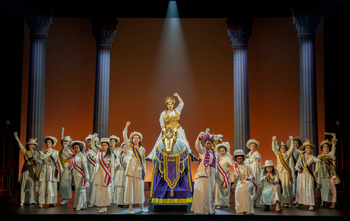
Taub picks up the thread of the journey toward the Nineteenth Amendment in 1913 on the eve of Woodrow Wilson's first inauguration. Although Carrie Chapman Catt is well aware that the struggle for suffrage (for some) has been in progress for sixty years, she remains committed not just to the cause, but to the tactics of respectability instilled in her by her late mentor, Susan B. Anthony. The much younger Alice Paul blows into town to urge Carrie, the woman whose academic and professional trailblazing inspired her own career, to shake up the attitudes and approaches that Paul sees as having stalled the movement. Carrie explains, in the condescending tone that seems inevitable between generations of activists, that their cause is doomed unless they play things safe. When Alice's relentless fire gains critical mass and results in a splashy and largely successful (again, for some) March on Washington, Carrie seeks to rein the youngsters in by offering them both funding and their own committee within the National American Woman Suffrage Association (NAWSA). This arrangement works for a time, but as the U.S. entry into The Great War looms, and Wilson's prospects for a second term with it, the movement fractures. Alice garners backing of splashy divorcée Alva Belmont to form the National Woman's Party, and Carrie stays the course, holding out for tea with the president. With the generational divide established, Taub primarily focuses on the younger generation through its losses and hardships through to the eventual ratification of the Nineteenth Amendment, an accomplishment for which both factions are eager to claim credit. Taub's interest in generations cuts through a complex story, one that someone creating a show will inevitably have to simplify. The choices that Suffs makes are largely successful in musical and narrative terms. The first number ("Let Mother Vote") is pointedly old fashioned, a choice well-punctuated by the deliberately stiff and mannered choreography (Mayte Natalio). The show then contrasts this with the much more dynamic and fluid music, lyrics, and movement in "Find a Way," whereas the generational styles mix and mingle in numbers like "Great American Bitch" and "If We Were Married." Paul Tazewell's costumes also slot in beautifully here, as he carefully and literally uniforms the older generation (though the costumes Ida B. Wells rightly stand out) and seeds intriguing diversity (particularly in hats and hairstyles) for the younger generation. The young Phyllis Terrell, as the only Black woman of the younger generation, is costumed much more like her well-known mother, telling a different tale of respectability for the community she comes from. But for all its success as a story and as a show, Suffs doesn't necessarily satisfy politically. Black suffragists and political activists are present in the show, and Taub takes care to note that both generations of the movement are all too ready not only to shy away from race issues, but capitulate to racist factions within the movement. But Ida B. Wells and Mary Church Terrell are certainly back-burnered (though to Taub's credit, the show avoids homogenizing the attitudes and preferred strategies of these women). Similarly, Ruza Wenclawska's socialist politics and the issue of immigrant women and the poor run the risk of coming across as inclusion window dressing, rather than something Taub was committed to making integral to the show. Overall, the scenic design (Christine Peters, with original Broadway scenic design by Riccardo Hernández) supports Taub's big-picture vision. The design emphasizes looming, shuttered structures in dark wood that glide in either to shelter the women as they do their work or close off spaces to them. These floor-to-ceiling scenic elements also change the depth of the stage to facilitate intimacy or convey the kind of chance meetings that can and do become politically charged. The lighting design by Lap Chi Chu creatively incorporates flashbulbs in a way that helps to compensate for some of the political superficiality. Each time a woman (or an uneasy pair or grouping of them) freezes for the camera, the audience is reminded that what we know of these women has been heavily curated by a hostile media and a society that once insisted on hyphenating women and minorities out of history and society (and that now resists even that as some kind of "special treatment" that siphons something away from the privileged). One intersection of the lighting and scenic design that doesn't quite work is the use of a bare cyc upstage that is drenched in color at various points. In some cases, this facilitates a slow-motion/silhouette effect that might have had greater impact if used in smaller doses. At other points, though, it seems to stand in for absence, as during the "Young Are at the Gates," when we get no sense of the events unfolding immediately in front of the White House. There is no fault to find with any of the performers. As Carrie Chapman Catt, Marya Grand is all graciousness and timid movements until Alice Paul and the next generation push every button she has. Grand is a gifted singer and equally capable actor who maintains sympathy for a character that could easily become a rigid stereotype whose disappearance from the political scene would go unmourned. Maya Keleher is a worthy foil as Alice Paul. In the early going, it seemed as if Keleher might have gone somewhat overboard with her intensely physical, emotionally heightened contrast to Grand's Catt, but the performance pays off, as Keleher distinguishes between Alice's public and private personae, and as the relationship and rivalry between Paul and Catt builds. As Mary Church Terrell, Trisha Jeffrey offers a productive alternative to Catt's version of respectable, "get along" femininity. Jeffrey infuses her character with joy, but also with fire as Terrell grooms her daughter Phyllis for participation in the movement and butts heads with her friend, Ida B. Wells. The light-heartedness of Jeffrey's performance speaks in interesting ways the steely, rather subdued rendition of Wells by Danyel Fulton. Fulton has true presence and offers a performance that certainly makes one wish that the role were not so underwritten here, but there's more than a hint of quite understandable despair in her approach to the role, which helps to offer some depth to the show's politics. Monica Tulia Ramirez is a standout as the sultry, charismatic Inez Milholland. Ramirez's voice is particularly deep and rich, which makes a wonderful contribution to group numbers. Ramirez also has a magnetic physicality that makes her a believable warrior queen. In a smaller role as Alva Belmont, Laura Stracko makes similar contributions, but puts her own stamp on this particular feminine archetype. Livvy Marcus is sweetly nerdy and charming as the group's secretary, and it's to Marcus's credit that she blends timidity, intelligence, and fierce determination into a believable character, rather than a stereotype. Moreover, the work that Marcus does opposite Brandi Porter (Dudley Malone, elevated in the show to Wilson's Chief of Staff) rewards the elevation of what would typically be a romantic B plot. Porter, for her part, has excellent comedic chops and plays very well opposite Merrill Peiffer's Wilson. Peiffer, who was covering the role usually played by Jenny Ashman at this performance, clearly reveled in playing Wilson's politically expedient thickness and lent a necessary troubling undercurrent of menace to the role as well. Gwynne Woods has a particularly sweet voice and clear enough dramatic ability that one wishes that the character of Lucy Burns had a chance to develop beyond Alice's oldest friend and most stalwart compatriot. On a related note, Joyce Meimei Zheng has tremendous appeal in the equally appealing role of Ruza. Victoria Pekel fares very slightly better as the intriguing but underutilized Phyllis Terrell in that Pekel also plays the role of Robin, the Second Wave feminist who crosses paths with Paul decades later. It's a pleasure to see a bit more of Pekel, who does a wonderful job of both playing the spoiled side of Phyllis and the well-raised daughter who bolsters her mother in her lowest moments. The show would have been stronger if it had found ways to use these secondary characters, and especially Wells, more consistently and fully. Suffs runs through July 19, 2026, at the CIBC Theatre, 18 W. Monroe St., Chicago IL. For tickets and information, please visit www.BroadwayInChicago.com. For information on the tour, visit SuffsMusical.com |