|
Regional Reviews: Chicago Hail Mary/Maria
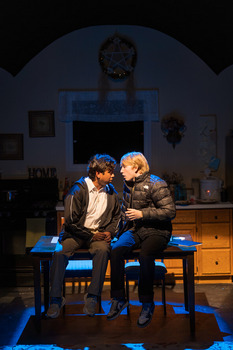
Kid, short for "Kindness," is a teenager from a Filipino family who is doing his best to continue going unnoticed through the end of his high school career at a private Catholic school in the bougie northern suburbs of Chicago. But Jack, a white kid from a privileged family, sees Kid watching women's professional wrestling matches on his laptop at school, and he definitely begins noticing Kid. When it comes to his obsession with women's wrestling, Kid is passionate and embarrassed by turns. But Jack, who is equally inclined to geek out about movies and comic books, is completely charmed by Kid's fierce defense of the wrestlers he loves, in particular the sultry Maria, as more than just eye candy. With Jack taking the lead, the two take tentative steps toward a relationship. This comes to an abrupt halt when the first kiss turns to something more heated, and Jack accidentally breaks Kid's "Mama Mary" necklace. This sends Kid into a spiral of guilt and fear as he pushes Jack away and avoids him at school. Ultimately, Kid breaks down and comes out to his mother, "Nurse Marie," who does all she can to disabuse Kid of the notion that he is bad, weak, or unworthy of the sacrifices she makes to give him a brighter future. The shape of the story has great potential, and much of it, as the play presents it, is quite lovely. But there are a number of interesting and important threads that Silva introduces, but never pursues. For example, Jack's parents, both doctors, work at the same hospital as Nurse Marie, who works tremendously hard not only at the job itself, but also at performing her identity as "the good immigrant," for example, spending hours cooking adobo to bring to the hospital for both her patients and the doctors. Early on, it seems as if Silva is interested in exploring the ways that class and outsider identity shape the relationship between Kid and Jack. Silva even introduces the idea that throughout the timeframe of the play, Kid is struggling to write an essay about who he is and what he wants as part of the application for a scholarship that will be critical to him attending college. But this interesting potential for exploring how class and immigrant identity might contribute to Kid's self-image as someone unworthy is never effectively pursued. The use of the fantasy characters of Maria the wrestler and Mama Mary also seems not to be fully thought through. The emphasis is on Maria, and although the character is fun, the purpose of exploring her story at length (beyond the way Kid's telling it charms Jack) is not really clear. It's not always clear why Maria enters scenes, and Kid's heart-wrenching scenes with Mama Mary seem rather after the fact. The production, likewise, has many strong elements, but others that tug at its success. Katelyn Montgomery's scenic design sets all of the action against the backdrop of Kid and Nurse Marie's house. It is instantly and effectively recognizable as a respectable middle-class house. The pile of outdoor shoes and indoor slippers by the door, the kitchen counter cluttered with, among other things, an oversized rice cooker, and the elaborate shrine to Mama Mary and lost loved ones mark it as the home of carefully striving immigrants. However, the shifts from scene to scene are sometimes slow and awkward. The attention to detail as the action shifts to the school that Kid and Jack attend, the pediatric ward where the two volunteer, and ultimately to a wrestling ring, is impressive and ambitious, but in a show that strives for a running time under 90 minutes, something more impressionistic might have allowed for development of the story's very strong substance. Emma Berry's lighting design, which is very well done, certainly seems like something the production could have leaned into more fully to help strip back the time-consuming scene changes. Mikael Silan's sound design has strong potential and is effective in a number of ways. Its execution, though, needs work, as often the music (another important element of the story that is unevenly employed) drowns out dialogue or leads to actors having to hold, waiting for a cue to end. Gin Ko's costumes are relatively simple, but effective. Even when wearing his school uniform, Jack's look is higher end and far more relaxed than Kid's. Conversely, Kid reads as carefully buttoned up whether or not he is in school. The opposing designs for Maria/Mama Mary (played by the same actor) are wonderful. The performance by Juan Sedonio as Kid is fantastic. Sedonio plays Kid as deeply introverted and eternally careful, yet blends this effortlessly with conviction and passion that quite believably charm Jack. Moreover, Sedonio makes the most of the regrettably few moments when the script shows long-standing frustration emerging into anger at microagressions like Jack's lack of interest in learning how to pronounce "Tagalog" and the slights his mother routinely encounters on the job. It would have been gratifying to see this actor have more of an opportunity to play with this unique aspect of coming-of-age for a young immigrant. Aidan Leake is also very good as Jack. It's a pleasure not just to watch him fall for Kid, but to see how Kid, as an individual, gives Jack the courage to more fully express aspects of himself. Leake has a light touch with Jack's unthinking privilege, which adds interesting dimensions to this and adds to the wish that the play had spent more time on this. On the one hand, the play's perspective is so strongly Kid's that these moments hit suddenly and sharply, so Leake's off-handedness is startling and painful. But on the other, that same light touch triggers a "but he's not a bad guy" response that is accurate, yet troubling in a productive way that has more potential than is realized here. Carina Lastimosa is hilariously high energy as Maria, and her hair flips alone deserve high praise. For as shaky as this character's integration into the story sometimes is, there's not a second of regret that Lastimosa has an opportunity to be on the stage. This pairs very effectively with her quiet, steady, loving presence as Mama Mary. As Nurse Marie, Marie Tredway is a lovable steamroller. The play does not do as much as it could to explore the character, and there's the risk that she will become nothing but the stereotype of a loving, but overbearing immigrant mother. Tredway's performance, however, skillfully gets between the lines to lend much-needed dimension here. Hail Mary/Maria runs through August 23, 2026, at Theater Wit, 1229 W. Belmont, Chicago IL. For tickets and information, please visit The-Novas.com. |