|
Regional Reviews: Chicago Sunday in the Park with George
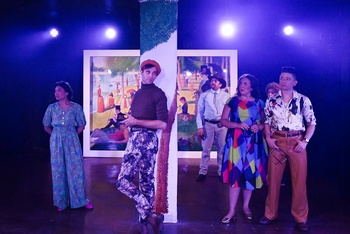
In Act I, which focuses on the artist Georges Seurat and his relationship with "Dot," an imagining of the model with whom Seurat had a child, scenic and lighting designer G "Max" Maxin IV confines Georges to a white canvas in the center of the in-the-round theater space. The design integrates the support pillars into the suburb of Paris that Georges has such difficulty navigating by painting them with snippets of what the audience knows will become Seurat's complicated masterwork. This conveys the tension, one of Seurat's core artistic principles, between the inspiration the artist finds in the trees, the water, and the people of all classes and the fact that this inspiration traps him in the studio, with brush in hand. Maxin's agile lighting design not only mimics the artist's techniques by flooding the space with colors that shift rapidly, making the audience's eye do the work of blending colors, it also serves the more practical function of gradually unveiling the physical space, which is filled with the sketches and studies that Seurat became famous for. In Act II, when the focus shifts to George, an artist a century on, who may or may not be the great-grandson of Seurat, Rachel Sypniewski's costumes take center stage. As George tries to gain recognition and support for his latest "chromolume," the science goes wrong and the art even more egregiously so. Sypniewski creates a crowd of insufferable gallery snobs, critics, and hangers on using color, cut, material, and juxtaposition to tremendous effect. The makeup by Syd Genco and wig and hair design by Keith Ryan provide invaluable support in this. The colors, patterns, and cuts of the costumes and the cacophonous combination of wannabes desperately striving to be unique draw us into George's headspace. Maxin's scenic additions are simple but effective, as well. This George is able to leave the "canvas," but he lives in the shadow of his (maybe) ancestor's massive work. A single bench is placed in the center of the small stage. Both are painted white, transforming the space into the sterile, regimented world of the gallery, a world that literally and figuratively cannot accommodate the work George feels compelled to do. Van Barham's blocking and choreography slot into this visual design with ease, as well. There's hardly a moment when the potential challenges of the space draw the audience's focus from the show itself, but "The Dog Song" is a wonderful showcase for strong, sure-handed direction that is wonderfully executed. All of this skill in creating the visuals, though, would be nothing without equally skillful handling of Sondheim's music. Nick Sula's music direction is wonderful. The arrangements lean heavily on the piano and other keyboards, but the cello, French horn, and woodwinds round out the sound, tapping into the melancholy beauty of Sondheim's work. Kevin Webb does an excellent job as Georges/George. His dramatic performance garners sympathy for the isolation he suffers because of his obsession with his emerging technique, but Webb does not settle for a simple narrative that demands we have infinite patience with genius. Without ever turning him into a villain, Webb demonstrates the harm to others that comes from the artist's singular focus. Certainly this is evident in his unraveling relationship with Dot, and the work Webb and Missy Wise Vanderzee do together is wonderful in both incarnations, but we also see how drawing the artist's eye affects the other figures of all classes and social identities that end up in the painting. Wise Vanderzee offers a similarly complicated, nuanced, and satisfying performance as Dot and Marie, the later George's grandmother. The show could easily show its age, particularly in its female characters, but Wise Vanderzee finds opportunities to create a three-dimensional, lived-in character. She and Webb are particularly wonderful together, both dramatically and vocally, in "Color and Light." As the Old Lady, Georges's mother, Lauren Miller adds an important layer to the show's emotional blend in "Beautiful." In the extremely strong supporting cast, Nathe Rowbotham is a particular standout as Yvonne, Dot's counterpart in the relationship with Jules (Danny Andrew Bennett, who creates an impressive blend of awe, jealousy, and cynical manipulation), a more conventional artist and a kind of frenemy to Georges. Yvonne is transformed into the upright figure with a parasol, holding the hand of a small child (Ella Carson as the delightfully annoying and disruptive Louise), and Rowbotham captures the snobbery, the class consciousness, and the gender performativity that this figure embodies. And when Dot and Yvonne have a conversation that starts off confrontational and evolves into mutual commiseration, Wise Vanderzee and Rowbotham feed off one another to lend depth to the play's women. Abraham Shaw also contributes to the production's ability to fill in some of the show's narrative cracks. The character of Louis can easily become a plot contrivance as Dot chooses the dull, reliable alternative to the erratic brilliance of Georges. Shaw, however, has tremendous presence and charisma and makes the most of moments to blend jealousy with sorrow and determination as he looks on at the tense interactions between the woman he loves and his rival. Rachel Carreras (Nurse), Z Moore (Franz), and KyraJo Petit-Walla (Frieda) are engaging in their individual performances, and in their contributions to the various "B plots" that the production wisely offers a fair amount of attention. Nick Arceo is also up to the task of bringing these characters off the canvas in his performance as the Boatman. Arceo leans into the comedy of the role, but injects stinging, justified anger into the mix. Similarly, the two Celestes, Emily Holland and Samantha Ringor, offer effortless laughs at their perfectly synchronized attempts at fishing and attracting the attention of a pair of soldiers (hilariously played by Jack Saunders and a minimally costumed dress form that Saunders has to haul around the stage). But Holland and Ringor pay equal attention to the venom the women direct at one another as they try to cling to their relationships with the men they've managed to attach themselves to. Sunday in the Park with George runs through November 1, 2026, in the Chopin Theatre, downstairs space, 1543 W. Division St., Chicago IL. For tickets and information, please visit kokandyproductions.com. |