|
Regional Reviews: Chicago Shane Also see Karen's review of The Man Who Fell with the Rain and Richard's review of Joan Crawford Goes to Hell
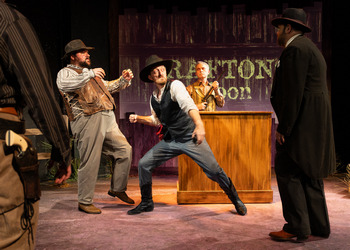
Schaefer's story touches on all the tropes of the genre: Shane is a shadowy figure who simply wants to water his horse, then move on from the community of homesteading farmers and whose conflict with encroaching ranchers is escalating. When Joe Starrett insists on extending hospitality to him, Shane finds himself drawn in by the decency of Starrett and his family, and eventually drawn into the community's conflicts. Mixed in is a complicated mutual attraction between Shane and Marian Starrett, Joe's wife. But what moves the story beyond these tropes, and what Pracht skillfully brings to the forefront, is the fact that it is rooted in genuine emotion and real, complex relationships. Certainly the villains are rather mustache-twirling and two-dimensional, but this serves to underscore how fully fleshed out the other characters are and to signal that the story is not really about black hats and white hats and who will win the battle for land. Rather, it is about what people, men in particular, see and bring out in one another. Pracht anchors this view of the story through the use of Bob, the Starretts' young son, as a narrator. The actor playing this character shifts between spotlighted moments when he, as a young man, reflects on the months Shane spent with them and the complicated lessons he is still learning from all that transpired. In connecting the scenes of the past, Bob contemplates the ways that Shane enriched their household, but also complicated it. And most importantly, Bob ponders what this story has to say about the tangled relationship between masculinity, violence, mercy, and grace. City Lit's black box theater is an ideal space for telling Schaefer's story through Pracht's lens. Jeremiah Barr's set is simple, effective, and mostly confined to the stage's perimeter. Up left is a simple structure, one step up from the floor, that suggests either the exterior or the Starretts' house or the wall between kitchen and dining area. Most of the upstage wall is dominated by a split-rail fence that also runs along the stage-right wall, accented with clumps of brush. But the focus of the upstage wall is a projection screen. The projection design by G. "Max" Maxin IV, with artwork by Jim Terry, is very well done, conveying the sweep of the Wyoming landscape, and through the use of silhouetted figures, the mystery that Shane continues to be for Bob, both as a child and as he tries to discover himself as a young man. The projections also work to both acknowledge that "dime store Western" nature of the story, even as the play salutes and builds on its deeper, more enduring elements. Josiah Croegaert's lighting design supports Pracht's adaptation well, too. The shifts between Bob the narrator and Bob the child who plays a part in the events of the past are crisp and well executed, supporting the play's strong pacing. Although the projections do much of the heavy lifting in setting the scene, Croegaert's design subtly builds on this, conveying not just shifts from scene to scene or location to location, but also between emotional registers. Beth Laske-Miller's costumes put the finishing touches on the show's evocation of Wyoming in the late nineteenth century. The clothing for the homesteaders is practical and in the case of Marian and Bob, nods to concerns about respectability and the things that Marian misses about a less isolated life in a town or city. The ranchers' costumes are more elaborate and stereotyped, underscoring the choices that Pracht's adaptation makes. The music and sound design by Petter Wahlbäck are subtle and well done through most of the show. However, if there is a single questionable moment in the production, it comes during the climactic fight in Grafton's saloon. The projection suddenly becomes an abstract design and the music abruptly becomes much louder than at any other point in the show. Although the intentions of the moment are clear, as this really is the climax of the story, the execution perhaps needs some finessing. Michael B. Woods offers an excellent performance as Shane. The role is so steeped in stereotype that runs from the original literature, up through comic books, radio dramas, and a host of Western films, that it is nothing short of extraordinary that Woods carves out a person that feels real, yet still exists as a larger-than-life legend in Bob's mind as he retells the story. The work that Woods does is matched by equally good performances by Josh Odor as Joe and Whitney Minarik as Marian. Joe Starrett is a character that one can see as either irrationally stubborn or admirably standing his ground, and Odor skillfully walks the line in between these. Minarik has, perhaps, an even more difficult job than Woods or Odor in steering clear of stereotypes, as this is very decidedly a story about men, and the show's lone woman has more heavy lifting to do and less source material to do it with. Minarik is up to the task. She is intent on anchoring her family in the conventions of civilization, but she is not some prissy scold. Similarly, she clearly misses many aspects of her old life, but Minarik does not let this translate into brooding or bitterness. One of the rare shaky areas in Pracht's adaptation is the first moment when Shane and Marian acknowledge their attraction to one another. Although it's to the show's benefit that Pracht keeps things lean and artfully uses Bob's narration to stitch scenes together, it comes as a bit of an abrupt revelation that Marian, a woman who is overall satisfied in her life and marriage, is romantically attracted Shane, rather than admiring him, being intrigued by him, and perhaps attaching some of her wistfulness about her past to this man who can casually ride through cities and towns. Woods and Minarik, however, do very good work together to smooth over this initial moment, and the triangle between the three characters does ultimately play out as something more interesting than the trope it could have been, thanks to the efforts of Woods, Minarik, and Odor. Bruce Holtman is very good as Bob, particularly the child incarnation of the character. The narration as a device is a worthwhile and effective approach, but particularly early on, it does seem as if the direction and engagement with the text need some additional attention to establish where Bob the narrator is in the course of his life and in relation to the events of the story. But Holtman's performance quickly becomes stronger, and he does a very good job in the difficult task of an adult playing a child. Jay Donley, who plays both the slick equipment salesman, Ledyard, as well as the villainous gunslinger Stark Wilson, understands the assignment in playing Pracht's broadly drawn bad guys. Donley's swagger and poisonous version of manhood believably exist in Bob's childhood memory and unfortunately endure in real life. Donley's performances complement (and are complemented by) Sean Harklerode's approach to Fletcher, the prosperous fat cat who pulls the strings of willing accomplices like Wilson as well as young men at a crossroads in the development of their character, like Chris. (Andrew Pappas offers a memorable performance in this relatively small, but important, role.) Chuck Munro is also good as Grafton, the proprietor of the town's saloon. This is a role that could turn into a simple plot mechanic that is necessary to shift the action from the Starrett home to the broader community, but Munro injects an additional lived-in version of masculinity into the story. On the homesteader side, Brandon Boyer (Ernie Wright) and Frank Nall (Lou Shipstead) create personalities that believably contribute to the cracks that form in the alliance among the farmers, but do so in a way that supports the story's ending, which does not make it seem as if the ranchers' victory is inevitable. On the ranchers' side, Ross Childs (Curly) makes the most of the role to show an alternate future for Chris if he continues down the path he is on at the story's beginning. Shane runs through October 4, 2026, at City Lit Theater, second floor of the Edgewater Presbyterian Church, 1020 W. Bryn Mawr Avenue, Chicago IL. For tickets and information, please visit www.citylit.org or call 773-293-3682. |