|
Regional Reviews: Chicago Dead Girl's Quinceañera Also see Karen's review of Operation Mincemeat, Richard's review of Chopin in Winter, and Savannah's review of I'm Gonna Marry You Tobey Maguire
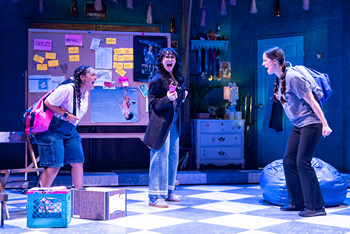
The play crosses true-crime obsession with angsty, grown-up-too-soon teen drama, mostly to great effect. In the wake of the abrupt end to their friend's Quinceañera, Salma, Este, and Phoebe, who are not quite friends and yet so much more than friends, investigate the "disappearance" of Maria, the hypothetically dead girl herself. Each has her own reasons for driving the investigation, dragging her heels, or doing a little bit of both. Salma's brittle, intense energy and a mind that is always turning toward the macabre have her the most deeply tuned into the true-crime vibe, but she also harbors resentment against Maria, who is rich, beautiful, and seemingly perfect. Moreover, Maria's disappearance puts Salma's own impending quince, which she cares a great deal about, despite how badly it goes against the grain of her persona, in jeopardy. Este, an immigrant from El Salvador, is the perennial outsider looking in at the others, who have been friends since childhood. Her desire to reach across the lines of class and privilege makes her something of a follower, but none of Phare's characters are so two-dimensional that this can fully describe her. Este is more than a hanger-on. She is in search of true connection with the other girls who, despite being unlike her in so many ways, are her sisters in fundamental ways. Phoebe's relationship to Maria is complicated by the fact that they are family, not just symbolically, but literally. We learn that although the cousins were close as children, their relationship became strained when Phoebe's father died shortly after her own Quinceañera. Maria, in Phoebe's view, dumped her to devote all of her attention to her new boyfriend, Manny. Moreover, Phoebe and her mother "from the wrong side of the island" are isolated and vulnerable within the family that seems to practically revolve around Maria. With Salma's expertise driving the investigation, the girls question the "suspects": Maria's boyfriend (Manny); the mysterious "Gold Chain Guy"; and "Plant Daddy," the girls' young, hot agriculture teacher, Mr. Evans. Along the way, their relationships with one another unfold and grow ever more complex as they explore what they want and why they want it. There's trauma, pain, and no small amount of darkness in this exploration, but also joy, ambition, and the kind of dreaming that has real power. Taken as a whole, Phare's play is a success, if a slightly qualified one. Playing up the fascination with true crime serves its purpose, but it is problematic to treat it as all in good fun. The text seems to know this, as it at least touches on the racism and enthusiasm for institutional violence that are baked deeply into the genre, but these glancing acknowledgements are not entirely satisfying. A more serious issue is the fact that Maria's secrets are revealed very late in the play. Although their nature is not a surprise by the time they emerge, the bombs Maria drops are complicated and heavy, but Phare leaves little time to explore the full weight of their impact on Maria and offers no real time to consider how that might have radiated out among the group. Did Maria, for example, distance herself from Phoebe as an unconscious way of keeping her clear of this specific danger? Or was her sudden investment in Manny a byproduct of an attempt to broker her own safety? The relationships the play does take the time to create are so complex, tender, oblivious, cruel, and celebratory, that one wants to know at least a little bit more about how Maria fits (and fails to fit) into them. Production-wise, the show is practically perfect. Sara Brown's set captures the frenetic energy and oddball warmth of a space these just-about women have carved out for themselves and made their own. When the scene shifts from the girls' shed to the back room at the quince hall, and later to the teacher's greenhouse, Brown's design facilitates smooth, brisk transitions while still underscoring that the characters are venturing out into other, more fraught spaces. In tandem, the lighting by Dan Kotlowitz and sound by Salvador Zamora perfectly support the way the text calls for zipping in and out of "true crime" mode. Moreover, these two aspects of the design facilitate the characters' shifts inward. A script that demands pivoting between rapid-fire dialogue and sustained monologue can go wrong in a number of ways, and this production design and direction does far more than simply avoid these. The transitions are seamless and build the intimacy of these sustained moments. Raquel Adorno's costumes also make great contributions to the character building. The four young women are distinct in their styles, as befits their personalities, as well as their different identities under the Latina umbrella. They slip in and out of costume pieces with an ease that feels authentic to the adolescent experience, and the way Adorno handles the actors shifting into the guise of their suspects is both funny and impressively practical. The program lists the four actors as "Ensemble," rather than by the names of the characters each primarily plays. That certainly speaks to the fact that the play does not work at all without the performers being tuned into one another well enough to support lots of overtalk and rapid-fire conversation. They also often need to manage the shifts between modes as a unit, and make lightning-fast adjustments to one another in the interrogation scenes. They certainly achieve this beautifully. But their individual performances are equally splendid. As Este (and Manny), Carmen Berkeley is almost painfully relatable and believable. Without once engaging in any kind of heartstring tugging, Berkeley cultivates sympathy for Este as she conveys the lessons this character has learned from a lifetime of needing to fly below the radar to survive. She pairs this with effortless intelligence and charm that we know Este possesses, even if she is only just coming to know this of herself. As the acerbic Salma (and Gold Chain Guy), Jacqueline Guillén knows where the expected laugh lines for her character are. She lands them and smoothly moves on, which is essentially Phare's intention and the rhythms of her language. But Guillén's performance goes well beyond simply providing dark humor. She taps into the absurdity of Salma's confidence and lets vulnerability peek through even as the character lobs outrageous social and political positions as obvious test balloons. These cracks in her facade are critical to why the audience has sympathy for her, and Guillén renders legible both the frustration and borderline hatred Phoebe harbors for Salma and Este's genuine admiration and affection. Of the three primary ensemble members, the performance by Ariana Burks probably could have done with a bit more seasoning. Burks is very good quite often, and it is worth noting that Phoebe's character does not seem to have been as well developed on the page as Salma or Este. (In fact, what might have been for the character is rather lost to the fact that Maria's ultimate entrance into the story is arguably mistimed.) But there are moments when Burks seems to be playing a 16-year-old girl, rather than inhabiting the character. As Maria, Andrea Ferro has a fairly brief period in which to establish her character. She certainly handles admirably the intense, thorny material that Phare provides for the character. We can see around the edges what Ferro seems capable of, and her performance certainly makes one wish that the play had run just a touch longer to afford her more opportunity to demonstrate that capability. Dead Girl's Quinceañera has been extended through November 8, 2026, at Goodman Theatre, Owen Theatre, 170 N Dearborn Street, Chicago IL. For tickets and information, please visit GoodmanTheatre.org/Quince or call 312-443-3800.
|