|
Regional Reviews: Cincinnati The Sign in Sidney Brustein's Window
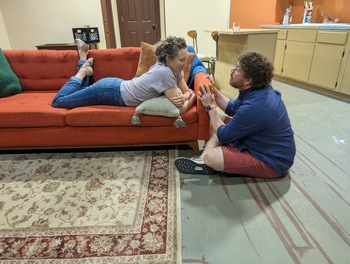
Not only was her death a tremendous loss for the American theatre, but it also cut short what would surely have been a prolific and meaningful writing career. The Sign in Sidney Brustein's Window is evidence of her potential, even though she was continually revising the script during the final months of her illness. Had Hansberry lived longer, she might have tightened and refined this play's messages. As it is, it is overstuffed with numerous challenges that faced America in the early 1960s, from political corruption and anti-intellectualism to racism, antisemitism and homophobia. Hansberry personified each of these issues in the play's eight characters, giving them lengthy and momentous scenes of argument and discourse that unfold in a crowded New York apartment. Sidney (Chad Brinkman, intense and argumentative) is a rumpled, idealistic bohemian intellectual. His most recent endeavor, a club he called Walden Pond where people could come together to debate issues and listen to music, has failed. Despite his inexperience in journalism, he's on to his next project, an unsuccessful weekly newspaper, The Crier. Sidney's wife Iris (Anna Hazard, lithe and free-spirited) is a vivacious aspiring actor in desperate pursuit of stage opportunities. Physically beautiful but apparently minimally talented, her failed ambitions resemble her husband's. They have a fiery relationship, constantly bickering and disparaging one another, then apologetically making up. Brinkman and Hazard handle the couple's seesaw relationship believably, making it clear that they are in love, but they are also often self-centered and hurtful. Theirs is a very human if ill-fated connection. Hansberry's other characters tend to be personifications of issues she wanted to her play to explore. Alton Scales (D'Waughn Hazard) is a Black hipster who is naïve and as idealistic as Sidney but also attuned to how he's judged and discriminated against. Max (Christie Bishop) is a free-spirited artist and graphic designer, full of zany philosophy. Wally O'Hara (Mike Nalley) is an aspiring politician, but Sidney is oblivious to his friend's opportunism. Wally proves to be willing to do whatever is necessary to get results. The couple's upstairs neighbor David Ragin (Michael Sanchez) is a struggling gay playwright whose momentary success proves to be another trigger for conflict. Iris's sisters represent a pair of extremes. Judgmental and almost comically conservative older sister Mavis Parodus Bryson (Katie Jensen) is unhappily married to a successful businessman. She is disdainful of Iris and Sidney's marriage–he's Jewish–and fails to recognize how her judgmental pronouncements are taken by others. Younger sister Gloria Parodus (Molly Simpson) is an object of concern: More discussed than seen onstage, she has become a high-class prostitute, much to her sisters' dismay. Alton has planned to propose marriage to her, but when he learns the truth of her life, it's one more terrifying eruption of emotion among several characters. Simpson handles the show's harrowing climactic scene well, but Hansberry has not provided much back story foundation to flesh out this character. All three Parodus sisters seem to be victims of stern parenting, sending them off in wildly different directions rooted in divergent recollections of their father's influence. Launching his new journalistic enterprise, Sidney resists endorsing Wally's political campaign. When he relents–posting a sign in his apartment window, "O'Hara for Reform"–everything begins to spin out of control. Hansberry's characters are repeatedly fueled by alcohol and high emotion, and their disputes become more and more uncontrolled as events unfold. Perhaps the most believable revelatory scene has Mavis, drinking heavily, confessing to Sidney about her childhood and her unhappy marriage. Jensen delivers this moment powerfully, enhanced by Brinkman's Sidney actually listening attentively, something he's not usually doing. It takes a lot of time onstage to roll out all these complex characters and issues: The performance runs close to three hours with one intermission. It's a shame Hansberry did not have more time or encouragement to make it more concise. Director David Derringer has succeeded at sensitively shaping these troubled characters and giving voice to the many messages and issues they represent. All of his actors commit themselves admirably to the long-winded storytelling. Mariemont Players has given this production a credible staging. Scenic designer Ryan Oelker's cluttered Greenwich Village apartment has a lived-in look, and lighting design by jef brown adds emotional depth to the action. Douglas Berlon's sound–especially employing pop music and Broadway cast recordings from the 1960s–further underscores the moment in time. Not many community theatre companies would undertake such an ambitious production. The fact that Mariemont Players has given Derringer the opportunity stage this seldom-seen work by an important writer is one more piece of evidence as to why amateur theater is a meaningful component of Cincinnati's theatre scene. The Sign in Sidney Brustein's Window, produced by Mariemont Players Inc., runs through July 27, 2025, at Walton Creek Theatre, 4101 Walton Creek Road, Cincinnati OH. For tickets and information, please visit www.MariemontPlayers.com or call 513-501-1718. |