|
Regional Reviews: Cincinnati Juliet: A Dialogue About Love Also see Scott's reviews of The World Goes 'Round and It's Fritz!
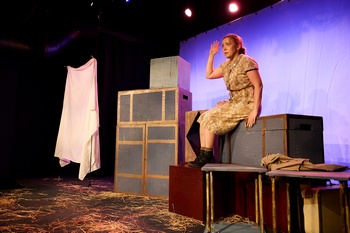
Visky's father, Ferenc Visky, was a pastor in the Hungarian Reformed Church. In 1958 he was sentenced to 22 years of prison and forced labor for "the crime of organization against socialist public order." Soon after his conviction, the brutal Communist regime deported his family to the gulag where they lived in horrific circumstances, in roofless huts with little to eat. (The family was reunited in 1964 when the repressive Romanian administration relaxed momentarily.) Today, Visky, now in his late 60s, is a leading theatrical voice in Eastern Europe. He is a poet, playwright, essayist, and the resident dramaturg at a Hungarian theater in Romania. His plays have been staged across Europe and now occasionally in the United States. The production of Juliet: A Dialogue About Love at Falcon might be just its second staging in this country. Visky's playwriting employs his theory of "barrack dramaturgy" which considers theatre as a space for exploring feelings of cultural and personal captivity, inspired by personal experience. Juliet: A Dialogue About Love uses his family's experience, especially his mother's, to explore themes of gender, justice, and trauma. On Falcon's cramped stage, the lights come up on a woman–Weil as Juliet–asleep, totally covered by a sheet, on a floor strewn with straw. Awakened with a start by fearful, indistinct sounds, she begins to question why God has given her seven children (she illustrates them by gathering seven handfuls of straw) and then subjected her to this dire existence. It's clear that her situation is meant to invoke the biblical Book of Job, a man who maintained his faith despite suffering extreme tests and struggles to understand why he was persecuted. Juliet yearns for her husband Ferenc, represented by a jacket that hangs overhead; she pulls it down, talks to it, feels its embraces, and recalls their love, unsure if he's even still alive. Offered the chance for a divorce that would mean release for her and the children, she joyfully interprets it as a sign that Ferenc is still alive and refuses to give in to the advances of a slimy attorney. As Juliet's tale unfolds, she describes other people and moments from her past as well as from her straitened existence in exile. They are ingeniously presented and enacted, often using the sheet Juliet was covered with at the show's opening hung to become a backlit screen. Weil occasionally steps behind it, and her shadow momentarily becomes someone else. It's a simple but effective piece of stage business. Weil frequently scrambles over the stage's boxes and trunks, climbing up, jumping down, reclining awkwardly, sometimes rambling through the aisles set close to the stage as she wrestles to understand God's testing of her faith. Her love for her husband never fades, and even her encounters with death do not dim her faith or diminish her ardor to protect her children and eventually reconnect with her husband. Weil gives this astonishing 90-minute solo role a tour-de-force performance. Credit must also be given to director Zoë Peterson, who has kept Weil's performance in motion but simultaneously focused, and to movement coordinator Grace Wagner, who choreographed much of Weil's complex physical representation of Juliet's character. As she goes through Juliet's trials, Weil is constantly connected to the audience through gesture and facial expression. Juliet: A Dialogue About Love has moments of humor, but it is principally a fiercely told tale of resilience and focus on a desired outcome of freedom and love. Lighting design by Ted Weil also conveys evolving moods and underscores emotional moments as the monologue unfolds. A performance by one actor for 90 minutes can be a challenge for audiences used to more characters, action, and variety. This might not be a production for everyone, but it's a riveting story of persecution survived and overcome by love and faith that is told with commitment. Juliet: A Dialogue About Love runs through December 20, 2025, at Falcon Theatre, 636 Monmouth Street, Newport KY. For tickets and information, please visit falcontheater.net or call 513-479-6783. |