|
Regional Reviews: Cincinnati A Soldier's Play Also see Rick's review of Louisa May Alcott's Little Women
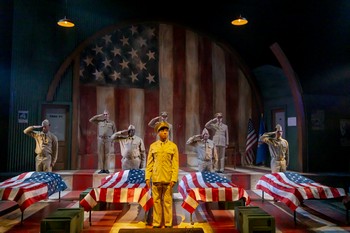
But in this production staged by Cincy Shakes veteran director Christopher V. Edwards, the tone is far from jocular or patriotic. Silhouetted in an opening scene, we see a drunken soldier in a violent exchange with two others, resulting in a brutal execution. The story follows virtuous and committed Captain Richard Davenport (K.P. Powell), arriving to handle the investigation and potential prosecution of the murderers. He's a rarity, a Black Army officer, and his greeting by a white man of parallel rank, Captain Charles Taylor (Brent Vimtrup, performing with fierce, frustrated opinions), is not welcoming. Taylor admits that Davenport is the first Black officer he has ever met, and he questions the choice of Davenport for reasons of racism and likely complications in a white town where the initial suspects are Ku Klux Klansmen. But the steely Davenport, a Howard University educated lawyer, proceeds as the mystery of Sargeant Vernon Waters's murder is unraveled through flashbacks. Davenport interviews each of the soldiers in the unit–handled through dimmed lighting shifts (designed by Jessica Drayton and Kassidy Schley) for flashbacks representing various perspectives preceding the murder. No easy conclusions are possible. Two officers become suspects, Captain Wilcox (Carey Davenport) and fiercely racist Lieutenant Byrd (Patrick Earl Phillips), but Davenport has pieced together a different scenario. It's evident that Waters, played with impatient vile by Geoffrey Warren Barnes II, is a harsh leader of the unit, a man who loathed his recruits whom he saw as Uncle Toms, old-fashioned racist stereotypes. Recollections show Waters literally combative with impetuous Melvin Peterson (Anthony T. Gross) and angrily dismissive of gentle, naïve musician, Private C.J. Memphis (Montez Jenkins Copeland), who is goaded into an attack that results in detention and death. The cast is populated with talented Black actors, a demonstration of Cincy Shakes' continuing strength with ensembles that enable productions of classic works about Blacks to succeed. Others performing in A Soldier's Play include "ranney" as subservient, jocular Private James Wilks, Sylvester Little Jr. as docile Corporal Ellis, Jason Coffenberry as forthright Corporal Bernard Cobb, Malik Smith as Private Louis Henson, and Jay Wade as Private Tony Smalls. They constitute a convincing ensemble representing a range of minority behaviors in the 1940s. Keisha L. Kemper is the production's military consultant. She has sharply detailed the actors' performances with a snap-to-command, stiff-spined physicality that adds authenticity to the storytelling. Military behavior, especially deference to rank, produces uniformity and disciplinary structure. But it is also the enemy of the truth-telling that Davenport requires as he determine what led to Waters's demise. As the story unfolds through flashback episodes, Davenport wrestles with grasping what really happened, ultimately coming down to an unanticipated conclusion, one that surprises Taylor, who is man enough to admit he was wrong to doubt Davenport's ability to handle the investigation at the story's conclusion. A Soldier's Play was considered too difficult for a Broadway production in 1981; it debuted in an award-winning Off-Broadway production and became a well-received film in 1984 (A Soldier's Story), nominated for three Academy Awards. The play was finally produced on Broadway in early 2020. It's an important work, one that examines Black identity and the historic complexities of race relations in America. Waters is virulently prejudiced against Black men he sees as shiftless and discredits to their race. He believes his harsh behavior–modeled on white men's racist behaviors–will advance him in the military. But his dying words–easily misinterpreted in the murder investigation–are "They still hate you." His tortured realization was that no matter how hard he tried to emulate racist behavior, he would always be the victim of such attitudes. The psychic damage done to several characters is the dismaying driving force behind Fuller's powerful script. For a stage work that's been around for more than four decades, A Soldier's Play remains today a stark, powerful reminder that racism comes and persists in many forms–and colors. It remains a factor in contemporary American life, despite efforts of some to whitewash our past and fantasize about an unrealized present. A Soldier's Play at Cincy Shakes is a powerful, meaningful piece of theatre for audiences in Cincinnati in 2026. A Soldier's Play runs through February 15, 2026, at Cincinnati Shakespeare Company, 1195 Elm Street, Cincinnati OH. For tickets and information, please visit cincyshakes.com or call 513-513-381-2273. |