|
Regional Reviews: Cincinnati Where We Stand
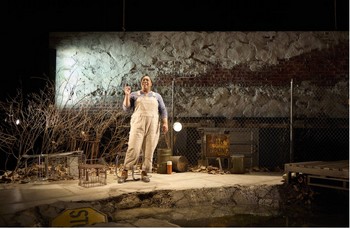
The play was produced Off-Broadway in early 2020, just before the COVID-19 pandemic brought theatre (and the rest of the world) to a screeching halt. The playwright originated the role of "Man" in this solo piece, about 75 minutes long (no intermission). Meyers knew she had the ideal performer close at hand to bring this unusual work to ETC's stage: Actor Torie Wiggins is also on staff as the company's artistic associate. Over the course of her 15 years since returning to Cincinnati–the Atlanta native graduated in 2002 with a degree in drama from the University of Cincinnati's College-Conservatory of Music and spent close to a decade in New York City she has excelled in leading roles at ETC and Cincinnati Shakespeare Company (CSC). In particular, she has performed memorably in several solo shows at ETC, including Your Negro Tour Guide and His Eye Is on the Sparrow. She's at it again in Where We Stand. Meyers recruited Candice Handy, associate artistic director at CSC, to stage this production. She and Wiggins are a surefire pair: They have partnered to dazzle CSC audiences in shows such as The Amen Corner and Ma Rainey's Black Bottom. Together they have assembled another powerful ETC production. Where We Stand is an unusual piece of theatre, as much a fable as a play. As "Man," Wiggins wanders toward the stage from the entrance aisle through the steeply raked audience seating area. (The playwright indicates that the role is gender neutral, to be played by "anybody with a body.") She hums then sings a gospel-like line, "They come back around," wanders up and down the auditorium stairs, and encourages the audience to sing along. It ends with the line "we all come back to the end of the street." By then Wiggins is on the stage, a weed-choked dead-end backed by a crumbling brick wall, featuring a sizeable pothole and strewn with a half-buried stop sign and fetid water. (ETC's resident designer Brian c. Mehring has crafted another evocative environment for the show.) It's apparent that this is a down-and-out neighborhood, and Man lives in the midst of its desolation. But not for long: A charming, genie-like character appears with an offer to change things. Wiggins switches back and forth between the humble, self-effacing, lonely Man and this suave tempter–there's a reference to the story of the Pied Piper, and there's certainly a whiff of Mephistopheles who tempts Dr. Faustus–who entices Man to take the lead in effecting a much-needed transformation. But it comes with a warning: Failure can be devastating. As the narrative unfolds, Wiggins swivels through numerous vivid roles of supporters and skeptics. Her performance employs physical and vocal qualities that make various characters vivid and recognizable as citizens who are dubious and others who eagerly embrace the possibilities of change. And through Man's direct address and movement into the audience, everyone in attendance becomes a townsperson, a participant in the story. Grays' poetic, lyrical language is full of rhythmic wordplay, reinforced by clapping and finger-snapping, which the audience takes up with Man's encouragement. Visions of what "used-to-be" are brushed aside by the promise of what "still could be." Subtle lighting changes (Mehring is also the lighting designer) offer glimmers of possible improvement. But those new ways have a cost, and consensus is not assured. As the tale reaches its conclusion, Wiggins' character asks the audience to consider forgiveness, desire, and community. And to do more than merely think about it: Everyone watching is asked to vote on a choice between justice or mercy. The house lights are turned up, hands are raised and votes are counted and announced. It's worth giving Meyers the final word: "I think our country has gotten to a place where we've forgotten about compassion, redemption, or the potential for salvation that every individual might find within themselves." Another strong ETC production provides the Greater Cincinnati community with provocative, and essential, choices. Where We Stand runs through February 22, 2026, at Ensemble Theatre Cincinnati, 1127 Vine Street in the Over-the-Rhine neighborhood, Cincinnati OH. For tickets and information, please visit ensemblecincinnati.org or call 513-421-3555. |