|
Regional Reviews: Cincinnati Emma
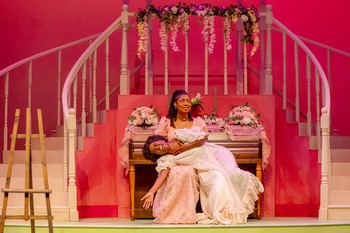
In her program note, Handy says she's "proud to share with audiences a big, grand and pink production ... that showcases a picture of the Black elite." She explains that there was an "exclusive, wealthy, and educated upper-class tier of African Americans, existing in northern cities in America during the 'Gilded Age' (approx. 1870-1900)." That's where she has landed her production, with a strong injection of "Bridgerton," Shonda Rimes's alternative history, soap-opera-ish TV series that presents Regency England through a distinctly modern filter, featuring contemporary music and melodramatic storylines. Hamill's feminist bent has been wholly embraced by Ernaisja Curry as the coy, manipulative title character. Emma Woodhouse fancies herself to be a masterful matchmaker; Curry spends much time coming forward and directly addressing Emma's innermost ambitions and scheming plans for romantic manipulation to the audience, especially those in several dozen seats close to the stage apron. Her most common project is Harriet Smith, her young protégé played by A.J. Baldwin, at least a head taller than Curry but as uncertain of her own path to marital success as Emma is confident (but wrongheaded) in her mentoring. Austen's novel and Hamill's adaptation fall squarely into the realm of campy rom-com, thanks to frequent slips into modern tropes and outbursts of thoroughly contemporary music and physical movement. Susan Jung's choreography, at first in the restrained symmetry of the early 19th century, is often disrupted by hip-hop moves and even a touch or two of twerking in spirited line dancing. All ten cast members have fully embraced Hamill's humorous overlay. Brandon Burton has two opportunities, as the down-to-earth farmer whose proposal to Harriet is initially spurned and then as Frank Churchill, a self-serving, preening "popinjay," slickly slithering around and insinuating himself into the affections of several women. He is balanced by Samuel Stricklen's straightforward Mr. Knightley, a lifelong friend to Emma who struggles to steer her in a more honest direction. Sylvester Little Jr. is Emma's doting but quirky father; in the show's funniest running joke, he's a proponent of a healthy diet, seeking to impose disgusting gruel to anyone he deems in need fortification. Montez Jenkins Copeland is Mr. Elton, an effusive, social-climbing vicar intent on a profitable marriage, ultimately paired with a daffy but wealthy young woman, played with comic intensity and squealing laughter by Jasmine Bouldin. Local theatre veteran Torie Wiggins is the common-sense Mrs. Weston, struggling to keep Emma on a more polite path. Burgess Byrd, another familiar Cincinnati performer, is Miss Bates, a silly, effusive older woman who constantly offers extreme praise–underscored by rhythmic outbursts–for her niece Jane Fairfax, played with solemn-faced focus by Aleah Vassell. Emma disdains Jane as her social inferior but chafes at the complications she brings to Emma's matchmaking endeavors. Hamill's adaptation actually hews closely to Austen's plot and characters, even as she infiltrates the action with a modern feminist attitude. In particular, Emma has an outburst near the play's conclusion when she bemoans the fact that wealthy women in her time have little choice for careers beyond making mischief. That's clearly more Hamill's take than Austen's. It's especially amusing when Curry's Emma berates the audience for not enlightening her sooner about her best romantic choice. Curry's banter with everyone in attendance makes this production especially amusing, as does her pairing with Baldwin, who finally evolves into the moment when she boldly suggests that the story might have better been titled "Harriet," delivered with fierce rage in a stark spotlight. This production is enhanced by numerous technical elements. Gabby Trice's Regency scenic design–awash with pink, pink and more pink details–has a few moveable furnishings pushed on and off by stagehands dressed as maids. Baxter Chambers's lighting design further supports the pervasive pinkness and provides useful highlights at key moments, and projections by Robert Carlton Stimmel further underscore the floral atmosphere. Costumes, by Lindsey McGee Jones, have the right period flair and flourish but with some amusing modern touches, especially the duded get-up sported by Burton's Frank Churchill and a jacket festooned with strawberries and puffed shoulders that alert Emma that Stricklen's Mr. Knightley just might be more than she had imagined. Several wigs designed by Kayla Cieslinski–in particular an odd mop worn by Copeland's Mr. Elton, and the sinuous yard-long braid (with a tiny hat) that crowns Vassell as Jane Fairfax–add to the show's frivolity. In her program note, director Handy expressed a hope that "audiences will appreciate experiencing Black joy and beauty, in addition to the witty and feminine voices of both Jane Austen and Kate Hamill." She has achieved that in this satisfying and entertaining production. Emma runs through June 14, 2026, at Cincinnati Shakespeare Company, 1195 Elm Street, Cincinnati OH. For tickets and information, please visit cincyshakes.com or call 513-381-2273. |