|
Regional Reviews: Connecticut and the Berkshires The Urmetazoan
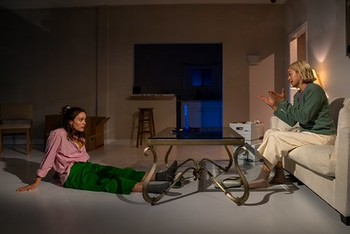
Director Jack Serio opens the performance when two girls designated as Young Abigail (Beatrix Flynn-Powell) and Young Alice (Lyla Randall) scamper around the stage. The speak one word at a time like this: Alice's word is "In" and Abigail responds with "A." Alice says "In" and Abigail replies with "My." The exchange goes on for a while. Scenic designer Marsha Ginsberg brings us to a contemporary living area in a Florida bungalow. The furnishings are very much white or off-white. Unfortunately, those sitting on the extreme right side in house seats cannot fully see all of an actor's expressions later when dialogue transpires on that sector of the St. Germain Stage. A solid wall obliterates a clear sight-line. Here's a recommendation to move a sofa and chair four or five inches toward center stage, which should address this issue. The adult sisters Alice (Julia Chan) and Abigail (Francesca Carpanini) have not seen each another in seven years. Alice is a Nobel Prize winning scientist who plans to rocket to Mars where she and colleagues will determine if they can develop a new living space. Abigail (age 37, three years the junior sibling) still searches for her identity. With the help of Stacey Derosier's deft lighting, the two women gaze upward at a simulated solar system on the ceiling. Alice, citing climate, destructive violence, war, and more, demonstrates optimism that hope rests elsewhere. When Alice departs, she will not make a return trip. For now, she packs boxes situated at the rear of her house, very here and now, and eloquently speaks of extra-terrestrial life on another planet. Abigail does not seem terribly taken with her sister's ambition and instead seems content to provoke if not disparage her sister. Still, it seems that Abigail has come to Florida to stay on a permanent basis. These women talk with one another but, for the most part, they do not connect. Rugman's dialogue is oftentimes clipped. Yes, there are times when characters address each another in a more conventional mode, but these are in the minority. Eventually, Justin Mark, playing Will, makes an appearance. Will was or is Alice's boyfriend and his presence proves pivotal. Late in the show, he is on stage with Abigail and the subplot quickly draws focus upon Abigail and Will. The scene is engrossing. As the 90-minute presentation continues, it becomes more confusing as Alice preps for departure and space. Enough said. The Urmetazoan is about siblings to be sure, but it also addresses the human condition and doubt of survival. Some AI experts posit the end of civilization within several years. Hence, this show could be timely. The author's specific choice to write quite abbreviated dialogue is a brave one, but it is not always successful: audience members are simply unused to this vocal device rather than more traditional back-and-forth, and this mode of speech lessens dramatic impact. Accolades to Alex Rugman for this innovative work. This product is entirely original and leaves one contemplating and considering while walking out of the theater. A more typical play would have suggested the stronger Alice and the less-focused Abigail as diametrical opposites. This script demands and receives more nuanced performances. Julia Chan, as Alice, is audacious but not fully in control. Francesca Carpanini's Abigail is more intuitive but scattered. Some would be more satisfied with specific definition and recognizable sibling rivalry, but these characters do not proceed in straightforward fashion. Abigail meanders while Alice does not quite proceed from her Point A to Point B as unreservedly she might have wished. The Urmetazoan runs through October 25, 2026, at Barrington Stage Company, 36 Linden St., Pittsfield MA. For tickets and information, please visit barringtonstageco.org or call 413-242-6411. |