|
Regional Reviews: Minneapolis/St. Paul The Great Armistice Day Blizzard Also see Arty's reviews of A Christmas Carol...More or Less, Cirque du Soleil: 'Twas the Night Before... and The Phantom of the Opera and Deanne's reviews of The Chaos of the Bells
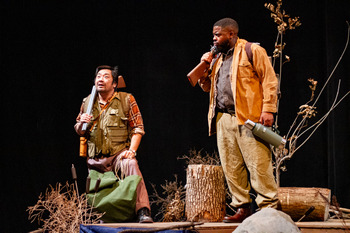
The mighty blizzard that occurred with little warning impacted the entire upper midsection of the nation, from Kansas to Michigan, hitting Minnesota particularly hard. Of the 146 deaths attributed to the storm, 49 were Minnesotans, and about half of those were duck hunters taking advantage of the holiday and what started as an unseasonably warm day in the 60s to trek out to marshes and islands along the Mississippi River to shoot the birds migrating south. The greatest number of casualties were 66 sailors who lost their lives in the sinking of three freighters and two smaller boats, all on Lake Michigan. The monster storm originated in the Pacific Northwest, where it destroyed the Tacoma Narrows Bridge, completed only a few months before. Neerland's play creates a quartet of fictional characters and places them within a framework of the documented facts. Sadie Ward's effective scenic design, visible upon entering the Crane Theatre, sets up the scenario for these characters to play out their ordeal, but first, to establish the calm, peaceable life of neighbors and friends in a Minneapolis working class neighborhood. On the audience-left side of the stage is the kitchen of Connie and Hugh, who recently relocated to Minnesota from the South for Hugh's work. On the audience-right side is the similarly humble kitchen of Gwen and Martin. Martin walks to work at the nearby Honeywell plant, sometimes accompanied by his childhood friend and co-worker, Bo. Both Connie and Gwen are homemakers. Both homes have a front door that opens to the audience and kitchen doors that face each other, with a small yard providing green space between the two. The positioning of the two homes is reminiscent of the Gibbs and Webbs in Thornton Wilder's Our Town. A clothesline is strung across that yard, from one home to the other; behind the clothesline, which can be lowered out of site, is a wooded island, covered by a tangle of brush. The eighty-minute-long play opens with a series of pantomimed scenes in which we see Connie arriving at her new home, being welcomed to the neighborhood by Gwen, and Gwen introducing Connie to Martin when he arrives home from work. As time passes we see Martin inviting his friend Bo home from work with him, and we see Connie appear in the advanced stage of pregnancy, and then caring for her newborn infant. The play shifts into spoken dialogue as Martin and Bo make plans to go duck hunting on Armistice Day, since the weather forecast is promising and they have the day off. Connie invites Gwen to go downtown and watch the holiday parade together. Hugh, whom we never meet, is out of town for his work. What seems like an easy day of simple pleasures turns into a tempest, literally, as we watch in alternating scenes as Bo and Martin contend with the sudden storm and frigid temperatures on the island, while Gwen and Connie negotiate it at home. A scene in which Gwen tries to get to Connie's home, from one kitchen door to the other, through the blinding snow and ferocious wind, using the clothesline as a navigation aid, is one of numerous harrowing scenes that depict the blizzard's fury. The artistry of Jon Kirchofer (lighting design), Forest Godfrey (sound design), and Josh Cragun (video design) meld together to create a vivid rendering of the storm, with the projection of falling snow becoming ever more intense until it seems about to swallow up the entire stage. Anyone would be terrified to be caught outside in that. Rubble & Ash (otherwise known as Barb Portinga and Andrea M. Gross) designed costumes that suit the 1940 time period and working-class status of these characters. Props, designed by Jennifer Moeller, including Connie's darling baby, add further authenticity to the piece. Cate Jackson, as Connie, and Starla Larson, as Gwen, both give superlative performances. These women lived in an era where they had no agency of their own, while their husbands dealt in the world outside, yet each exerts the power they have: Gwen to oversee the chores that Martin must complete before going hunting, Connie to choose to seek harmless amusements, such as the parade, rather than feel stranded at home. Both Jackson and Larson convey these qualities and bring authenticity to the importance of the women's bond of friendship. Martin is portrayed as a devoted husband, happy to let his wife run the household but eager to take time to pursue his own interests and friendships. The play doesn't offer much to flesh out the character of Bo. It is only when the two men find themselves imperiled by the storm, stuck on the island to encourage one another to get through it, that the characters show emotion–perhaps that was not so unusual for men at a time when "feelings" were thought to be the domain of women. At any rate, it is at this chilling point in the play that Quintin Michael, as Martin, and Song Kim, as Bo, bring heat to their performances. While the opening, pantomimed sequence is sweet and establishes all four characters as good, plain, folks, it isn't until the latter half of The Great Armistice Day Blizzard that we sit up and take notice. Of course, knowing even a little of the history behind it, their preparations for their respective outings trigger rising tensions, for we know, as Connie, Gwen, Martin and Bo do not, what lies ahead for them. I admit that I felt a bit slighted by the absence of Connie's husband, Hugh. Had the play started with the days leading up to that fateful Armistice Day, the premise that he was away on business would hold up, but it felt weird that he is never seen in the opening pantomime sequences, which covers a lengthy time frame. In fact, until he is mentioned about a third of the way in, both my companion and I thought that Connie was a single parent. Come to think of it, that might have added additional interest to the play's slight narrative, added to Connie's adjustment as a transplanted Southerner to the frozen northland. The Great Armistice Day Blizzard does an excellent job of depicting a chapter of Midwestern history that is little known and which had a big effect on both storm preparedness and weather forecasting (prior to the storm, the Twin Cities received their weather forecasts from Chicago; subsequently, a Minneapolis-St. Paul weather bureau was created). With exceptionally strong stagecraft and solid performances, we see, hear, and feel the fury of this event. Survivors of the storm still with us–one was in the audience when I attended–can attest to the lasting impact, even though the event was completely overshadowed a year later by the storms of war brought on at Pearl Harbor. The Great Armistice Day Blizzard, runs through December 21, 2025, at Nimbus Theatre, Crane Theater, 2303 Kennedy Street N.E., Minneapolis MN. For tickets and information, please visit nimbustheatre.org or call 612-548-1379. Playwright and Director: Liz Neerland; Set Design: Sadie Ward; Costume Design: Rubble & Ash; Lighting Design: Jon Kirchhofer; Sound Design: Forest Godfrey; Prop Design: Jennifer Moeller; Video Design: Josh Cragun; Stage Manager: Alyssa Thompson. Cast: Josh Cragun (Voice heard on radio), Cate Jackson (Connie), Song Kim (Bo), Starla Larson (Gwen), Quintin Michael (Martin). |