|
Regional Reviews: Minneapolis/St. Paul My Name Is Florence Also see Deanne's review of Go, Dog. Go! Ve Perro ¡Ve! and Arty's review of The Happiest Man on Earth
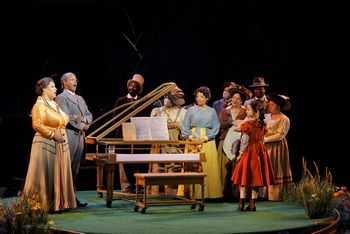
Based on a small sample within My Name Is Florence, as well as the listening I have since done to become more familiar with the artist, her recognition is long overdue. Almost all of the lush music heard in the course of My Name Is Florence is original, composed by B.E. Boykin, but with tonal and melodic currents that pay homage to Ms. Price's compositions. A few musical themes recur throughout the one-act opera, which begins with a brief opening in which we meet her mother, also named Florence but here called Granny, and her daughter who she also named Florence–making three generations of Florences–who is called Lo-Lo. The opera then divides into four segment, depicting periods in the life of Florence Price. The first segment set in 1900 in Little Rock, Arkansas shows Florence (born Florence Smith) as a child, being nagged by her imposing mother to practice her piano. In a clever bit of staging–Eboni Adams is the adroit stage director–Florence is portrayed as a child by a child actor, Denali Massie, who neither sings nor speaks, but through gestures and movement brings the child to life while Flora Hawk, with a luminous soprano, sings the role. We meet Florence's father, a dentist called Papa Jay, who encourages his daughter in more playful pursuits, to Granny's dismay. Granny repeats the mantra "Practice makes the master," to which young Florence sarcastically retorts "Master of practice?" But Granny's most insistent assertion to her daughter is to avoid the sun in order to maintain the light complexion that she credits with her own and her parents' "transcendence" of the oppressive conditions imposed on African Americans. In the second segment, Florence arrives at the esteemed New England Conservatory of Music, where she double majors in organ and piano, and earns teaching credentials. Her mentor, Professor Chadwick, encourages her interest in composing music. She tells the professor that she wants to "write about the everyday things that Negroes do." Her mother, however, cautions Florence that composition is a field for white men and that teaching is a more prudent pursuit for a Black woman. The third segment, set in 1911, has Florence back in Little Rock, having completed the conservatory. Her father has died and her mother plans to leave Arkansas to evade the increasing subjugation of Jim Crow. She is confident that in the North her fair complexion will continue to enable her to "transcend." The final segment spans the years 1931 to 1944. Florence moves to Chicago where she gives music lessons and creates an enormous repertoire of her own music, as well as raising a daughter. Florence (joined by Granny and Lo-Lo) gives voice to the power inherent in a woman's act of passing her name on to her daughter, just as men have done routinely for centuries. Though Florence means to bequeath power to her daughter, she has little time for Lo-Lo, as she is consumed by her drive to compose, even in the face of repeated rejections (after one early success) to have it played, or even considered, by major orchestra directors. Harrison David Rivers' libretto is beautifully scripted, with poetic phrases that capture Florence Price's emotionally challenging pursuit of her art. It is pleasing to listen to throughout and it complements Boykin's roiling score superbly. That said, there is much repetition of a few key ideas: the barrier posed by Florence's gender and race; the power in a legacy of women's names; and the notion of light skin tone enabling African Americans to "transcend" their race, a notion that the opera's conclusion firmly controverts. Rather than the repetition of themes, it would have been enriching to learn more about Florence's life, for example, her two marriages (the first ending in divorce, the second in life-long separation) or her long friendship with her student and fellow African American composer and pianist Margaret Bonds. There is also little to demonstrate how she was impacted by Jim Crow in the South or de facto racism in the North. We see her work repeatedly rejected by one particular orchestra director but do not see her reaching out to other major orchestras. Did she? We are left to speculate. The stunning score is performed by an on-stage orchestra of thirteen musicians, scaled back from the full Minnesota Opera, but while the ensemble is modest in size, it is substantial in its performance. They endow Boykin's score's first public hearing with grace and vigor, under the baton of music director Mario Antonio Marra. The three primary vocalists in My Name Is Florence are making their Minnesota Opera premieres. Flora Hawk holds the center as Florence Price with a glowing soprano that illuminates her mix of humility with determination and resilience, her struggle to balance her role as a mother with the drive to produce new work, and her belief in the inherent value in her art, even thought it was unacknowledged by the elites of the classical establishment. Hawk emits a radiance that contributes to the feeling that her character, Florence Price, has a rare gift. Deborah Nansteel plays Granny, with a rich mezzo-soprano that seems to come from deep within as it portrays the dignity, and an implied sense of superiority, with which she traverses her life. Arianna Rodriguez is Lo-Lo, Florence's daughter, whose plaintive soprano expresses the hurt she feels as her mother obsesses about her work, then manages to redirect those feelings in order to support and be a champion for her mother's genius. The three other soloists are all Minnesota Opera Resident Artists. Florence's father is played by bass-baritone John Mburu, who sings effusively as he presents his character's emotional connection with his daughter. The way in which he encourages her spontaneity and laughter is in marked contrast to Florence's mother's character. As presented in My Name Is Florence, it is difficult to conceive of these two characters as a happily married couple. Tenor Angel Vargas sings the role of Professor Chadwick, conveying his firm belief in his pupil's talent. Mezzo-soprano Kara Morgan sings the small role of Jane, Florence's friend at the conservatory, in clear, lovely tones. The opera chorus (pared to eight members for this production) appears in several scenes, with full, precisely harmonized voices under direction of chorus director Celeste Marie Johnson. The production's scenic design by Eli Sherlock eschews detail and lavishness often associated with opera. Sherlock places the skeleton of a piano, in vibrant yellow, on an apron extending over the orchestra pit (as the orchestra is on onstage), where much of the work's drama is staged. Two raised playing areas, to either side and upstage, provide other locations. The rear of the stage is ringed by large sculptural reeds that curl inward, which, along with floral plantings places around the piano area, create a sense of Florence Price cultivating her music as if in a garden. Rachel N. Blackwell's lighting enhances the production throughout, and Trevor Bowen's exquisite period costumes are a great asset. I would happily listen again and again to Boykin's score, especially if performed by the immensely talented musicians and singers in this production. However, it would be an even more enriching experience if the creative artists had chosen to tell more of Florence Price's story, with its emotional and contextual complexity. Minnesota Opera's My Name Is Florence runs through February 8, 2026, at the Ordway Center for the Performing Arts, 345 Washington Street, Saint Paul MN. For tickets and information, please call 612-333-6699 or visit www.mnopera.org. Music: B. E. Boykin; Libretto: Harrison David Rivers; Conductor and Head of Music: Mario Antonio Marra; Stage Director: Eboni Adams; Scenic Design: Eli Sherlock; Costume Design: Trevor Bowen; Lighting Design: Rachael N. Blackwell; Wig, Hair and Make-Up Design: Emma Gustafson; Chorus Director and Assistant Conductor: Celeste Marie Johnson; Intimacy Director: Alli St. John; Assistant Stage Director: Margaret Jumonville; Répétiteur: Fumiyasu Kawase; Stage Manager: Luci Burdick. Cast: Flora Hawk (Florence Beatrice Price), Denali Massie (Young Beatrice), John Mburu (Papa Jay), Kara Morgan (Jane), Deborah Nansteel (Granny), Arianna Rodriguez (Lo-Lo); Angel Vargas (Professor Chadwick). |