|
Regional Reviews: Minneapolis/St. Paul Marie and Rosetta Also see Arty's review of Vienna, Vienna, Vienna
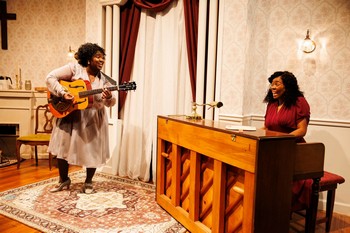
Co-directors Ansa Akyea and Richard D. Thompson deftly balance vibrant musical performances with exposition in which Hodges, as Marie, and Gilliam, as Rosetta, each reveal their backstories. When the play begins, we find ourselves in a Mississippi funeral parlor in 1946. The older woman, Rosetta, sits facing the audience with her eyes closed while the younger, Marie, applies makeup to her, vocally expressing her desire to bring out every facet of Rosetta's beauty. When she is done, Marie gets no response from Rosetta until, with a start, Rosetta says she must have fallen asleep. From that point on she is wide awake, regaling both Marie and the audience with her songs and stories. We learn that is the first time the two women are rehearsing together, Rosetta having just recruited Marie away from a gospel quartet on tour with Mahalia Jackson, then an emerging star. Rosetta refers demeaningly to Jackson as "Saint Mahalia" because of the piety in her music, as opposed to the earthiness with which Rosetta delivers the gospel. Though the quartet singing with Jackson was similarly restrained, Rosetta saw and heard something in Marie that set her apart. The fact is, Rosetta's career has been ebbing the past couple of years, after a hot streak beginning with her first recording, "Rock Me," in 1938. She believes that pairing up with Marie will give her the edge to regain her stature. Marie accepts Rosetta's offer, but with trepidation about playing music that honors the Lord in a growly, bluesy voice augmented by swiveling hips. She also worries about displeasing the Lord by playing in seedy joints. Rosetta explains that up north she can perform in swank places–at Carnegie Hall and the Cotton Club, on bills with Cab Calloway and Duke Ellington–but in the Jim Crow south, she plays barns, warehouses, and any spot where Black folks can gather for a night out. She and her band travel with a white bus driver so there's someone able to enter a diner and purchase their food. And forget hotels: they count on the kindness of good Samaritans willing to offer whatever lodging they can, even if it means dressing and sleeping in a mortician's front parlor, as is the case tonight. As the two get to know one another better, Rosetta persuades Marie that her music, with its fire and grit–after all, Sister Rosetta Tharpe is often referred to as the "Godmother of Rock and Roll" and is said to be an influence on the likes of Elvis Presley (who cited Tharpe as one of the five greatest influences on his music), Little Richard, Eric Clapton and Jimi Hendrix–nonetheless brings folks in need of salvation over to the Lord. She asserts to Maria, "You reach more sinners in a dance hall than at church." Largely through her music, Rosetta, who insists that Marie call her "Sister," and not "Miss" Rosetta, loosens her protegee up, including a delightful bit in which she gives Marie hands-on instruction in hip-swiveling, while Marie's queries open Rosetta up to more reflective talk about her religious upbringing and her early marriage to an abusive preacher. The two find more in common than first met the eye. Brant does a good job of laying out this exposition with dialogue that flows authentically from the experience of these women's lives, but it's the music that raises Marie and Rosetta from a well-crafted but slight play to a celebration of gospel, soul, blues and rootsy rock. We first hear Sister Rosetta's joyful rendition of "This Train," followed by pious Marie's dignified but moving "Were You There." When they get to "Rock Me," their respective ties to roadhouse and to church collide. To no one's surprise, Rosetta's deep-throated, hip-swaying, truth-telling "Rock Me" prevails over Marie's demure performance style. From there, each song is performed with glorious power and heart, with both solos and duets. These include the comedic "Sit Down, (I Can't Sit Down)," the beseeching cry for truth in "Didn't It Rain," the lusty "Tall Skinny Papa," and the smart-alecky "Four Five Times." Some of the songs were part of Marie and Rosetta's repertoire during their three years performing together, while others come from earlier or later periods of their careers. Their placement within the play advances the growing relationship between these two women, to illustrate Marie's drift from pure gospel toward Rosetta's sensuality, along with the inner challenges each faces. Near the end, Rosetta brings out her secret weapon, an electric guitar that she is about to introduce to her audiences. Marie wonders if there isn't something evil about it, but she is soon on board with the celebratory "Strange Things." Brant concludes the play with a bit of dramatic license in order to flash forward and describe the three years of Sister Rosetta Tharpe and Marie Wright's performing together, and then how they lived their lives out apart, culminating with a beautifully poignant "Peace in the Valley." Both Gilliam and Hodges are new to me. Both actors perform their roles beautifully, both vocally and in conveying the bawdy humor and tender poignancy laced throughout the play. Except for a couple of songs, one for each actor, in which they hold their guitars vertically so are visibly not actually playing as pre-recorded music accompanies their voices, they work with both piano and guitar convincingly. Sound designer Jeff Bailey has synchronized the recorded musical accompaniments to the actors' voices with precision. Sarah Brandner's set creates a reasonable facsimile of a humble funeral parlor's front room. Samantha Fromm Haddow's costume design provides each character with a dress that reflects post World War II styles and suits their personalities. Alex Clark's lighting design softens and funnels on one of the two women when the play reaches into their interior lives, while brightening and filling the stage when they make exultant connections through the music. One note, which may be of interest to anyone who has seen Marie and Rosetta before, as I did when Park Square mounted the play in 2019. In that production I sensed a sexual attraction forming between the two women. I learned since then that there were unconfirmed rumors, according to Thorpe's biographer Gayle Wald, that the two were not only musical partners but lovers. Whether or not that was true, those feelings are not apparent in this production. What comes across is genuine respect for one another's talent, and an abiding affection as friends. . Marie and Rosetta is pleasing as a biography of a true pioneer in twining the sounds of gospel and blues into two wholly new American sounds, rhythm and blues, and rock and roll. Much more could be said about Sister Rosetta Thorpe's life than this 100-minute play allows, but it does do justice to the tension between music deemed as sacred and music deemed as profane. It makes a case that each is in the eye of the beholder, or more aptly the ear of the listener, and the heart of the musician. The real heart of Marie and Rosetta, though, is in the spirited and beautifully rendered performances of songs that are bound to lift your heart and put a little swivel in your hips. Marie and Rosetta runs through April 19, 2026, at Yellow Tree Theatre, 320 5th Ave SE, Osseo MN. For tickets and information, please call 763-493-8733 or visit YellowTreeTheatre.com. Playwrights: George Brant; Co-Directors: Ansa Akyea and Richard D. Thompson; Set Design: Sarah Brandner; Costume Designer: Samantha Fromm Haddow; Lighting Design: Alex Clark; Sound Design: Jeff Bailey; Props Designer: Brandt Roberts; Norm Tiedermann; Technical Director: Dylan Gourley; Stage Manager: Samantha Smith; Assistant Stage Manager: Ninchai Nok-Chinclana. Cast: Adair Gilliam (Sister Rosetta Thorpe), Chaz Shermil Hodges (Marie Knight), Angela Stewart (understudy for Sister Rosetta Thorpe). |