|
Regional Reviews: Minneapolis/St. Paul Harry Potter and the Cursed Child Also see Arty's review of The Wizard of Oz
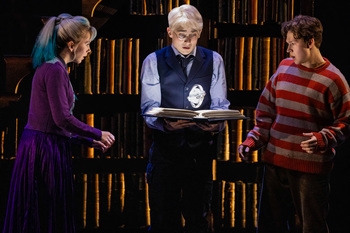
Cursed Child was developed as a story by J.K. Rowling (author of all seven Harry Potter novels), Jack Thorne, and John Tiffany before being adapted to a play by Thorne. Tiffany went on to direct in London (Olivier Award), on Broadway (Tony Award), and the touring production. The show is saturated with dazzling stage effects that, if you let yourself, can easily be taken as actual magic (Jamie Harrison is the wizard credited for illusions and magic). Phenomenal lighting (designed by Neil Austin), sound (Gareth Fry), and sets (Christine Jones) transcendently move the story from place to place and time to time. Add Rinn Ross and Ash J. Woodward's video work, Katrina Lindsay's astutely realized costumes, and Carole Hancock's wig, hair, and makeup, and we have a show that is never less than captivating to the eye. But what about the story? J.K. Rowling (who has her fans and her detractors) did show a genius through the seven novels for intricate plotting, distinctive characters, and gingerly bringing back bits from here and pieces from there to make each book into a gratifying whole. Does Cursed Child show the same narrative mastery? I will say yes and no. Be forewarned, for those unfamiliar with the plotline of the series, there are a couple of spoilers (of the books, not the play) in what follows. In addition to John Tiffany's herculean labors in assembling this long and intricate narrative on stage, he works with his childhood friend, movement director Steven Hoggett, to insert bridges between scenes that depict a throng of wizards darkly attired, moving in militant formations while flashing their black cloaks under the piercing lights, that all creates a very foreboding effect. There are also choreographed vignettes of students navigating the labyrinthian corridors and stairwells of Hogwarts, using movable stairs and bridges to create an endless array of directions. The imagery is quite engrossing, but I am uncertain of its intended effect. It does convey an atmosphere of foreboding, as well as an awareness of stretching out the play's already long run-time. The play jettisons forward nineteen years from where the last of the novels, "Harry Potter and the Deathly Hallows," left off. Harry has settled into a senior management position in the Ministry of Magic. His boon companion through their years at Hogwarts School of Witchcraft and Wizardry, Hermione Granger, is now Minister of Magic, while his other boon companion, Ron Weasley, is married to Hermione and runs a joke shop. Harry is married to Ron's younger sister, Ginny, and they have three children: Lily and James, named for Harry's parents whose heroic deaths left him an orphan, and Albus Severus, named for Harry's mentor and Hogwarts' late headmaster, Albus Dumbledore, and his nemesis/protector, Severus Snape. Young Albus struggles not only with living in the shadow of his celebrated father but with bearing the names of two legendary wizards. Harry finds it difficult to counsel Albus; Ginny better understands their son's needs. Albus has reached the age of attending Hogwarts, where a magical Sorting Hat determines in which of the school's four houses each student is to spend their next seven years, and in a sense, will set the course of their life. Those unfamiliar with the books will be at a disadvantage here, as the business of the four houses isn't really explained in the play, other than Albus' strong preference to land in Gryffindor, home to his father and mother during their Hogwarts years. Riding to school on the Hogwarts Express with Rose Granger-Weasley, daughter of Hermione and Rose, Albus expresses his fears of being friendless at school, which makes it a pleasant surprise when he strikes up a friendship with a fellow traveler. When they discover that this boy is Scorpius Malfoy, son of Harry's arch-nemesis Draco Malfoy, Rose suggests they sit elsewhere, but Albus has a sense that he belongs with the unathletic, chattering Scorpius. In fact, like Albus, Scorpius struggles with meeting the expectations of a notable father. Scorpius, Albus, and their dads, Draco and Harry, are the primary characters for the duration of the play, which involves several loops of time travel that bring us back to incidents in the earlier books (and even further back) and to alternative versions of the present. We are introduced to Delphi Diggory, a new character who accompanies Albus and Scorpius on their mission to undo the death of Delphi's cousin, Cedric, while a student at Hogwarts, a death for which Cedric's embittered father Amos still blames Harry. Some well-known characters from the novels also make appearances, including Dumbledore, Snape, Professor McGonagall, Dolores Umbridge, and the sad sack ghost, Moaning Myrtle. The plotting is intricate, akin to the novels, and full of inventive twists and devices. Its primary characters show inner development while dealing with fought challenges both of wizardry and parenting. To this degree, the play succeeds in fulfilling its promise. On the other hand, a play is not a novel–for one thing, you can't turn back the pages to reread or recall something when the need arises–and the play's series of repeated loops that call for keeping a vast array of characters, gadgets, magical powers, and other details straight becomes frustrating and even a bit tedious, as it is not always clear where a given leap through time has landed us. With the emphasis on travelling back in time, the play offers no forward development in the narrative in terms of further adventures. There are, however, emotional developments in the rapprochement between Harry and Albus, in a final mending of fences between Harry and his mentor, Dumbledore, and in the blossoming relationship between Albus and Scorpius. The last is left open enough for theatregoers to form their own understanding of what may lie ahead. This emotional growth comes unexpectedly and mitigates some of the disjointedness experienced in telling the story, as the epic comes to a satisfying conclusion. Nick Dillenburg gives a remarkable performance as Harry, expressing the doubt that plagued the young wizard all through the novels, and the courage do what is necessary to defeat evil–including risking a transformation into the source of evil itself. Ryan Hallahan also gives a solid performance as Draco, retaining the character's snide posturing, but finding the capacity to work "across the aisle," in a sense, for the greater good of rescuing his son. Adam Grant Morrison is impressive as Albus, convincing as a lost adolescent struggling to find his own truth, whose self-doubts and resentments can come across as snipes. David Fine conveys tenderness and captures the comical aspect of Scorpius, though frequently goes beyond comical to camp, which is a distraction from the overall tone of the play. Julia Nightingale makes a strong impression as Delphi, the cheery niece who harbors a dark inner self. Rachel Leslie nicely captures Hermione's sense of propriety and her competitive spirit. Matt Harrington, as Ron, is saddled with an underwritten character that becomes mainly a bit of comic relief. Abbi Hawk makes a fine Ginny, a strong-spined, yet warm-hearted partner for Harry and mother for Albus. Andy Pogson deftly presents quite different personas as Dumbledore, Snape, and Amos Diggory, each a small but significant role. Katherine Leask, as McGonagall and Umbridge, captures the characters' spirits, but allows their accents to call too much attention to themselves. While the play is lengthy, it is a shadow of its original self. Harry Potter and the Cursed Child first opened both in London and in New York as a two-part play, to be seen either on the same day (matinee and evening performances) or successive evenings. Before reopening after the COVID lock-down, the New York production was consolidated into a single part, running three and a half hours. Since then, it has been shortened even more, with a current run time of two hours, 55 minutes, which is the version seen in the tour. Other productions world-wide have switched to the shorter version. Only the original London production continues to show the play in two parts, but that too is planned to switch to the one-part version in October of this year. While the benefits of a shorter running time are manifold, one wonders if some elements that might have made the plot feel less choppy were sacrificed. Still, this play is substantial and certainly worth seeing, if only for the fantastic design and stagecraft on display. It really does impress, garnering applause mid-scene for some of the illusions. Several strong performances, in particular from Nick Dillenburg as Harry Potter, add further strength. The story is engaging, even if difficult to stay abreast of at times, and the satisfying conclusion makes it easy to forgive the sense of being jostled back and forth before arriving there. And if you are a Potterhead–or obliging parent to a young Potterhead–you probably have your mind fairly made up about whether or not Harry Potter and the Cursed Child is a must-see. Harry Potter and the Cursed Child runs through May 17, 2026, at the Orpheum Theatre, 910 Hennepin Avenue, Minneapolis MN. For tickets and information, please call 612-339-7007 or visit hennepinarts.org. For information on the tour, visit tour.harrypottertheplay.com. Playwright: Jack Thorne, base on an original story by J.K. Rowling, Jack Thorne, and John Tiffany; Director: John Tiffany; Movement Director: Steven Hoggett; Composer and Arranger: Imogen Heap; Scenic Design: Christine Jones; Costume Design: Katrina Lindsay; Lighting Design: Neil Austin; Sound Design: Gareth Fry; Video Design: Rinn Ross and Ash J. Woodward; Wig, Hair and Makeup Design: Carole Hancock; Illusions and Magic: Jamie Harrison; Music Supervisor and Arranger: Martin Lowe; Associate Director: Colette Robert; Associate Movement Director: Chelsey Arce; Production Stage Manager: Kate McDoniel; Casting: Jim Carnahan, CSA and Alexandre Bleau, CSA. Cast: Kaleb Alexander (Sorting Hat), Julianna Austin (Polly Chapman), Josh Bates (Cedric Diggory/ James Potter Jr./James Potter Sr.), Markcus Blair (ensemble), Danny Bó (Yann Fredericks), Riley Bocchicchio (ensemble), Ashley Bufkin (Madam Hooch), Casey Butler (ensemble), Erin Chupinsky (ensemble), Nick Dillenburg (Harry Potter), Jamyl Dobson (until May 3 Teacher), David Fine (Scorpius Malfoy), Simon Gagnon (ensemble), Matt Harrington (Ron Weasley), Ryan Hallahan (Draco Malfoy), Abbi Hawk (Ginny Potter), Nathan Hosner (Voldemort), Danielle Lee James (ensemble), Chris Jarman (voice of Phone Box), Torsten Johnson (Professor Mazoni), Katherine Leask (Professor McGonagall/Professor Umbridge), Rachel Leslie (Hermione Granger), Mackenzie Lesser-Roy (Moaning Myrtle/Lily Potter Sr.), Evan Maltby (ensemble), Naiya Vanessa McCalla (Rose Grange-Weasley/Young Hermione), Adam Grant Morrison (Albus Potter), Julia Nightingale (Delphi Diggory), Zach Norton (Karl Jenkins/Viktor Krum), Chanté Odom), Andy Pogson (Albus Dumbledore/Amos Diggory/Severus Snape), Will Rhem Jr. (beginning May 5 Teacher), Ayla Stackhouse (ensemble), Elise Southwick (ensemble), Jennifer Thiessen (ensemble), Timmy Thompson (Craig Bowker, Jr.), Paul Thornley (voice of Ludo Bagman), René Thornton Jr. (Stationmaster), Lauren Zakrin (Trolley Witch). |