|
Regional Reviews: Minneapolis/St. Paul Two from the Fringe: Also see Arty's reviews of Machinal, In the Heights and Private Lives
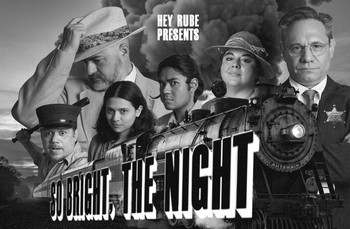
So Bright, the Night by Marcus Anthony, who also directed, is a noir-ish historical drama set in 1930s California. A woman, Maria de la Fuente, and her teenage daughter Paula have purchased tickets for a first-class compartment heading from Sacramento to Los Angeles. Maria carries a purse crammed with all the remaining money she could get her hands on. In a car carrying prisoners on the same train, her husband is among those rounded up by immigration agents for deportation in the days of the Mexican Repatriation that accompanied the Great Depression, particularly in its first few years. Maria hopes that her money will enable her to free her husband once they arrive in Los Angeles. Paula is more pessimistic about the endeavor, especially after being told she must speak English and avoid drawing attention in order to pass for white. Even so, they attract the unnerving attention of the Bull, a combined conductor and bouncer who checks passengers' tickets and looks for Mexicans to send to the prison car. The fact that the Bull is a Mexican himself and enjoys holding his privilege over his less fortunate countrymen makes it even worse. Three other men aboard the train enter the story. Sheriff Trager, who claims to represent the law, is a full out racist, determined to not let any Mexicans slip past him alive. Whether they, their parents, or their grandparents were born and lived all their lives in the United States makes no difference. Fritz Garza is a private detective claiming to have been sent by Maria's family to stop her. He is Hungarian, having fled to the United States after being on the losing side of World War I–so, also an immigrant, but one with white skin. Ernesto is Paula's boyfriend, who boards the train at great risk after receiving a note from Paula telling him she was leaving. Ernesto is involved in Repatriation resistance activities. Fringe shows are restricted to 50 minutes, and that's a lot of exposition to set up, flesh out, and bring to resolution in such a short time. The playwright does a good job with the first step, setting up an intriguing set of circumstances based on an historical episode that is not well known, yet bears striking similarities to our government's current treatment of immigrants. This relevance and the sense of an unsavory chapter of our history repeating itself, draws us tightly in to the drama and characters. Unfortunately, those fifty minutes pass quickly, so there is little time to fully develop the characters. Under those constraints, Anthony does a fairly good job of embedding both Maria, played by Claudia Garcia, and Paula, played by Nina Aguilera, with discernible personalities; the others are portrayed as "types," through no fault of the actors, all of whom give solid performances, particularly Matthew Saxe as the opportunistic Garza. The play takes place mainly in that small first-class railroad compartment, the set made up of two wooden benches facing one another, angled to allow the audience a clear view of the actors. It is simple and effective. Anthony, as director, makes good choices that take advantage of the tightly enclosed space, and keeps the level of tension and uncertainty rising throughout. The end comes too soon in So Bright, the Night; the resolution feels rushed and the chaotic final scenes have the feel of being tacked on out of the playwright's desperation to wrap things up before his fifty minutes run out. Anthony nicely sets up the story, with interesting characters and dialogue that feels authentic. I believe there is enough substance and promise in the play's beginning to warrant further development, perhaps as a ninety-minute play, and give the characters and their story more room to breathe.
Be Not Afraid is set in the tar-oil fields of western North Dakota during the early 1990s, when farmers were only too glad to sell off their hard-scrabble land to oilmen who got rich drawing carbon-based fuels out of the earth. In the process, the influx of free-spirited men to work the fields, the inflated cost of living due to insufficient housing and other amenities, and the damage done to the natural environment took their toll. One farmer, Jordan, is determined to hang on to his farm and does everything he can to make a go of it, despite the fact that his father, before dying, sold the mineral rights to the oilmen. Jordan's wife, Micah, is fearful about their prospects. Peter, Jordan's brother (I think, his brother, it was hard to follow), has come back, not to work on the farm but to earn money in the oil fields. Sam, another farmer (who might also be Peter and Micah's sibling, this too was never clear) struggles with her part of the land that is their legacy. Then an angel appears, a rather frightening angel, but still an angel, issuing a warning to Micah to leave the land. At this point the play fell apart for me. Is the Angel encouraging the farmers to give up, to concede the Earth to its despoilers? I must say, I love plays that challenge me to think beyond the realm of our known world, but this just feels contrived, and without a cord of internal logic. Micah suffers a nervous breakdown trying to heed the angels warning, as she understands it. Jordan becomes ever more anguished as he struggles to keep the farm going, Peter ponders the possibility of the angel being real but takes no decisive action, Sam's beloved horses suffer a horrible fate when they come in contact with the oil fields, and a slimeball oilman named Mason, taken in as a lodger by Jordan, shoots a white deer that seems to have more wisdom than any of the other characters. Church and Stephanie Kahle co-directed the production, which utilizes some visually effective stage images–particularly images of the oil-field workers pounding into the earth with long poles. Ben Qualley, as Jordan, and Logan Lang, as Peter, both give good performances. Costume designer Mary Lofreddo came up with a wonderful costume for the deer, and Rachel Brees contributes well-conceived sound design. But the play overall rambles, conveying the notion that it has something important to say but without sorting out quite what that is. I have a hard time making heads or tails of the take-away the playwrights had in mind. The story is grim, without being particularly enlightening. So Bright the Night, a Hey Rube! production, runs through August 16, 2026, at the Minnesota Fringe Festival, Southern Theater, 1420 Washington Avenue South, Minneapolis MN. For more information, please visit minnesotafringe.org/fringe-festival. Playwright, Director, and Producer: Marcus Anthony; Choreographer: Kirsten Stevens; Costumes: The Costume Collective; Props: Next Stage Props. Cast: Nina Aguilera (Paula de la Fuente), Shad Cooper (Sheriff Trager), Claudia Garcia (Maria de la Fuente), Jeyman Rodriguez (The Bull), Matthew Saxe (Fritz Karza), Diego Symouksavanh (Ernesto Cabral). Be Not Afraid, a Third Space Theater production, through August 16, 2026, at the Minnesota Fringe Festival, Southern Theater, 1420 Washington Avenue South, Minneapolis MN. For more information, please visit minnesotafringe.org/fringe-festival. Playwrights: Mariabella Sorini and Alex Church; Directors: Alex Church and Stephanie Kahle; Costume Design: Mary Lofreddo; Sound Design: Rachel Brees; Composer: Alex Church; Stage Manager: Wren Heiman. Cast: Sebastian Grimm (Mason), Logan Lang (Peter), Hannah Leatherbarrow (The Baron), Mary Lofreddo (Deer), Ben Qualley (Jordan), Tamira Rashid (Sam), Em Adam Rosenberg (The Angel), Mariabella Sorini (Micah). |