|
Regional Reviews: Minneapolis/St. Paul Wait Until Dark Also see Arty's review of Dirty Dancing
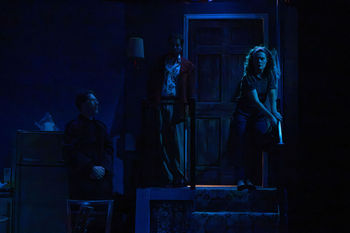
Wait Unit Dark ran a year on Broadway, and a film adaptation that closely followed the play's plotting opened almost immediately afterwards. The movie was a major hit in 1967, owing to its slick, fright-inducing plot, and the star power of Audrey Hepburn in the leading role of Suzie Hendrix, a young, blind housewife living with her husband in a Greenwich Village basement apartment, with strong support from Alan Arkin, Richard Crenna, Jack Weston, and Efrem Zimbalist Jr.. Because of this, and the magic of VHS, DVDs, cable, and streaming, quite a few people have some familiarity with the story. Until settling in for Dark & Stormy's production, I had never seen Wait Until Dark on stage, but I saw the movie years ago. I remembered the basic premise, but not many of the details–which was good. Wait Until Dark gets a lot of its mileage through elements of surprise and twists and turns in the plot. The less you know–or, as in my case, remember–going in, the better. I will give you a broad outline that will still leave you in the dark–pun intended. Susy (Sara Marsh) is set upon by three criminals, who, for the purpose of their ruse, use the names Mike (Paul LaNave), Officer Carlino (Bob Malos), and Harry Roat (Paul de Cordova) to retrieve a doll that Susy's husband, Sam (Josh Jabas), brought into their apartment, not knowing that it is stuffed full of heroin. The bad guys, with Roat at the helm, hatch a scheme to persuade Susy, while Sam is at work, to find the doll and gladly hand it over to them. There is one other character, and she is a corker: Gloria (Madelyn Tax), a keenly observant young girl who lives in the upstairs apartment and regularly runs errands for Susy. That's all I will say about the plot, but there is an element in the play that bears notice. We learn that Susy became blind from an accident a little over a year before. Shortly afterward, she met Sam, and they married about six months ago. Susy is clearly a strongly resilient woman, able to have moved forward after a traumatic loss and to enter into a relationship based on trusting a man she has never seen. We see Sam interacting with her, both deeply supportive and staunchly demanding. He coaches Susy on how to manage in their home, as well as out on the streets. He wants to prepare her to walk, alone, the several blocks from their apartment to the photo studio where he works. Sam is a photographer, meaning that Susy can never see the fruits of his work. What cruel irony! This does not enter into Knott's plotting of the narrative, but it speaks to the limits of what Susy can know about her husband, and the faith required to sustain a marriage within those limits. This presentation of Susy's resolve, her ability to draw on her wits under dire pressure, and her capacity for faith in the face of uncertainty, draws us to believe in her. Of course, to pull this off requires performances that fully embrace the nature of their characters, and this production, under Benjamin McGovern's adroit direction, achieves that up and down the line. Marsh, as Susy, is totally at ease early on, in conversations with her husband, joking and affectionate, asking him to ease up on his demands of her but, in fact, pleased with his confidence in her. She is reserved but amiable to Mike when he arrives and introduces himself as an old friend of Sam's. Then, as each piece of the scheme falls into place, Marsh conveys a gradually growing sense of alarm–at first, mainly confusion, then concern, and finally full-tilt fear, but still maintaining her head to plan a defense. The performance is beautifully modulated to match the rising tension the audience feels. LaNave, in a nuanced performance as Mike, conveys the sense of someone who has paid some dues and wants to get back what he lost, but perhaps is not wanting a full return to the depth of his past life. He even reveals regret at having to deceive Susy by pretending to be a family friend, when that is far from the truth. Malos, in the guise of Sargent Carlino, emits great nervous energy, wanting to get back in the game but always looking over his shoulder, lest he be nabbed in the act. De Cordova, who took over the role of Harry Roat shortly before the play's opening, delivers Roat's eccentricities which steadily reveals a truly sinister nature. De Cordova was not completely off-book on opening night, but his line readings were precise and he physically embodied the character with panache, owning the role. Madelyn Tax is remarkable as Gloria. If you saw Tax a year ago as Marie, the sex-minded college student in Dark & Stormy's production of Come Back, Little Sheba you wouldn't know this was the same actor. With effective costuming (Marsh designed the well-conceived costumes) and hair styling, and use of a child-like vocal cadence and physical bearing, Tax marvelously becomes Gloria. She and Marsh make the progression in Susy and Gloria's relationship over the course of the play feel totally authentic. Josh Jabas has the smallest role, as Sam, but it is critical to establishing Susy's resilience, and her reasons for holding on to her belief in her husband even when the criminals cast terrible doubts about him. Jabas conveys Sam's trustworthiness, both to Suzy and to all of us. Bobbie Smith's set design provides all the features necessary for the story to play out in cramped quarters, a combined living room and kitchen in a Greenwich Village apartment of mid 1960s vintage, complete with a highly place window typical of the basement level. Aaron Newman's sound design provides numerous essential sound cues–vehicles, footsteps, a ringing phone, weather activity–and Shannon Elliott's lighting provides shades of darkness leading up to the play's suspenseful end. The play itself is primarily an exercise that sets up a clever scheme, letting us in on it from the start, then letting us watch to see if its vulnerable victim will ferret out the truth and if called on, can defend herself. There is no great resolution of a burning issue, no narrative transit that brings us from a point A to a point B, no relationship solidified or shattered. Wait Until Dark is all about suspense that ratchets higher and higher, as if asking us to hold our breath until we begin to feel light-headed, then finally allowing us to release. But it does a damn good job of that, and if you enjoy that kind of entertainment–as many of us do–this one is for you. McGovern's water-tight production, and the compelling performances by Sara Marsh and a sterling supporting cast, deliver a top flight time at the theater. Wait Until Dark runs through September 13, 2026, at the Gremlin Theatre, 550 Vandalia Street, Saint Paul MN. For tickets and information, please call 612-401-4506 or visit www.darkstormy.org. Playwright: Frederick Knott; Director: Benjamin McGovern; Scenic and Props Design: Bobbie Smith; Costume Design: Sara Marsh; Lighting Design: Shannon Elliott; Sound Design: Aaron Newman; Fight Choreographer: Annie Enneking; Stage Manager: John Novak; Producer: Sara Marsh Cast: Paul De Cordova (Harry Root, Jr.) Josh Jabas (Sam Hendrix), John Lager (voice of Policeman #!), Paul LaNave (Mike Talman), Bob Malos (Sargent Carlino), Sara Marsh (Susy Hendrix), Benjamin McGovern (voice of Policeman #2), Madelyn Tax (Gloria), |