|
Regional Reviews: Minneapolis/St. Paul Nina Simone: Four Women
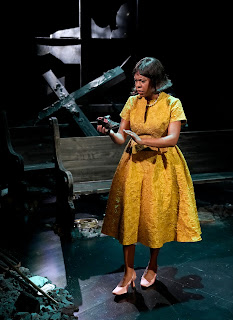
Nina Simone was an extraordinary African American singer, pianist, and composer. Born in 1933, she was a musical prodigy by the age of three. She was bent on being a classical musician, but those doors were barred to her–her skin being too dark and her nose too broad–so she found sustenance as a supper club performer in the 1950s, evolving through the 1960s and 1970s into a mesmerizing singer of soul, blues, and pop music. The mystical vocal incantations and movements she wove into her performances earned her the sobriquet "The High Priestess of Soul." She also became an outspoken proponent of civil rights, both through her music and public persona. The play is set in September 1963, with the civil rights struggle heating up and growing more restless. It is three months after the assassination of Medgar Evers and less than a month after Dr. Martin Luther King delivered his "I Have a Dream" speech on the steps of the Lincoln Memorial. Simone is driven to use her voice, through music, to join the fight. Then, on September 15, in Birmingham, Alabama, the 16th Street Baptist Church–heart of the city's civil rights movement–is bombed by Ku Klux Klan members. Four young Black girls in the basement to practice songs for the choir are killed. The production starts off with Simone (Erin Willis) in what appears to be a living room, singing "The Sun's Gonna Shine in My Backyard Someday," a song that offers hope, before diving into work on what she states will be her first "civil rights song." That work is interrupted by a woman in the garb of a housemaid. Her name is Sarah, but she is dismissively called "Auntie" by most folks. Sarah is skeptical of Simone's plan to compose a civil rights song, fearful that civil rights activism will only make their fraught lives worse. She is appalled by the word "goddamn" in the song, and calls it filthy. As they argue, a sudden explosion occurs (lighting designer Peter Morrow and sound designer Karin Olson provide the evocative effects) and they are transported to that church in Birmingham. Charred pews, broken windows, and strewn objects signify the state of devastation, rendered by William Boles' set design. In that setting, Simone and Sarah/Auntie continue to exchange opposing views. Sarah is shocked when Simone states, about the civil rights activists, "I wish they would stop marching and start shooting." Simone is scornful of Sarah's easy acceptance of the name "Auntie" rather than insist on being called by her given name, and Sarah retorts that Simone changed her own name–she was born Eunice Wayman. Simone, in fact, did change her stage name when she began performing at nightclubs in Atlantic City to earn money while a student at the Curtis Institute of Music in Philadelphia, to keep her pious parents from finding out that she was indulging in "the devil's music." This leads to Willis' thrilling performance of the traditional spiritual "If He Changed My Name." In time, Simone and Sarah are joined by two other women. First to enter is Sephronia (Thomasina Petrus), a civil rights activist whom Sarah immediately upbraids by calling her "High Yellow"–a term for light skinned African Americans, thought to be privileged over their darker skinned brethren. Sephronia dispels this notion: her mother's light skin made her the target of a white man's sexual predation. Sephronia then calls on Simone to join the fight on the streets, rather than hiding behind her music. They are joined, finally, by the fourth woman, Sweet Thing (Traci Shannon), a prostitute. She too is subject to disparagement by the other women but fights back, claiming that all of them have to sell themselves in some way to get by in a world where men hold all the cards. They question whether to continue to take a back seat to men, and if not, how women can claim their own power. Intermittently, bursts of shouting and gunfire are heard, indicating the rioting and mayhem outside the church. Additional songs flow throughout these conversations, giving all four talented actors opportunities to shine individually, along with beautifully rendered vocal harmonies and presentations that range from heartrending to rambunctious. These include "Trouble in Mind," "Old Jim Crow," "His Eye Is on the Sparrow," "Shout: Oh Mary," "Images," and a gloriously wrought, percussive rendition of "Sinnerman," another Simone composition. The anthemic "To Be Young, Gifted, and Black," written by Simone as a tribute to her friend Lorraine Hansberry, is another high point. Simone sings her completed civil rights song, "Mississippi Goddamn," and the other three women concur that the song is truthful and necessary. The show's titular song, "Four Women," serves as a summary, of sorts, of how women with different pasts and vantage points all are part of the overarching struggle for equality. Erin Willis is the newcomer to the cast, and she is remarkable as Nina Simone, singing with a beautifully resonant voice that suggests Simone's plaintiff growl, but is distinctively its own. Willis conveys the anger and frustration of a woman whose life has been steadily derailed from the course she set by the strictures of racist society. Aimee K Bryant, as Sarah, finds a core of dignity within a person encumbered by generations of racially-cast expectations and strictures. Thomasina Petrus, as Sephronia the activist, is a convincing firebrand, toughened by the tribulations of her life. Traci Shannon comes on strong as Sweet Thing, but Sweet Thing is a woman whose survival depends on coming on strong. She exudes the sex she is selling along with a bitter crust and a razor-sharp wit that she can use as a weapon. All four actors have beautiful singing voices that bring thrilling musicality to the production. The movement of the play's setting from its opening in a comfortable living room to the turmoil of the 16th Street Baptist Church is a contrivance. So are the entrances of Sephronia and Sweet Thing into that space, with no explanation. This creates a sense of surrealism, with the play as an internal pivot within Simone's mind. Taken as such, and given steady direction by Price, the gambit works. The original production started out from the beginning in the bombed church, with each woman giving an explanation for their entry, but that actually felt more contrived than the play's present form. Also, the original production had Simone enter with her accompanist, treating him as a character in the play, though he never spoke a word. Now, he–still played by the great Sanford Moore who is the production's music director–subtlety enters and leaves to play piano backup for some songs. On others, Willis sits at the piano and plays her own accompaniment, while other songs are done a capella, with percussive accompaniment provided by the actors. This change, again, moves the play from attempted realism in that smokey church basement (which didn't totally work) to a fantasized internal argument that results in Simone's creation of the provocative "Mississippi Goddamn." Price's direction underscores the significance of every moment, movement, and word in the play. From the beginning, it casts a spell from which the audience cannot turn away. Patricia Brown has devised evocative choreography that further animates the production. Jacourtney Mountain-Bluhm's costume designs and Jamakah Webb's hair and make-up designs create the outer expression of each character's persona, with Simone's demurely elegant shirtwaist dress and relaxed hair wig a visible sign of the strictures against which she chafes. When Nina Simone: Four Women premiered ten years ago, it came on the heels of a burst of interest in the artist, who died in 2003. There was a 2015 Academy Award nominated documentary, a bio-pic was about to be released (unfortunately poorly reviewed), and Simone showed up as a character in two different shows that had brief Broadway runs in 2013: A Night with Janis Joplin and While there is no burst of such activity (to my knowledge) around Nina Simone at present, there is certainly a reversion, on the public square, to concerns about the erosion of progress made toward achieving racial equity, with efforts to erase diversity, equity, and inclusion (DEI) from school curriculum, corporate policy, and government operations. All of this undercuts the work that Simone and many others did to demonstrate, in various ways, the necessity for those changes. In addition to an insightful glimpse into the creative process and motivating forces behind a great artist, and an occasion to hear wonderful songs from her repertoire, Nina Simone: Four Women also reminds us how art and artists can be trenchant forces in the struggle to achieve a free and equitable world.
Nina Simone: Four Women runs through September 27, 2026, at the Pillsbury House + Theatre, 3501 Chicago Avenue South, Minneapolis MN. For tickets and information, please call 612-825-0459 or visit pillsburyhouseandtheatre.org.
Playwright: Christina Ham; Director: Faye M. Price; Music Director: Sanford Moore; Choreographer: Patricia Brown; Assistant Director: Ashawnti Sakina Ford; Set Design: William Boles; Costume Design: Jacourtney Mountain-Bluhm; Sound Design: Peter Morrow; Light Design: Karin Olson; Prop Design: Jenny Moeller; Hair & Makeup Design: Jamakah Webb; Technical Director: Claudia Errickson; Stage Manager: Elizabeth R. MacNally.
Cast: Aimee K. Bryant (Sarah, aka Auntie), Thomasina Petrus (Sephronia)T, Traci Shannon (Sweet Thing), Erin Willis (Nina Simone, aka Peaches).
|