|
Regional Reviews: Minneapolis/St. Paul Mystic Pizza
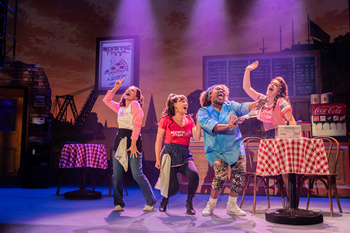
The movie was the affable tale of three young, working-class Portuguese-American waitresses, each on a different trajectory toward the future. Its biggest claim to fame is being the movie that gave Julia Roberts her first big break, with critics predicting big things for the leggy newcomer (along with her co-stars, Anabeth Gish and Lili Taylor, which has also come true, but to a far lesser degree). It also featured Matt Damon in his first-ever screen role, but in a part too small to garner any attention. The stage edition of Mystic Pizza's tagline is "a new musical," but it remains set firmly in 1988. The show was originally announced as a musical that would have songs written by Melissa Etheridge, but at some point gears were switched and instead it uses popular songs from its era–generally, the mid 1980s through the mid 1990s, including Ethridge's hit "I'm the Only One," along with songs by John Mellencamp, Cyndi Lauper, Debbie Gibson, Wilson Phillips, Pat Benatar, and others. Prince is represented by "Manic Monday," which he wrote but was recorded by The Bangles. Mystic Pizza's book, by Sandy Rustin (The Cottage, recently staged here by Gremlin Theatre), follows the screenplay by Amy Holden Jones very closely, though it omits a scene of over-the-top jealous-girlfriend mayhem, and eliminates a four-year-old character. As in the movie, those three waitresses–sisters Kat and Daisy, and their best friend Jojo–hold center court. Of the three, Kat is the one everyone expects to leave Mystic's small-town confines. In fact, she has a partial scholarship to Yale, where she plans to study astronomy in the fall. To earn the money she will need for school, she has picked up other part-time jobs, including doing chores at a rental cottage being occupied this summer by a sensitive and good looking, not-yet-30 architect while he works on restoring a historic mansion. Until now, Kat has been too busily focused on her future to have time for boys, but one conversation with Tim and, bam, she has fallen. Daisy is the polar opposite of her sister. Though she is plenty smart, she was not a good student. She yearns to get out of Mystic but doesn't see an escape route in her future. She amuses herself with the horny young men of Mystic–holding the upper hand, which keeps her safe but also keeps her from making any real connections. Then she crosses paths with a wealthy and handsome law student named Charlie "slumming" at a local dance hall. After one game of pool, Porsche-driving Charlie is hot on her trail, and for once, she feels something more than a way to pass the time. But a chasm separates her world–her immigrant mother works in the fish cannery–from his blueblood existence. Jojo has a steady boyfriend, Bill, who desperately wants to marry her. In fact, the show (as does the movie) opens with their wedding about to take place, only for Jojo to pass out from anxiety triggered by the prospect of marriage. Like most locals, Bill works in the town's fishing industry. He is a traditional guy, and since they are having sex–and because he truly loves Jojo–he wants to marry her. She loves him too, but isn't ready for the finality that marriage implies. Yet, Jojo has no desire to leave Mystic. She would love nothing better than to take over Mystic Pizza when it's proprietor, Leona, is ready to hang up her apron, and is forever badgering Leona to reveal the secret recipe for her pizza sauce. The show switches back and forth between the travails of Jojo, Kat, and Daisy as they navigate the potholes on the road to their future, as well as Leona's deliberations over whether or not to sell the restaurant, which has been losing money. The working-class community setting, complete with Bill and his buddies' rock band ("The Lobster Rolls") playing weekends at local bars, and characters harboring unlikely dreams fits well with the raw, heart-thumping sound of the songs chosen from the era's Billboard charts. While, on principle, I have a preference for musical theatre that comes with brand new songs, rather than drawing jukebox style on familiar oldies, adept bookwriters (in this case, Rustin), orchestrators (Carmel Dean), and directors (Jennifer Werner, who also did Mystic Pizza's choreography) can make the inserted songs work. They have done so in Mystic Pizza–in a way. For example, when Kat and Tim sing "When I See You Smile," the song isn't so much about Kat and Tim, as it is about any two people acknowledging the joy they have discovered in each other. That's how popular songs usually work–not linked to a specific plot or set of characters, but tapping universal feelings that any listener can absorb. The songs here are, for the most part, not telling the story, but rather creating an atmosphere that amplifies the feelings generated by that story. Also, the show's creators smartly end each act with a high energy anthem: "Hold On," which was a hit for Wilson Phillips, and Starship's "Nothing's Gonna Stop Us Now," ensuring that when the house lights come up, the audience is abuzz with positive energy. The songs are played by a six-member band that delivers a high-powered rock and roll vibe throughout, conducted by music director John Tengowski It helps tremendously that there is at least one of the three fantastically talented lead actors in this non-Equity cast–Kendal Becerra as Kat, Lexxi Frilles as Jojo, and Chloë Lezotte as Daisy–in virtually every song. All three sing beautifully, with heartfelt depth and melodious tones. Becerra handles both the pain and the elation of Kat's first foray into love with aplomb, revealing both her naivete and the wisdom gained when innocence is lost. Frilles has the most comedic of the roles, and delivers laugh lines with superb timing and attitude. Lezotte, who bears more than a passing resemblance to Julia Roberts (as Daisy in the movie), delivers an aptly brittle combination of snark and resignation to a life of disappointment, before blossoming as she discovers her own worth. Matt Woodward is extremely likeable as the eager-to-be-married Bill, and displays great rock and roll pipes. On opening night in St. Paul, Travis Flynt covered for Mike Leadbetter in the role of Tim. Flynt sings well and persuasively depicts Tim's realization of his attraction to Kat with both sensitivity and desire. Jack Baylis, as the law student rebelling against the strictures of family wealth, is less convincing when acting forceful and asserting his positions, but more convincing as a docile young man in thrall of his love. Tieisha Thomas, as Leona, brings a great force of personality that mixes brio with common sense, and contributes powerful vocals in several of the songs. The show is staged by Werner with great fluidity, moving adroitly from scene to scene, the settings established by the use of projections and smaller scenic elements rolled on and off without drawing attention to the changes. The set was designed by Joshua Warner, with no separate credit indicated for projection designs. Effective, character-appropriate costumes were designed by Jen Caprio. Matt Kraus designed sound for the production–the music comes across well, rocking the house as intended. Early on, spoken language was overamplified at the performance I attended, making it difficult to make out the dialog, but that seemed to be brought under control before too long. There is a lot of dancing in Mystic Pizza, well executed by the ensemble, though Werner's choreography doesn't provide a great deal of interest. If anything, it is too beholden to its context, aping dancers at a club who have pretty good style and moves, but nothing that is elevated to what would feel like musical theatre dance. In the past few months, I have seen four jukebox musicals: Mamma Mia!, Dirty Dancing, Head Over Heels, and now, Mystic Pizza. While their quality varies, in all cases the use of established songs works, and I enjoyed all four. Does adding music and dance to Mystic Pizza bring something new to the narrative? I have to say that it doesn't, not really. Of course, it broadens the scope of entertainment being put on offer, so those that enjoy 30- to 40-year-old rock music receive a bonus along with the generally well-constructed narrative that is the movie's gift to the production. Whether that "bonus" is enough to draw audiences from watching Mystic Pizza on home video or a streaming service, and to pay to see the live musical, depends on the person. The audience at the Ordway seemed to be thoroughly enjoying themselves, as were my companion and myself. True, they didn't react with over-the-top squeals of recognition at familiar elements as they did when Dirty Dancing, which just this week announced that it is heading to the Lena Horne Theatre on Broadway this spring, played the Ordway in August. Personally, I like my theatre free of squeals, a point in Mystic Pizza's favor. Mystic Pizza runs through October 11, 2026, at the Ordway Center for the Performing Arts, 345 Washington Street, Saint Paul MN. For tickets and for information, please call 651-224-4222 or visit www.ordway.org. For information about the tour visit www.mysticpizzaonstage.com. Book: Sandy Rustin, based on the MGM motion picture with story and characters by Amy Holden Jones; Director and Choreographer: Jennifer Werner; Arrangements and Orchestrations: Carmel Dean; Music Supervisor & Additional Arrangements: Andrew Graham; Music Director: John Tengowski; Set Design: Joshua Warner; Costume Design: Jen Caprio; Lighting Design: Dalton Hamilton; Sound Design: Matt Kraus; Wig and Makeup Design: Roxanne DeLuna; Music Coordinator: Michael Aarons, M2 Music; Casting: ARC, Jarrett Reiche, CSA& Jaron Cole; Associate Director: Jr Bruno; Technical Supervisor: D. Wade Jolly; Production Supervisor: Owen O'Brien; Production Stage Manager: Sierra Friday; Executive Producer: Daniel Sher; Associate Producer: Sophie Whitfield. Cast: Jack Baylis (Charles Gordon Windsor Jr.), Kendall Becerra (Katherine "Kat" Arujo), Nina-Simone Diaz (ensemble), Lizzie Fitzpatrick-Cárcamo (swing), Sam Foti (ensemble), Travis Flynt (swing), Lexxi Frilles (Josephine "Jojo" Barboza), Albert "Al" Igbinigie (ensemble), Will Ingram (Frankie/Steamer/ ensemble), Mike Leadbetter (Tim Travers), Chloë Lezotte (Daisy Arujo), Richard Morgan (Priest/ Gourmet/Chuck Windsor Sr./ensemble), Catherine Rodriguez O'Connor (Mrs. Arujo/ensemble), Abby Scalici (Lorna/Serena /ensemble), Tieisha Thomas (Leona Silvia), Gabe Tobierre (ensemble), Matt Woodward (Bill Montijo). |