|
Regional Reviews: Phoenix Angels in America: Millennium Approaches Also see Gil's reviews of Hell's Kitchen, The Miraculous Journey of Edward Tulane: The Musical, and Tarzan
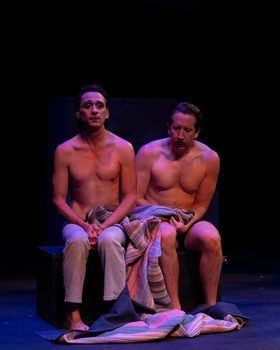
The play centers on two couples in crisis: Joe and Harper, a Mormon husband and wife who are forced to face his homosexuality and her mental health issues; and Louis and Prior, a gay couple whose relationship is tested by illness and fear. There is also a fictionalized portrayal of Roy Cohn, the closeted, hard-line Republican lawyer, and Joe's boss. Kushner uses Cohn as a way to depict the hypocrisy of the conservative Republicans at this time, since Cohn contracts HIV yet threatens his doctor to state he has liver cancer instead. The piece is set against a backdrop of personal upheaval and national tension as it explores stress, identity, and the harsh realities of life while also focusing on religion and politics. Subtitled "A Gay Fantasia on National Themes," the work confronts the AIDS crisis head-on, exposing both its human toll and the political hypocrisy surrounding it. Kushner's writing is theatrical yet entirely authentic, filled with language that is sharp, poetic, and emotionally charged. His characters are flawed, complicated, and often contradictory, yet so fully fleshed out with honesty that they remain empathetic even as you scrutinize their decisions. Kushner also combines realism and imagination and features scenes that blend the past with the present and reality with hallucination. Despite its considerable length, the play remains consistently engaging, with scenes that are intimate and introspective and characters you care about. However, the play has less of an urgency now and is more of a period piece with less of an emotional impact. This is mainly due to how advances in HIV medication that were only accessible to the public after Angels premiered no longer warrant a positive HIV diagnosis as a death sentence. However, Kushner's work is still as impressive, resonating, and rewarding as when I first saw it over 30 years ago. Director Ron May has done a fantastic job with a cast who delve into the nuances, layers, and depths of their characters. The solid portrayals under May's crisp direction ensure that there is both clarity and care on hand and that the pace of the play never falters while the three-hour runtime flies by. While Dori Brown's set design, which uses file cabinets of various shapes and sizes, is incredibly vague, it also gives a surreal landscape for the scenes to play off of. Stacey Walston's lighting is fantastic, and the sound design by Pete Bish features impressive effects and a rich musical underscore; the combination of light and sound adds a mix of both humor and terror to the fantastical moments in the drama. The costumes by Allison Gilkey are character and period appropriate. The cast is excellent. Marshall Glass infuses the character of Prior Walter with an abundance of conviction and pride but also fear and uncertainty. Nathan Spector is perfect as Prior's partner Louis, the neurotic, high-strung, emotional mess of a man who feels guilty and pained by the way he reacts to Prior's HIV diagnosis. Devon Mahon is appropriately fraught with confusion and uncertainty as Joe Pitt, the Mormon husband who has to come to grips with his true sexuality, and Courtney Weir is wonderful as Joe's lonely, fragile, drug addicted wife Harper. All four actors do excellent work depicting these two couples who are at crossroads in their relationships. Louis Farber is appropriately slimy, controlling, argumentative and malicious as Roy Cohn, although he plays down the terrifying notes of the character other actors I've seen have brought to the role and uses an eerie charm instead to depict the control he has over others. As Belize, Prior's friend, Michael Thompson is fantastic, with a no-nonsense portrayal of this matter-of-fact individual. As a few characters, including Joe's mother Hannah Pitt and Cohn's doctor, Nina Miller brings complete conviction. Megan Holcomb has a calming presence as a nurse who helps Prior, a sense of frenzy for a homeless woman Hannah encounters, and brings both elegance and power to the Angel. Without an impending millennium and the AIDS epidemic no longer as pressing an issue as it once was, Angels in America doesn't quite have the same impact it did or the same underlying doubt about the future. Fortunately, the drama still resonates, as the themes depicted are mirrored in the uncertainty and confusion in our current world as we all find ourselves struggling to survive while politics and power stoke fear and societal change. Stray Cat Theatre's production has a fantastic cast and assured direction ensuring that the play's timeless, almost mythic quality, with its angels, visions, and spiritual questioning, allows us to connect with its larger questions about humanity, change, and the possibility of hope. Part II of Tony Kushner's work, Angels in America: Perestroika plays next week, with both parts playing in repertory the following week. Stray Cat Theatre's Angels in America runs through May 16, 2026, at the Tempe Center for the Arts, 700 W. Rio Salado Parkway, Tempe AZ. For tickets and information, please call 480-227-1766 or visit straycattheatre.org. Director: Ron May |