|
Regional Reviews: Phoenix Eureka Day Also see Gil's review of Pippin
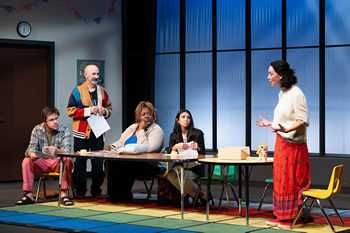
The play centers on a committee at a private school in Berkely, California made up of faculty members and parents who find themselves at odds with each other around questions of childhood vaccinations when an incident happens on campus. As the characters discuss their differing beliefs, the concerns they face, and the consequences their decisions may have for themselves, their children, and the community, their conversations become heated and their relationships grow complicated. Eureka Day premiered in 2018, but seeing it in a post-COVID world makes its subject matter very compelling, especially since the debate concerning vaccinations seems to have sky rocketed in the last five years since the COVID vaccine became available. Spector does a fairly good job exploring the tension between individual choice and community responsibility, as well as depicting the challenges of separating personal convictions from scientific evidence, although it's fairly evident which side of the debate Spector is on. The play also examines how fear, misinformation, and deeply held beliefs can influence decisions that ultimately have consequences. The COVID pandemic, and how some individuals felt they were forced to get vaccinated in order to be allowed into their place of employment or to attend a public event, has made these questions and conversations even more immediate and relevant. While the play could be considered an ensemble piece, the central conflict is between Suzanne and Carina, two mothers who have differing opinions on vaccinations. As Suzanne, a woman whose many children have gone to the school and who is deeply invested in its culture, Bonnie Beus Romney delivers a portrayal that is pointed, yet warm and well-intentioned, with a monologue toward the second half of the piece that is emotionally truthful. As Carina, a Black mother who recently moved to Berkeley with her wife and son, and who joins the committee as its representative for a new school family, Felicia Penza does a great job depicting a woman who is initially cautious about her role on the committee but who gradually becomes more willing to challenge the group's members and advocate for what she believes is best for the community. As Don, the head of Eureka Day School, Jon Gentry delivers a perfect depiction of an excited school administrator who serves as a mediator of the group. Although Don strives to remain calm and impartial, the escalating conflict tests his ability to lead and find common ground. Tony Latham is lovely as Eli, a stay-at-home father with considerable wealth from his connection to the tech industry. Latham's performance allows us to see the many layers of the character, from the enthusiastic committee member who cares about inclusivity and making sure everyone feels heard, to the concerned parent who has to navigate his feelings and beliefs. Willa Eigo is bright and anxious at times as Meiko, a somewhat reserved single mother who often knits during meetings but whose personal relationships and convictions become increasingly significant as the committee confronts a crisis. Kay B. Rose appears in the smaller role of Winter, another new Eureka Day parent whose child has just started to go to the school. Louis Farber's direction effectively emphasizes the play's important messages without allowing them to overwhelm the human drama. Spector's script does a great job in depicting how some members of a group react to a new member, especially individuals who aren't like them, and that while they believe their intentions are good, they can dominate the conversations and talk over the new committee member. Farber's pacing of those moments and the cast's performances of those interactions will make anyone who has ever been in one of those group situations immediately recognize how realistically they are depicted. The script also avoids reducing the characters to simple representatives of opposing viewpoints, and under Farber's astute direction, the cast create recognizable people whose motivations and reactions make the conflicts feel genuine. Farber's staging makes excellent use of Harrison Rosenberg's realistic-looking set of a classroom at the school. Allison Gilkey's costumes are character appropriate and the media design by Rob Littlefield, which depicts the group chat in a digital town hall meeting, is fantastic. Brianna Fallon's sound design creates a lovely soundscape and both the pre-show music and the between-scene song choices are excellent. My only quibble is that some of the cast could project more in order for all of the dialogue to be heard. Eureka Day succeeds as a thought-provoking drama because it invites audiences to listen, reflect, and question rather than simply offering easy answers. With a strong cast, thoughtful direction, and subject matter that I have to imagine resonates even more today than when the play was written, Stray Cat Theatre presents an engaging production that is likely to spark conversation long after the curtain falls. Even if you feel firmly settled in your views concerning childhood vaccinations, this thoughtful, engaging piece will most likely give you something to think about. Eureka Day runs through October 16, 2026, at Stray Cat Theatre with performances at the Tempe Center for the Arts, 700 W. Rio Salado Parkway, Tempe AZ. For tickets and information, please call 480 227-1766 or visit straycattheatre.org. Director: Louis Farber Cast: |